Department of Health Management, The First Affiliated Hospital of Hunan University of Traditional Chinese Medicine, Changsha, Hunan, China.
Regenerative Medicine Institute, School of Medicine, National University of Ireland (NUI), Galway, Ireland.
Front Immunol. 2023 Aug 17;14:1234924. doi: 10.3389/fimmu.2023.1234924. eCollection 2023.
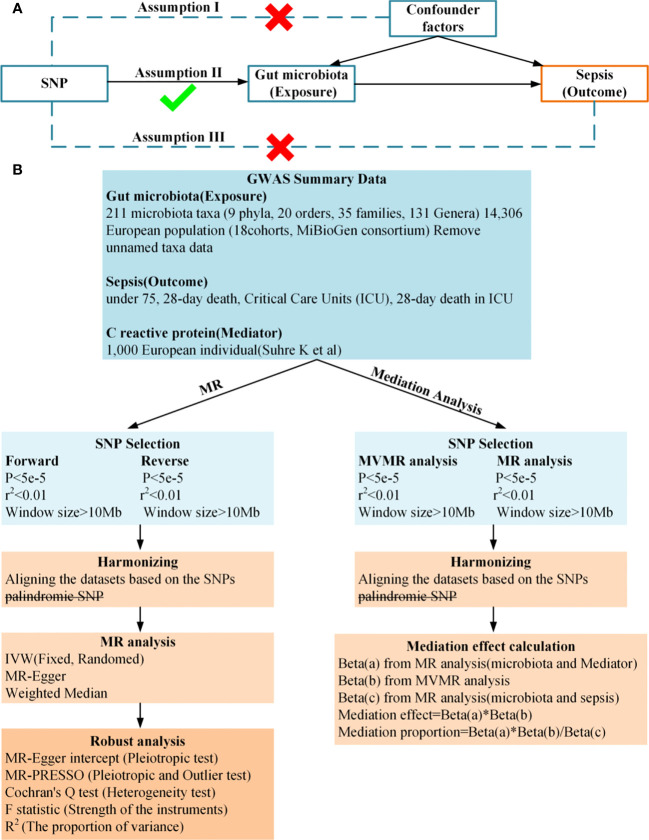
There is a growing body of evidence that suggests a connection between the composition of gut microbiota and sepsis. However, more research is needed to better understand the causal relationship between the two. To gain a deeper insight into the association between gut microbiota, C-reactive protein (CRP), and sepsis, we conducted several Mendelian randomization (MR) analyses.
In this study, publicly available genome-wide association study (GWAS) summary statistics were examined to determine the correlation between gut microbiota and sepsis, including various sepsis subgroups (such as under 75, 28-day death, Critical Care Units (ICU), 28-day death in ICU). Initially, two-sample and reverse Mendelian randomization (MR) analyses were conducted to identify causality between gut microbiota and sepsis. Subsequently, multivariable and two-step MR analyses revealed that the relationship between microbiota and sepsis was mediated by CRP. The robustness of the findings was confirmed through several sensitivity analyses.
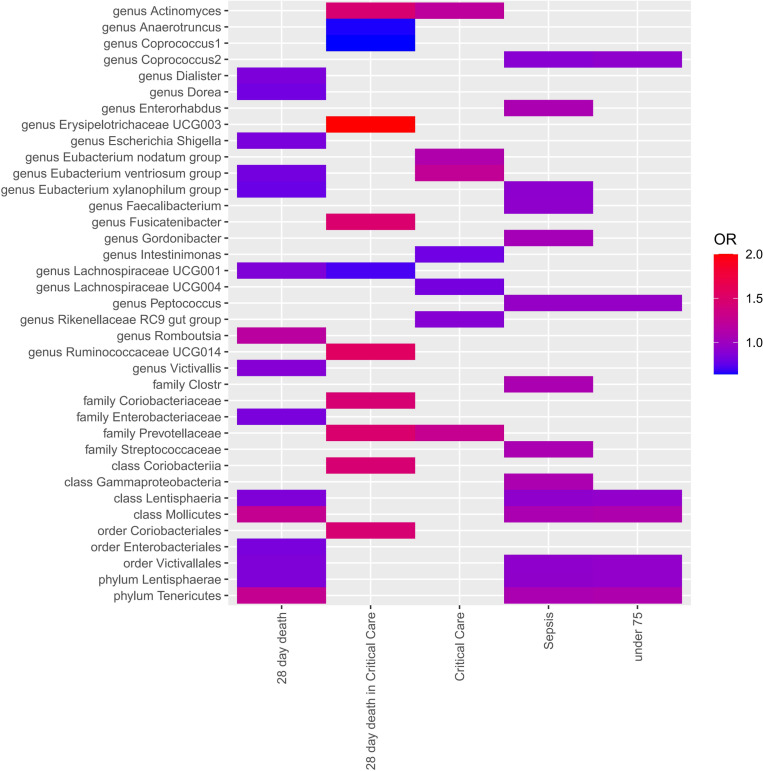
In our study, we revealed positive correlations between 24 taxa and different sepsis outcomes, while 30 taxa demonstrated negative correlations with sepsis outcomes. Following the correction for multiple testing, we found that the Phylum Lentisphaerae (OR: 0.932, = 2.64E-03), class Lentisphaeria, and order Victivallales (OR: 0.927, = 1.42E-03) displayed a negative relationship with sepsis risk. In contrast, Phylum Tenericutes and class Mollicutes (OR: 1.274, = 2.89E-03) were positively related to sepsis risk and death within 28 days. It is notable that Phylum Tenericutes and class Mollicutes (OR: 1.108, = 1.72E-03) also indicated a positive relationship with sepsis risk in individuals under 75. From our analysis, it was shown that C-reactive protein (CRP) mediated 32.16% of the causal pathway from Phylum Tenericutes and class Mollicutes to sepsis for individuals under 75. Additionally, CRP was found to mediate 31.53% of the effect of the genus Gordonibacter on sepsis. Despite these findings, our reverse analysis did not indicate any influence of sepsis on the gut microbiota and CRP levels.
The study showcased the connection between gut microbiota, CRP, and sepsis, which sheds new light on the potential role of CRP as a mediator in facilitating the impact of gut microbiota on sepsis.
越来越多的证据表明肠道微生物群落的组成与脓毒症之间存在关联。然而,为了更好地理解两者之间的因果关系,还需要更多的研究。为了更深入地了解肠道微生物群、C 反应蛋白 (CRP) 和脓毒症之间的关联,我们进行了几项孟德尔随机分析 (MR)。
本研究通过检查公开的全基因组关联研究 (GWAS) 汇总统计数据,确定了肠道微生物群与脓毒症之间的相关性,包括各种脓毒症亚组(如 75 岁以下、28 天内死亡、重症监护病房 (ICU)、28 天内 ICU 死亡)。最初,我们进行了两样本和反向孟德尔随机分析 (MR),以确定肠道微生物群与脓毒症之间的因果关系。随后,多变量和两步 MR 分析表明,微生物群与脓毒症之间的关系是由 CRP 介导的。通过几项敏感性分析证实了研究结果的稳健性。
在我们的研究中,我们发现 24 个分类群与不同的脓毒症结果呈正相关,而 30 个分类群与脓毒症结果呈负相关。在对多重检测进行校正后,我们发现厚壁菌门(OR:0.932, = 2.64E-03)、 Lentisphaeria 纲和 Victivallales 目(OR:0.927, = 1.42E-03)与脓毒症风险呈负相关。相反,柔膜菌门和 Mollicutes 纲(OR:1.274, = 2.89E-03)与脓毒症风险和 28 天内死亡呈正相关。值得注意的是,柔膜菌门和 Mollicutes 纲(OR:1.108, = 1.72E-03)也与 75 岁以下人群的脓毒症风险呈正相关。从我们的分析中可以看出,C 反应蛋白(CRP)介导了厚壁菌门和 Mollicutes 纲对 75 岁以下人群脓毒症的因果关系的 32.16%。此外,CRP 还介导了属 Gordonibacter 对脓毒症的影响的 31.53%。尽管有这些发现,但我们的反向分析并未表明脓毒症对肠道微生物群和 CRP 水平有任何影响。
本研究展示了肠道微生物群、CRP 和脓毒症之间的联系,这为 CRP 作为肠道微生物群对脓毒症影响的中介物的潜在作用提供了新的见解。