Nam Je Shik, Kim Hyun-Ah, Kwak Tae-Jin, Cho Kang Hee, Jung Il-Young, Moon Chang-Won
Department of Rehabilitation Medicine, Chungnam National University Hospital, Chungnam National University College of Medicine, Daejeon, Korea.
UNIVR Company, Daejeon, Korea.
Ann Rehabil Med. 2024 Feb;48(1):75-85. doi: 10.5535/arm.230023. Epub 2024 Feb 28.
To investigate the feasibility and effects of a mobile app-based home cycling exercise program compared to home cycling exercise without additional monitoring system. Compared with fitness facilities or outdoor exercise, home-based exercise programs effectively improve physical performance in an indwelling community. However, a flexible, informal environment may decrease motivation and impair adherence to physical exercise. Mobile devices for aerobic exercise and mobile applications provide real-time monitoring, immediate feedback, and encouragement to increase motivation and promote physical performance. We investigated the feasibility and effects of a mobile app-based home exercise program on body composition, muscular strength, and cardiopulmonary function.
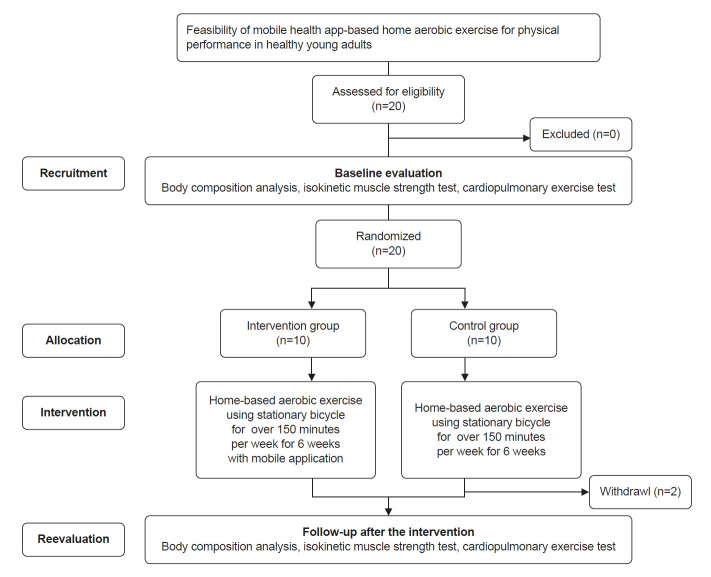
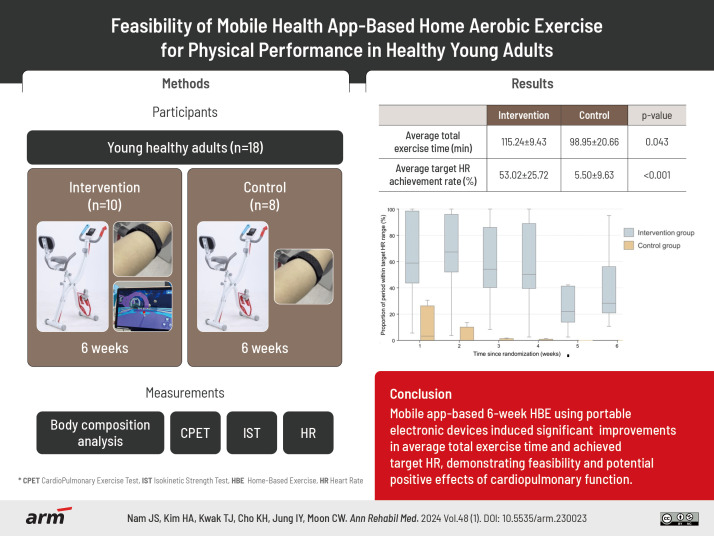
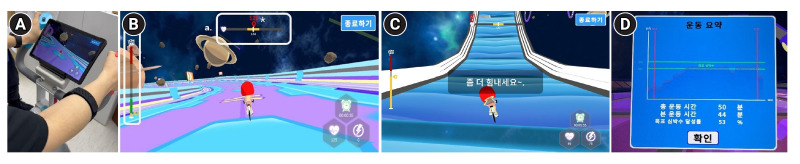
Between February and May 2023, 20 participants were randomly allocated to the intervention (mobile application with a tablet) and control groups, and they performed aerobic exercise using a stationary bicycle for ≥150 minutes per week for 6 weeks (≤30-minute exercise session, with 3-minute warm-up and 3-minute cool-down). Karvonen formula-based heartrate defined the weekly increase in exercise intensity. Outcome measures included body-composition parameters, isokinetic knee flexor and extensor strength tests, cardiopulmonary exercise test results, and rate of target heart rate (HR) achievement. Participants were assessed at baseline and after the intervention.
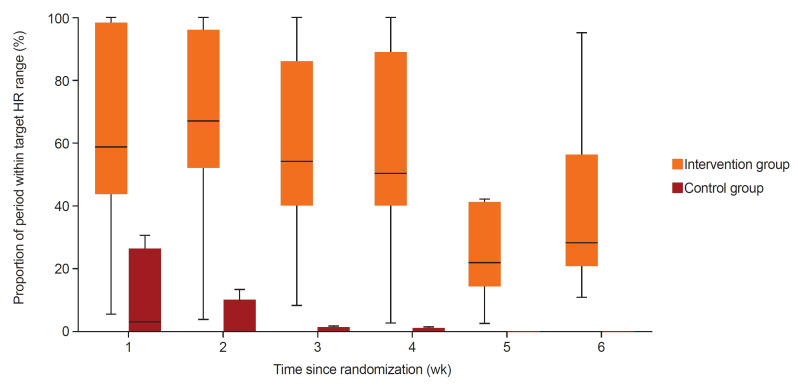
Unrelated personal events led two participants to drop out. The intervention and control groups had similar baseline characteristics. Compared with the control group, in the post-intervention isokinetic strength test, bilateral knee flexor and extensor power, and time to target HR achievement significantly increased each week in the intervention group.
Home-based exercise to achieve long-term cardiovascular fitness with portable electronic/mobile devices facilitates individualized exercise using real-time feedback to improve motivation and adherence.
研究基于移动应用程序的家庭骑行锻炼计划与无额外监测系统的家庭骑行锻炼相比的可行性和效果。与健身设施或户外运动相比,家庭锻炼计划能有效提高居家社区人群的身体机能。然而,灵活、非正规的环境可能会降低锻炼积极性并削弱对体育锻炼的坚持性。用于有氧运动的移动设备和移动应用程序可提供实时监测、即时反馈和鼓励,以增强积极性并提升身体机能。我们研究了基于移动应用程序的家庭锻炼计划对身体成分、肌肉力量和心肺功能的可行性和效果。
2023年2月至5月期间,20名参与者被随机分配到干预组(使用平板电脑的移动应用程序)和对照组,他们使用固定自行车每周进行≥150分钟的有氧运动,持续6周(每次锻炼≤30分钟,包括3分钟热身和3分钟放松)。基于卡尔沃宁公式的心率确定每周锻炼强度的增加。结果指标包括身体成分参数、等速膝关节屈伸肌力量测试、心肺运动测试结果以及目标心率(HR)达成率。在基线和干预后对参与者进行评估。
无关的个人事件导致两名参与者退出。干预组和对照组的基线特征相似。与对照组相比,在干预后的等速力量测试中,干预组双侧膝关节屈伸肌力量以及达到目标心率的时间每周均显著增加。
借助便携式电子/移动设备进行家庭锻炼以实现长期心血管健康,通过实时反馈促进个性化锻炼,从而提高积极性和坚持性。