Department of Exercise Physiology, Beijing Sport University, Beijing, China.
Department of Physical Health and Arts Education, Ministry of Education, Beijing, China.
Front Immunol. 2022 Jun 23;13:921085. doi: 10.3389/fimmu.2022.921085. eCollection 2022.
This study aimed to compare and rank the effectiveness of aerobic exercise (AE), resistance training (RT), combined aerobic and resistance training (CT), and high-intensity interval training (HIIT) on body composition and inflammatory cytokine levels in overweight and obese individuals by using network meta-analysis (NMA).
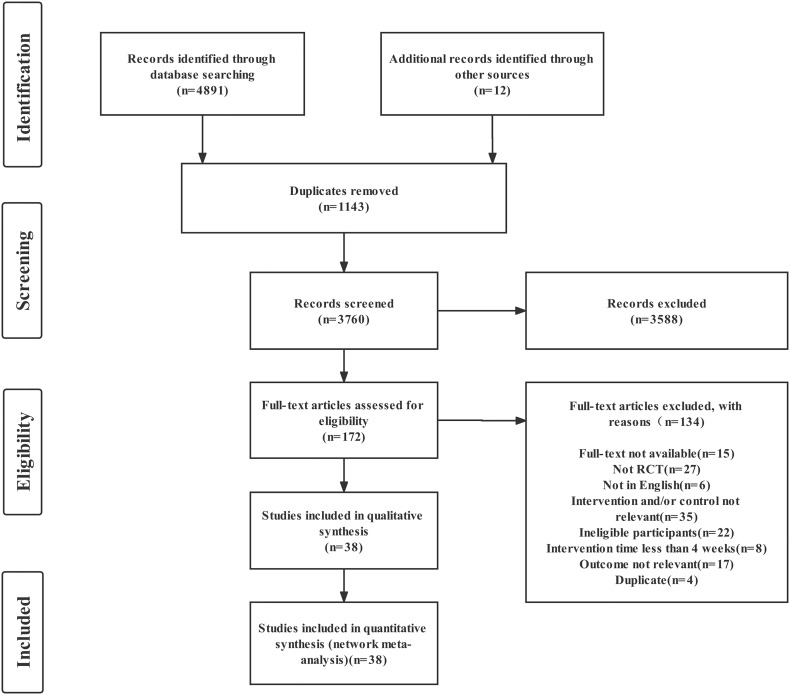
We searched the PubMed, Cochrane, Embase, Web of Science, and EBSCO databases to identify randomized controlled trials investigating the effects of exercise training on inflammatory cytokines in overweight and obese patients. The retrieval period was from inception to November 2021. Two reviewers independently screened the retrieved articles, extracted the pertinent data, and assessed the risk of bias of the included studies; then, they used Stata 16.0 and Review Manager 5.3 to perform an NMA.
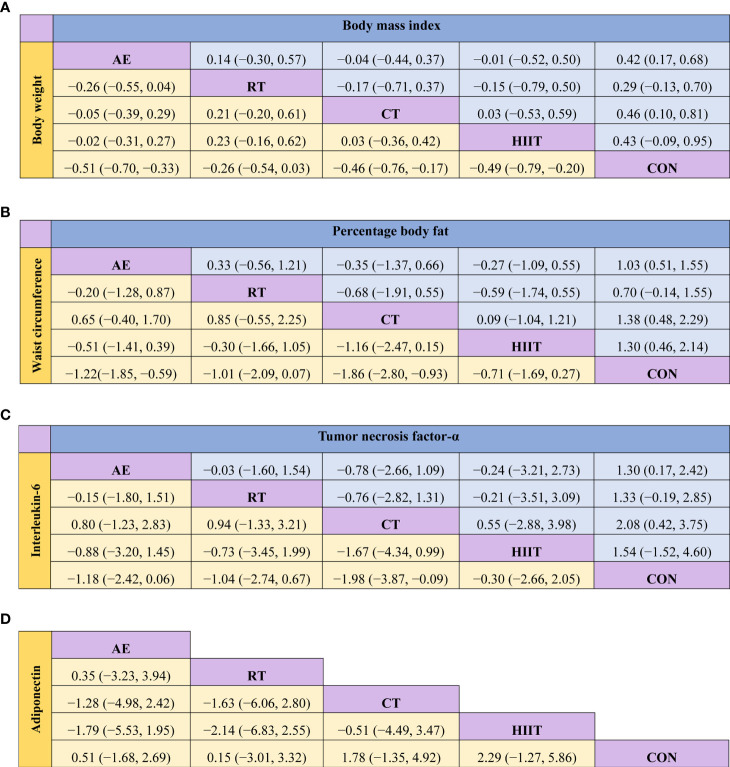
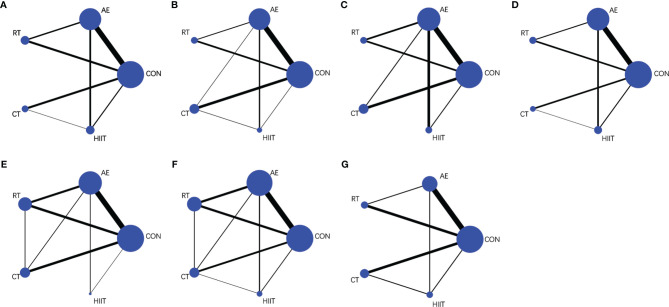
A total of 38 studies involving 1317 patients were included in this study. The results of the NMA indicated that AE had the greatest effect on weight loss (SUCRA=78.3; SMD=-0.51, 95% CI: -0.70, -0.33); CT had the greatest effect on reducing body mass index (SUCRA=70.7; SMD=-0.46, 95% CI: -0.81, -0.10), waist circumference (SUCRA=93.4; SMD=-1.86, 95% CI: -2.80, -0.93), percentage body fat (SUCRA=79.6; SMD=-1.38, 95% CI: -2.29, -0.48), interleukin-6 level (SUCRA=86.4; SMD=-1.98, 95% CI: -3.87, -0.09), and tumor necrosis factor-α level (SUCRA=79.4; SMD=-2.08, 95% CI: -3.75, -0.42); AE (SMD=0.51, 95% CI: -1.68, 2.69), RT (SMD=0.15, 95% CI: -3.01, 3.32), CT (SMD=1.78, 95% CI: -1.35, 4.92), and HIIT (SMD=2.29, 95% CI: -1.27, 5.86) did not significantly increase the adiponectin level.
The current results suggest that CT is the best exercise modality for improving body composition and inflammatory status in overweight and obese individuals. More rigorous randomized control trials are needed for further validation.
https://www.crd.york.ac.uk/prospero/, identifier CRD42022303165.
本研究旨在通过网状 Meta 分析(NMA)比较和排序有氧运动(AE)、抗阻训练(RT)、AE 和 RT 联合训练(CT)以及高强度间歇训练(HIIT)对超重和肥胖个体的身体成分和炎症细胞因子的有效性。
我们检索了 PubMed、Cochrane、Embase、Web of Science 和 EBSCO 数据库,以确定研究运动训练对超重和肥胖患者炎症细胞因子影响的随机对照试验。检索时间从成立到 2021 年 11 月。两名审查员独立筛选检索到的文章,提取相关数据,并评估纳入研究的偏倚风险;然后,他们使用 Stata 16.0 和 Review Manager 5.3 进行 NMA。
本研究共纳入 38 项研究,涉及 1317 名患者。NMA 的结果表明,AE 在体重减轻方面的效果最大(SUCRA=78.3;SMD=-0.51,95%CI:-0.70,-0.33);CT 在降低体重指数(SUCRA=70.7;SMD=-0.46,95%CI:-0.81,-0.10)、腰围(SUCRA=93.4;SMD=-1.86,95%CI:-2.80,-0.93)、体脂百分比(SUCRA=79.6;SMD=-1.38,95%CI:-2.29,-0.48)、白细胞介素-6 水平(SUCRA=86.4;SMD=-1.98,95%CI:-3.87,-0.09)和肿瘤坏死因子-α 水平(SUCRA=79.4;SMD=-2.08,95%CI:-3.75,-0.42)方面的效果最大;AE(SMD=0.51,95%CI:-1.68,2.69)、RT(SMD=0.15,95%CI:-3.01,3.32)、CT(SMD=1.78,95%CI:-1.35,4.92)和 HIIT(SMD=2.29,95%CI:-1.27,5.86)对脂联素水平无显著影响。
目前的结果表明,CT 是改善超重和肥胖个体身体成分和炎症状态的最佳运动方式。需要进行更严格的随机对照试验来进一步验证。
https://www.crd.york.ac.uk/prospero/,标识符 CRD42022303165。