You Wanfang, Li Qian, Chen Lizhou, He Ning, Li Yuanyuan, Long Fenghua, Wang Yaxuan, Chen Yufei, McNamara Robert K, Sweeney John A, DelBello Melissa P, Gong Qiyong, Li Fei
Department of Radiology and Huaxi MR Research Center (HMRRC), Functional and Molecular Lmaging Key Laboratory of Sichuan Province, West China Hospital, Sichuan University, Chengdu, 610041, Sichuan, People's Republic of China.
Research Unit of Psychoradiology, Chinese Academy of Medical Sciences, Chengdu, 610041, Sichuan, People's Republic of China.
BMC Med. 2024 Mar 4;22(1):92. doi: 10.1186/s12916-024-03313-2.
Autism spectrum disorder (ASD) and attention-deficit/hyperactivity disorder (ADHD) are neurodevelopmental disorders with overlapping behavioral features and genetic etiology. While brain cortical thickness (CTh) alterations have been reported in ASD and ADHD separately, the degree to which ASD and ADHD are associated with common and distinct patterns of CTh changes is unclear.
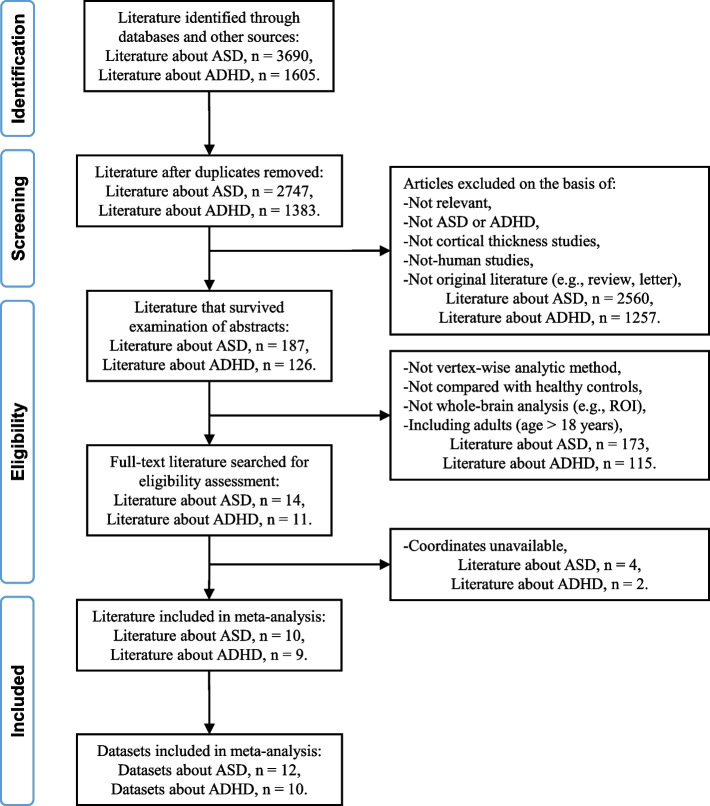
We searched PubMed, Web of Science, Embase, and Science Direct from inception to 8 December 2023 and included studies of cortical thickness comparing youth (age less than 18) with ASD or ADHD with typically developing controls (TDC). We conducted a comparative meta-analysis of vertex-based studies to identify common and distinct CTh alterations in ASD and ADHD.
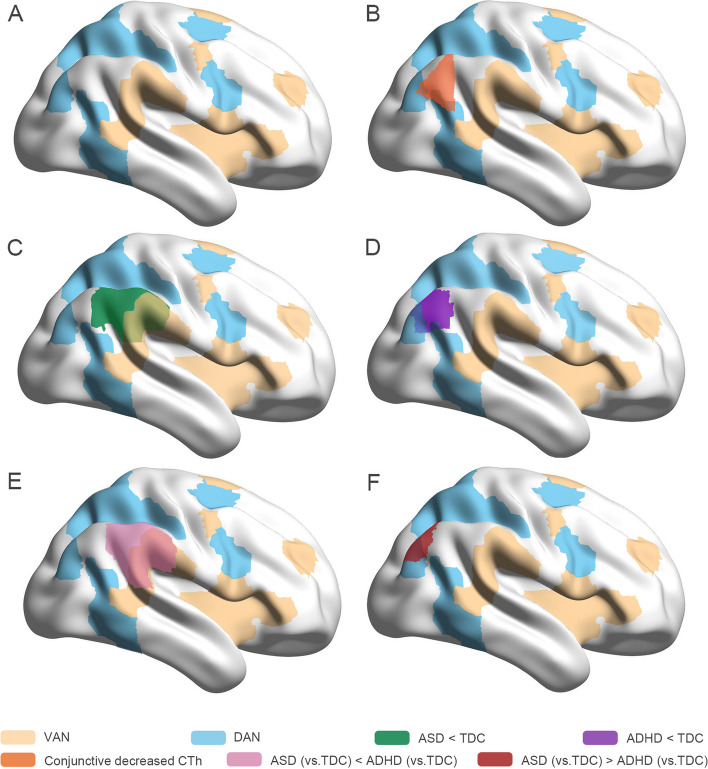
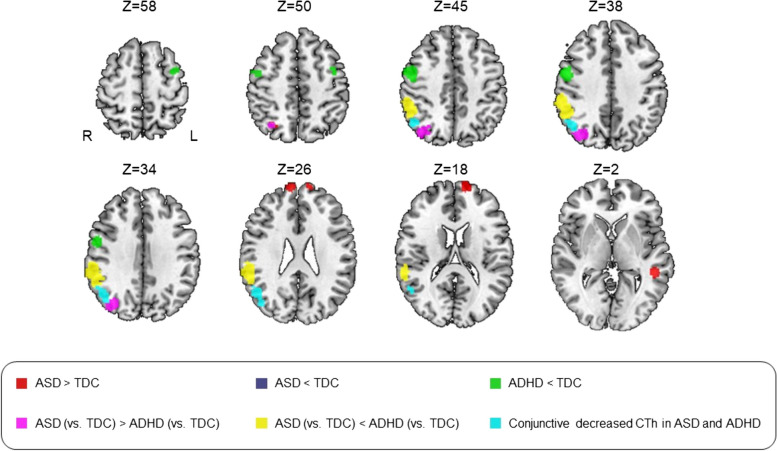
Twelve ASD datasets involving 458 individuals with ASD and 10 ADHD datasets involving 383 individuals with ADHD were included in the analysis. Compared to TDC, ASD showed increased CTh in bilateral superior frontal gyrus, left middle temporal gyrus, and right superior parietal lobule (SPL) and decreased CTh in right temporoparietal junction (TPJ). ADHD showed decreased CTh in bilateral precentral gyri, right postcentral gyrus, and right TPJ relative to TDC. Conjunction analysis showed both disorders shared reduced TPJ CTh located in default mode network (DMN). Comparative analyses indicated ASD had greater CTh in right SPL and TPJ located in dorsal attention network and thinner CTh in right TPJ located in ventral attention network than ADHD.
These results suggest shared thinner TPJ located in DMN is an overlapping neurobiological feature of ASD and ADHD. This alteration together with SPL alterations might be related to altered biological motion processing in ASD, while abnormalities in sensorimotor systems may contribute to behavioral control problems in ADHD. The disorder-specific thinner TPJ located in disparate attention networks provides novel insight into distinct symptoms of attentional deficits associated with the two neurodevelopmental disorders.
PROSPERO CRD42022370620. Registered on November 9, 2022.
自闭症谱系障碍(ASD)和注意力缺陷多动障碍(ADHD)是具有重叠行为特征和遗传病因的神经发育障碍。虽然已分别报道了ASD和ADHD患者的脑皮质厚度(CTh)改变,但ASD和ADHD与CTh变化的共同和不同模式相关的程度尚不清楚。
我们检索了从创刊至2023年12月8日的PubMed、Web of Science、Embase和Science Direct数据库,并纳入了比较青少年(年龄小于18岁)ASD或ADHD患者与典型发育对照(TDC)的皮质厚度的研究。我们对基于顶点的研究进行了比较荟萃分析,以确定ASD和ADHD患者中常见和不同的CTh改变。
分析纳入了12个ASD数据集,涉及458例ASD患者,以及10个ADHD数据集,涉及383例ADHD患者。与TDC相比,ASD患者双侧额上回、左侧颞中回和右侧顶上小叶(SPL)的CTh增加,右侧颞顶联合区(TPJ)的CTh减少。ADHD患者相对于TDC,双侧中央前回、右侧中央后回和右侧TPJ的CTh减少。联合分析显示,两种疾病在默认模式网络(DMN)中的TPJ CTh均降低。比较分析表明,ASD患者位于背侧注意网络的右侧SPL和TPJ的CTh比ADHD患者更厚,而位于腹侧注意网络的右侧TPJ的CTh比ADHD患者更薄。
这些结果表明,位于DMN中的共同变薄的TPJ是ASD和ADHD重叠的神经生物学特征。这种改变与SPL改变可能与ASD中生物运动处理的改变有关,而感觉运动系统的异常可能导致ADHD中的行为控制问题。位于不同注意网络中的疾病特异性变薄的TPJ为这两种神经发育障碍相关的不同注意力缺陷症状提供了新的见解。
PROSPERO CRD42022370620。于2022年11月9日注册。