Luo Lekai, Chen Lizhou, Wang Yuxia, Li Qian, He Ning, Li Yuanyuan, You Wanfang, Wang Yaxuan, Long Fenghua, Guo Lanting, Luo Kui, Sweeney John A, Gong Qiyong, Li Fei
Huaxi MR Research Center (HMRRC), Department of Radiology, West China Hospital of Sichuan University, Chengdu 610041, Sichuan, P.R. China.
Research Unit of Psychoradiology, Chinese Academy of Medical Sciences, Chengdu 610041, Sichuan, P.R. China.
Psychol Med. 2023 Oct;53(14):6666-6677. doi: 10.1017/S0033291723000089. Epub 2023 Feb 7.
Attention-deficit/hyperactivity disorder (ADHD) is a clinically heterogeneous neurodevelopmental disorder defined by characteristic behavioral and cognitive features. Abnormal brain dynamic functional connectivity (dFC) has been associated with the disorder. The full spectrum of ADHD-related variation of brain dynamics and its association with behavioral and cognitive features remain to be established.
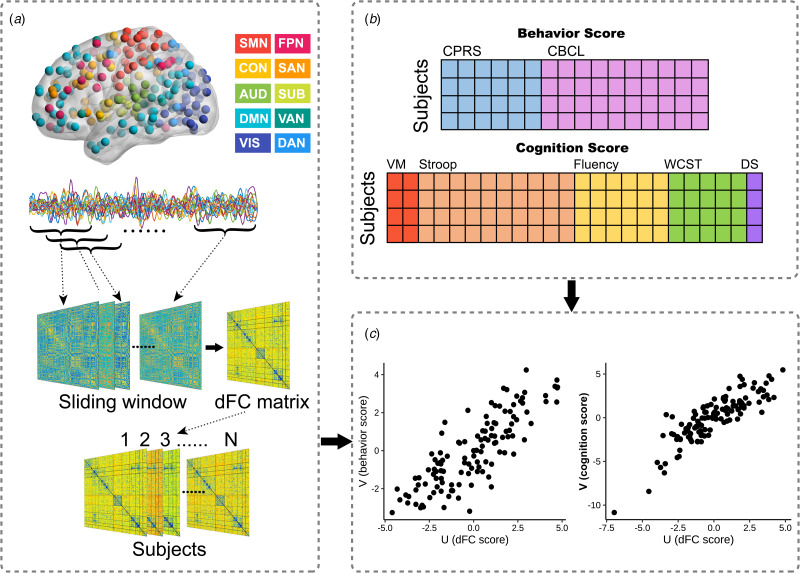
We sought to identify patterns of brain dynamics linked to specific behavioral and cognitive dimensions using sparse canonical correlation analysis across a cohort of children with and without ADHD (122 children in total, 63 with ADHD). Then, using mediation analysis, we tested the hypothesis that cognitive deficits mediate the relationship between brain dynamics and ADHD-associated behaviors.
We identified four distinct patterns of dFC, each corresponding to a specific dimension of behavioral or cognitive function ( = 0.811-0.879). Specifically, the inattention/hyperactivity dimension was positively associated with dFC within the default mode network (DMN) and negatively associated with dFC between DMN and the sensorimotor network (SMN); the somatization dimension was positively associated with dFC within DMN and SMN; the inhibition and flexibility dimension and fluency and memory dimensions were both positively associated with dFC within DMN and between DMN and SMN, and negatively associated with dFC between DMN and the fronto-parietal network. Furthermore, we observed that cognitive functions of inhibition and flexibility mediated the relationship between brain dynamics and behavioral manifestations of inattention and hyperactivity.
These findings document the importance of distinct patterns of dynamic functional brain activity for different cardinal behavioral and cognitive features related to ADHD.
注意力缺陷多动障碍(ADHD)是一种临床上具有异质性的神经发育障碍,由特征性的行为和认知特征所定义。大脑动态功能连接(dFC)异常与该障碍有关。ADHD相关的脑动力学变化的全貌及其与行为和认知特征的关联仍有待确定。
我们试图通过对一组患有和未患有ADHD的儿童(共122名儿童,63名患有ADHD)进行稀疏典型相关分析,来确定与特定行为和认知维度相关的脑动力学模式。然后,使用中介分析,我们检验了认知缺陷介导脑动力学与ADHD相关行为之间关系的假设。
我们确定了四种不同的dFC模式,每种模式对应于行为或认知功能的一个特定维度(= 0.811 - 0.879)。具体而言,注意力不集中/多动维度与默认模式网络(DMN)内的dFC呈正相关,与DMN和感觉运动网络(SMN)之间的dFC呈负相关;躯体化维度与DMN和SMN内的dFC呈正相关;抑制与灵活性维度以及流畅性与记忆维度均与DMN内以及DMN和SMN之间的dFC呈正相关,与DMN和额顶叶网络之间的dFC呈负相关。此外,我们观察到抑制和灵活性的认知功能介导了脑动力学与注意力不集中和多动的行为表现之间的关系。
这些发现证明了不同模式的动态功能性脑活动对于与ADHD相关的不同主要行为和认知特征的重要性。