Sapporo Medical University School of Medicine, Sapporo, Hokkaido, Japan.
Shizuoka Cancer Center Hospital and Research Institute, Shizuoka, Japan.
J Dermatol. 2024 Apr;51(4):475-483. doi: 10.1111/1346-8138.17096. Epub 2024 Mar 3.
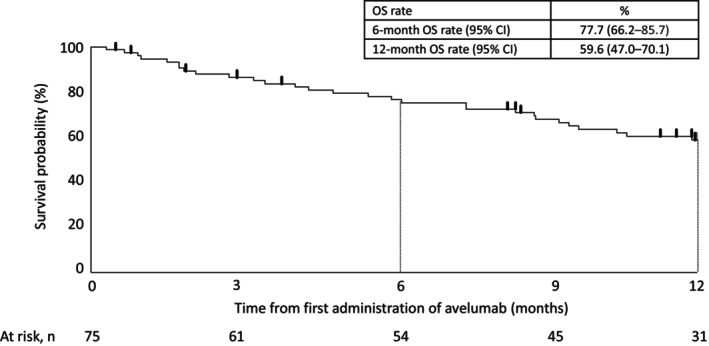
Avelumab, a programmed cell death ligand 1 blocking antibody, was approved for its first indication in Japan in September 2017 to treat unresectable Merkel cell carcinoma (MCC). Given that the pivotal JAVELIN Merkel 200 study only included a few Japanese patients, this post-marketing surveillance (PMS) evaluated the safety and effectiveness outcomes of patients with MCC who received avelumab in general clinical practice in Japan. This prospective, non-comparative, multicenter PMS included data from all patients with unresectable MCC who received avelumab between November 22, 2017 (avelumab launch date) and October 31, 2019. The primary objective was to evaluate avelumab safety (i.e., adverse events [AEs], adverse drug reactions [ADRs], and ADRs of safety specifications). The secondary objective was to evaluate avelumab effectiveness (i.e., objective response rate and overall survival [OS] rate). Seventy-five evaluable patients were included, of whom 81.3% experienced AEs of any grade (57.3% experienced AEs of grade ≥ 3; 41.3% experienced AEs of grade 5) and 61.3% experienced ADRs (14.7% experienced ADRs of grade ≥ 3; no grade 5 ADRs were observed). The most common ADRs were pyrexia (18.7%), infusion related reaction (10.7%), and chills (6.7%). The most common ADRs of safety specifications were infusion reactions (any grade: n = 21 [28.0%]; grade 3 or 4: n = 3 [4.0%]), thyroid dysfunction (n = 7 [9.3%]), and hepatic function disorders (n = 4 [5.3%]). The median observation period was 51 weeks. An objective response was achieved by 34/75 patients (45.3%; complete response, 24.0%; partial response, 21.3%) and 6- and 12-month OS rates were 77.7% and 59.6%, respectively. This PMS confirmed the clinical tolerability and effectiveness of avelumab in patients with MCC, with no new safety concerns. The risk-benefit profile of avelumab was comparable with that observed in clinical trials and remains favorable for use in general clinical practice in Japan.
avelumab 是一种程序性细胞死亡配体 1 阻断抗体,于 2017 年 9 月在日本首次获批用于治疗不可切除的 Merkel 细胞癌(MCC)。由于关键的 JAVELIN Merkel 200 研究仅纳入了少数日本患者,因此这项上市后监测(PMS)评估了 avelumab 在日本一般临床实践中治疗 MCC 患者的安全性和有效性结局。这项前瞻性、非对照、多中心 PMS 纳入了 2017 年 11 月 22 日(avelumab 上市日期)至 2019 年 10 月 31 日期间接受 avelumab 治疗的所有不可切除 MCC 患者的数据。主要目的是评估 avelumab 的安全性(即不良事件[AE]、药物不良反应[ADR]和安全性规格的 ADR)。次要目的是评估 avelumab 的有效性(即客观缓解率和总生存率[OS]率)。共纳入 75 例可评估患者,其中 81.3%的患者出现任何等级的 AE(57.3%的患者出现等级≥3 的 AE;41.3%的患者出现等级 5 的 AE),61.3%的患者出现 ADR(14.7%的患者出现等级≥3 的 ADR;未观察到等级 5 的 ADR)。最常见的 ADR 是发热(18.7%)、输注相关反应(10.7%)和寒战(6.7%)。最常见的安全性规格 ADR 是输注反应(任何等级:n=21[28.0%];等级 3 或 4:n=3[4.0%])、甲状腺功能障碍(n=7[9.3%])和肝功能障碍(n=4[5.3%])。中位观察期为 51 周。34/75 例患者(45.3%;完全缓解率 24.0%,部分缓解率 21.3%)达到客观缓解,6 个月和 12 个月的 OS 率分别为 77.7%和 59.6%。这项 PMS 证实了 avelumab 在 MCC 患者中的临床耐受性和有效性,无新的安全性担忧。avelumab 的风险-获益特征与临床试验观察到的一致,在日本的一般临床实践中仍具有良好的使用前景。