Lee Seung-Hoon, Han Changsu, Kim Junhyung, Jeong Hyun-Ghang, Lee Moon-Soo, Choi Jin Hee, Choi Hayun
Department of Psychiatry, Korea University Guro Hospital, College of Medicine, Korea University, Seoul, Republic of Korea.
Department of Psychiatry, Veteran Health Service Medical Center, Seoul, Republic of Korea.
Psychiatry Investig. 2024 Feb;21(2):191-199. doi: 10.30773/pi.2023.0299. Epub 2024 Feb 22.
Research on the association between posttraumatic embitterment disorder (PTED) and other psychopathologies in veterans and adults aged ≥65 years is lacking. This study aimed to assess embitterment among elderly war veterans and its association with major psychopathological factors.
Participants included Vietnam War veterans who visited a psychiatric clinic. Based on the Posttraumatic Embitterment Disorder Self-Rating Scale (PTEDS) score, the participants were divided into the embitterment (PTED(+), mean score of PTEDS items [mPTEDS] ≥1.6) and non-embitterment (PTED(-), mPTEDS <1.6) groups. Demographic characteristics, combat exposure severity, depression, anxiety, sleep, and alcohol use disorder symptom scores of the participants were collected and compared between the PTED(+) and PTED(-) groups. A correlation analysis between symptom measure scores and the mPTEDS was conducted. The influence of psychopathology on embitterment was investigated using stepwise multiple linear regression analysis.
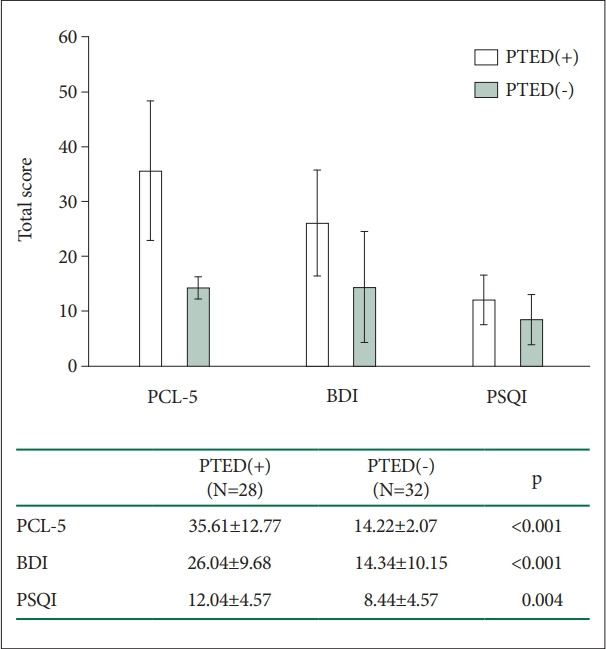
In total, 60 participants (28 in PTED(+) and 32 in PTED(-)) were included. Among those in PTED(+), 21 (35.0%) showed mild embitterment symptoms (1.6≤ mPTEDS <2.5) and 7 (11.7%) reported moderate or severe embitterment symptoms (mPTEDS ≥2.5). The mean scores of posttraumatic stress disorder (PTSD), depression, and anxiety were significantly higher in the PTED(+) than in the PTED(-) group. The mPTEDS were significantly correlated with PTSD, depression, anxiety, and sleep disorder scores. The PTSD symptoms significantly explained the higher mPTEDS score in a regression model.
Embitterment symptoms were associated with PTSD, depression, anxiety, and insomnia symptoms in elderly veterans, similar to the results of prior studies involving only the general population.
目前缺乏关于创伤后痛苦障碍(PTED)与退伍军人及65岁及以上成年人中其他精神病理学之间关联的研究。本研究旨在评估老年退伍军人中的痛苦情绪及其与主要精神病理学因素的关联。
参与者包括前往精神科诊所就诊的越战退伍军人。根据创伤后痛苦障碍自评量表(PTEDS)得分,将参与者分为痛苦组(PTED(+),PTEDS项目平均得分[mPTEDS]≥1.6)和非痛苦组(PTED(-),mPTEDS<1.6)。收集参与者的人口统计学特征、战斗暴露严重程度、抑郁、焦虑、睡眠和酒精使用障碍症状得分,并在PTED(+)组和PTED(-)组之间进行比较。对症状测量得分与mPTEDS进行相关性分析。使用逐步多元线性回归分析研究精神病理学对痛苦情绪的影响。
总共纳入了60名参与者(PTED(+)组28名,PTED(-)组32名)。在PTED(+)组中,21名(35.0%)表现出轻度痛苦症状(1.6≤mPTEDS<2.5),7名(11.7%)报告有中度或重度痛苦症状(mPTEDS≥2.5)。PTED(+)组的创伤后应激障碍(PTSD)、抑郁和焦虑的平均得分显著高于PTED(-)组。mPTEDS与PTSD、抑郁、焦虑和睡眠障碍得分显著相关。在回归模型中,PTSD症状显著解释了较高的mPTEDS得分。
与之前仅涉及普通人群的研究结果相似,痛苦症状与老年退伍军人的PTSD、抑郁、焦虑和失眠症状相关。