Guangdong Provincial Key Laboratory of Plant Adaptation and Molecular Design, Innovative Center of Molecular Genetics and Evolution, School of Life Sciences, Guangzhou University, Guangzhou 510006, China; Jiangsu Key Laboratory of Crop Genomics and Molecular Breeding/Zhongshan Biological Breeding Laboratory/Key Laboratory of Plant Functional Genomics of the Ministry of Education, Agricultural College of Yangzhou University, Yangzhou 225009, China.
Jiangsu Key Laboratory of Crop Genomics and Molecular Breeding/Zhongshan Biological Breeding Laboratory/Key Laboratory of Plant Functional Genomics of the Ministry of Education, Agricultural College of Yangzhou University, Yangzhou 225009, China.
Plant Commun. 2024 Jun 10;5(6):100857. doi: 10.1016/j.xplc.2024.100857. Epub 2024 Mar 2.
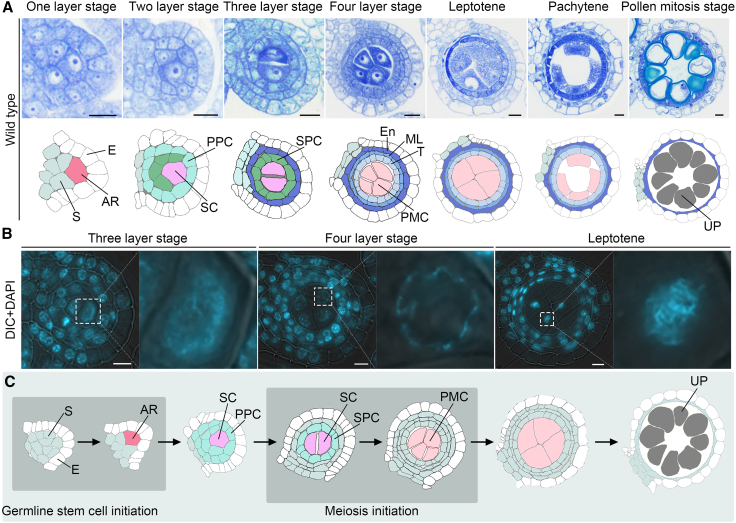
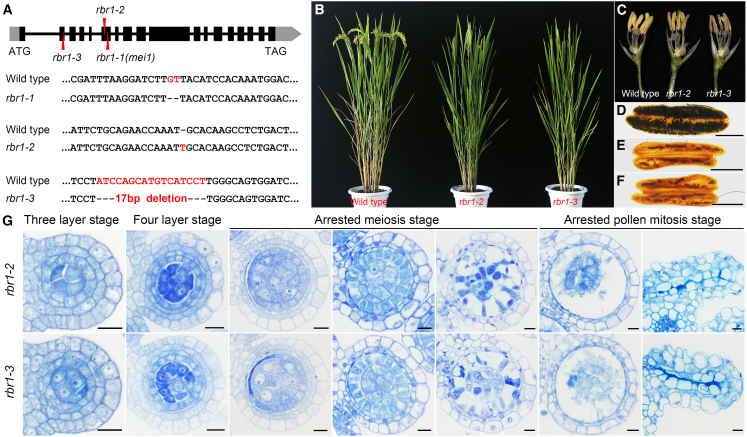
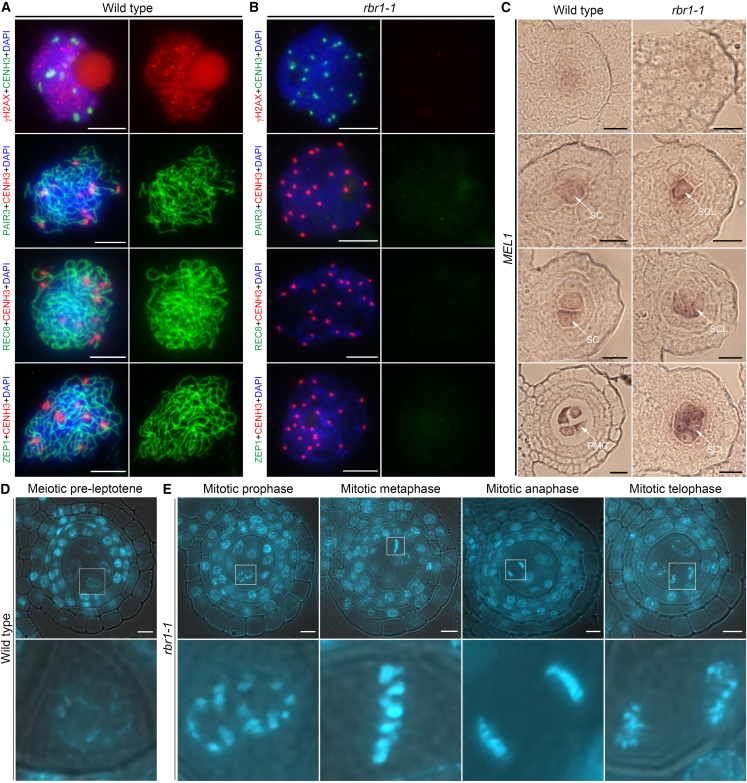
The transition from mitosis to meiosis is a critical event in the reproductive development of all sexually reproducing species. However, the mechanisms that regulate this process in plants remain largely unknown. Here, we find that the rice (Oryza sativa L.) protein RETINOBLASTOMA RELATED 1 (RBR1) is essential to the transition from mitosis to meiosis. Loss of RBR1 function results in hyper-proliferative sporogenous-cell-like cells (SCLs) in the anther locules during early stages of reproductive development. These hyper-proliferative SCLs are unable to initiate meiosis, eventually stagnating and degrading at late developmental stages to form pollen-free anthers. These results suggest that RBR1 acts as a gatekeeper of entry into meiosis. Furthermore, cytokinin content is significantly increased in rbr1 mutants, whereas the expression of type-B response factors, particularly LEPTO1, is significantly reduced. Given the known close association of cytokinins with cell proliferation, these findings imply that hyper-proliferative germ cells in the anther locules may be attributed to elevated cytokinin concentrations and disruptions in the cytokinin pathway. Using a genetic strategy, the association between germ cell hyper-proliferation and disturbed cytokinin signaling in rbr1 has been confirmed. In summary, we reveal a unique role of RBR1 in the initiation of meiosis; our results clearly demonstrate that the RBR1 regulatory module is connected to the cytokinin signaling pathway and switches mitosis to meiosis in rice.
有丝分裂向减数分裂的转变是所有有性繁殖物种生殖发育过程中的一个关键事件。然而,植物中调节这一过程的机制在很大程度上仍不清楚。在这里,我们发现水稻(Oryza sativa L.)蛋白 RETINOBLASTOMA RELATED 1(RBR1)对有丝分裂向减数分裂的转变是必不可少的。RBR1 功能丧失导致生殖发育早期花药室中出现过度增殖的孢原细胞样细胞(SCL)。这些过度增殖的 SCL 无法启动减数分裂,最终在发育后期停滞和降解,形成无花粉的花药。这些结果表明 RBR1 作为进入减数分裂的守门员。此外,rbr1 突变体中的细胞分裂素含量显著增加,而 B 型反应因子,特别是 LEPTO1 的表达显著降低。鉴于细胞分裂素与细胞增殖密切相关,这些发现表明花药室中过度增殖的生殖细胞可能归因于细胞分裂素浓度的升高和细胞分裂素途径的破坏。通过遗传策略,已经证实了 rbr1 中生殖细胞过度增殖与细胞分裂素信号转导紊乱之间的关联。总之,我们揭示了 RBR1 在减数分裂起始中的独特作用;我们的结果清楚地表明,RBR1 调节模块与细胞分裂素信号通路相连,并在水稻中启动有丝分裂向减数分裂的转变。