• 文献检索
  • 文档翻译
  • 深度研究
  • 学术资讯
  • Suppr Zotero 插件Zotero 插件
  • 邀请有礼
  • 套餐&价格
  • 历史记录
应用&插件
Suppr Zotero 插件Zotero 插件浏览器插件Mac 客户端Windows 客户端微信小程序
定价
高级版会员购买积分包购买API积分包
服务
文献检索文档翻译深度研究API 文档MCP 服务
关于我们
关于 Suppr公司介绍联系我们用户协议隐私条款
关注我们

Suppr 超能文献

核心技术专利:CN118964589B侵权必究
粤ICP备2023148730 号-1Suppr @ 2026

文献检索

告别复杂PubMed语法,用中文像聊天一样搜索,搜遍4000万医学文献。AI智能推荐,让科研检索更轻松。

立即免费搜索

文件翻译

保留排版,准确专业,支持PDF/Word/PPT等文件格式,支持 12+语言互译。

免费翻译文档

深度研究

AI帮你快速写综述,25分钟生成高质量综述,智能提取关键信息,辅助科研写作。

立即免费体验

一种在步态分析中选择动态时间规整最优对齐路径的方法。

A method for selecting the optimal warping path of dynamic time warping in gait analysis.

作者信息

Lee Hyun-Seob, Lee Jae-Hyun, Kim Kyung-Ryur

机构信息

Department of Physical Education, Graduate School of Education, Korea University, Seoul, Korea.

Department of Sports Science, Chungnam National University, Daejeon, Korea.

出版信息

J Exerc Rehabil. 2024 Feb 21;20(1):42-48. doi: 10.12965/jer.2346580.290. eCollection 2024 Feb.

DOI:10.12965/jer.2346580.290
PMID:38433858
原文链接:https://pmc.ncbi.nlm.nih.gov/articles/PMC10902693/
Abstract

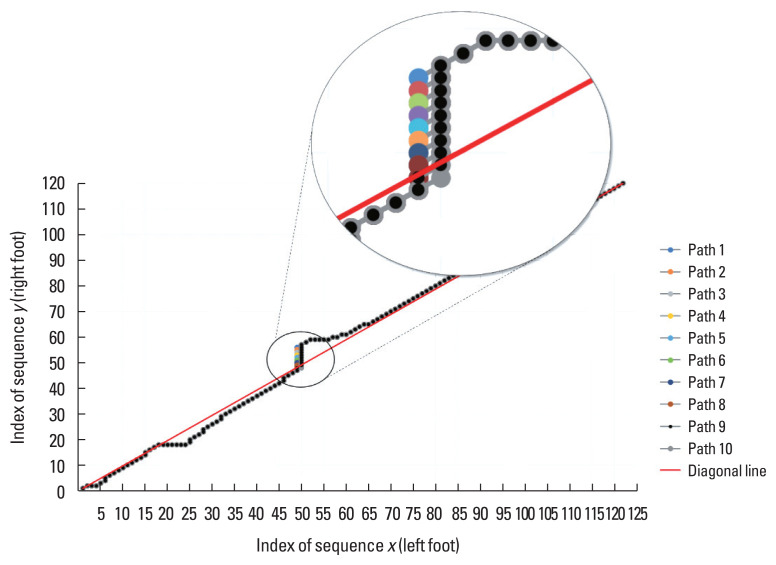
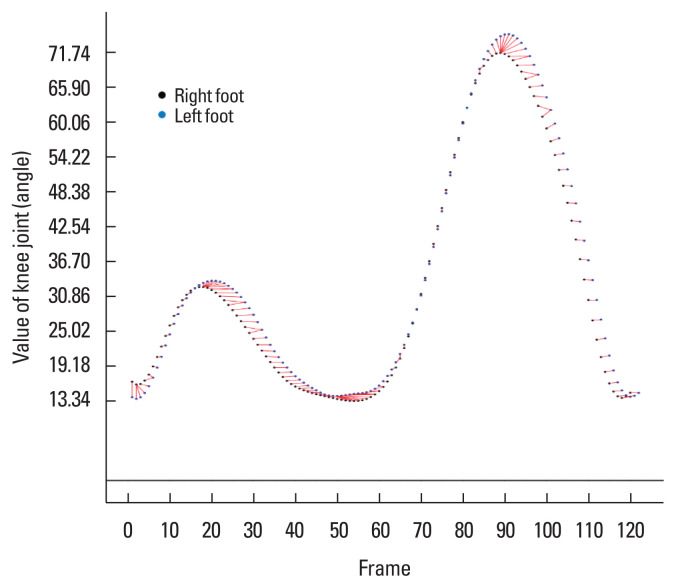
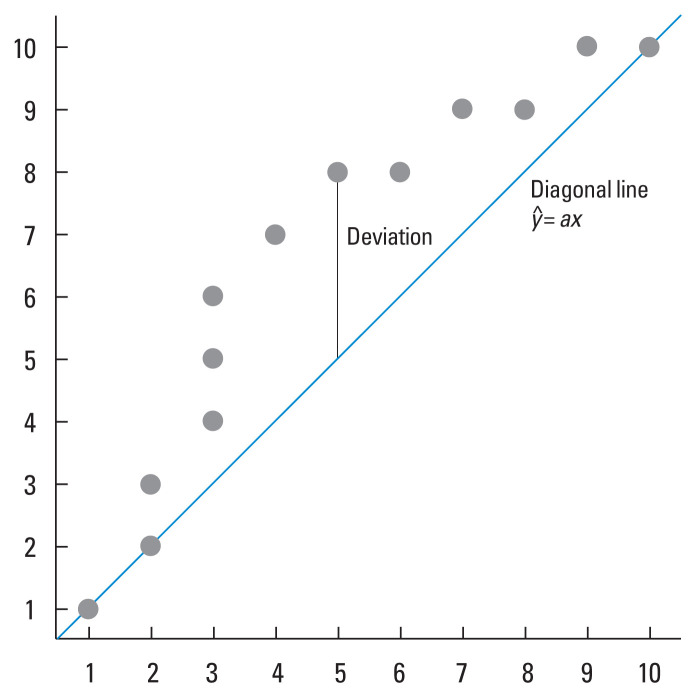
This study aims to demonstrate that when performing dynamic time warping (DTW) on gait data, multiple optimal warping paths (OWPs) with a minimum sum of local costs can occur and to propose an additional OWP selection method to address this problem. A 3-dimensional motion analysis experiment was conducted on 55 adult participants, including both males and females, to acquire gait data. This study analyzed 990 instances of DTW on gait data to examine the occurrence of multiple OWPs with the minimum sum of local costs. We subsequently applied an additional selection method to the multiple OWPs to determine the feasibility of identifying a single OWP. Multiple OWPs through DTW were observed 82 times, accounting for 8.28%. Notably, on the ankle joint of males, the rate was the highest at 11.11%. Cases with two multiple OWPs were the most prevalent at 56.10%, and cases with ten or more multiple OWPs accounted for 19.51%. The additional selection method proposed in this study was applied to the 82 instances in which multiple OWPs occurred. The results demonstrated the ability to identify a unique OWP in all cases. These results hold significance in identifying the shortcomings of conventional OWP selection methods previously employed and proposing solutions. It enhances the reliability, validity, and accuracy of studies utilizing DTW.

摘要

本研究旨在证明,在对步态数据进行动态时间规整(DTW)时,可能会出现具有最小局部成本总和的多个最优规整路径(OWP),并提出一种额外的OWP选择方法来解决这一问题。对55名成年参与者(包括男性和女性)进行了三维运动分析实验以获取步态数据。本研究对步态数据的990个DTW实例进行了分析,以检验具有最小局部成本总和的多个OWP的出现情况。随后,我们对多个OWP应用了一种额外的选择方法,以确定识别单个OWP的可行性。通过DTW观察到多个OWP的情况有82次,占8.28%。值得注意的是,在男性的踝关节处,这一比例最高,为11.11%。具有两个多个OWP的情况最为普遍,占56.10%,具有十个或更多多个OWP的情况占19.51%。本研究提出的额外选择方法应用于出现多个OWP的82个实例。结果表明在所有情况下都能够识别出唯一的OWP。这些结果对于识别先前使用的传统OWP选择方法的缺点并提出解决方案具有重要意义。它提高了利用DTW的研究的可靠性、有效性和准确性。
https://cdn.ncbi.nlm.nih.gov/pmc/blobs/0e7b/10902693/bafd56775f97/jer-20-1-42f5.jpg
https://cdn.ncbi.nlm.nih.gov/pmc/blobs/0e7b/10902693/59b9e164035f/jer-20-1-42f1.jpg
https://cdn.ncbi.nlm.nih.gov/pmc/blobs/0e7b/10902693/45226cab9f31/jer-20-1-42f2.jpg
https://cdn.ncbi.nlm.nih.gov/pmc/blobs/0e7b/10902693/953d199fb388/jer-20-1-42f3.jpg
https://cdn.ncbi.nlm.nih.gov/pmc/blobs/0e7b/10902693/4f75fa1b766a/jer-20-1-42f4.jpg
https://cdn.ncbi.nlm.nih.gov/pmc/blobs/0e7b/10902693/bafd56775f97/jer-20-1-42f5.jpg
https://cdn.ncbi.nlm.nih.gov/pmc/blobs/0e7b/10902693/59b9e164035f/jer-20-1-42f1.jpg
https://cdn.ncbi.nlm.nih.gov/pmc/blobs/0e7b/10902693/45226cab9f31/jer-20-1-42f2.jpg
https://cdn.ncbi.nlm.nih.gov/pmc/blobs/0e7b/10902693/953d199fb388/jer-20-1-42f3.jpg
https://cdn.ncbi.nlm.nih.gov/pmc/blobs/0e7b/10902693/4f75fa1b766a/jer-20-1-42f4.jpg
https://cdn.ncbi.nlm.nih.gov/pmc/blobs/0e7b/10902693/bafd56775f97/jer-20-1-42f5.jpg

相似文献

1
A method for selecting the optimal warping path of dynamic time warping in gait analysis.一种在步态分析中选择动态时间规整最优对齐路径的方法。
J Exerc Rehabil. 2024 Feb 21;20(1):42-48. doi: 10.12965/jer.2346580.290. eCollection 2024 Feb.
2
Normalization and possibility of classification analysis using the optimal warping paths of dynamic time warping in gait analysis.步态分析中使用动态时间规整的最优规整路径进行归一化及分类分析的可能性。
J Exerc Rehabil. 2023 Feb 23;19(1):85-91. doi: 10.12965/jer.2244590.295. eCollection 2023 Feb.
3
Application of dynamic time warping algorithm for pattern similarity of gait.动态时间规整算法在步态模式相似性中的应用。
J Exerc Rehabil. 2019 Aug 28;15(4):526-530. doi: 10.12965/jer.1938384.192. eCollection 2019 Aug.
4
Using Multi-Dimensional Dynamic Time Warping to Identify Time-Varying Lead-Lag Relationships.利用多维动态时间规整识别时变的领先-滞后关系。
Sensors (Basel). 2022 Sep 12;22(18):6884. doi: 10.3390/s22186884.
5
Implementation and evaluation of a multivariate abstraction-based, interval-based dynamic time-warping method as a similarity measure for longitudinal medical records.基于多元抽象和区间的动态时间规整方法的实现和评估,作为一种用于纵向医疗记录的相似性度量方法。
J Biomed Inform. 2021 Nov;123:103919. doi: 10.1016/j.jbi.2021.103919. Epub 2021 Oct 8.
6
Detecting early-stage Parkinson's disease from gait data.从步态数据中检测早期帕金森病。
Proc Inst Mech Eng H. 2023 Nov;237(11):1287-1296. doi: 10.1177/09544119231197090. Epub 2023 Nov 2.
7
Asymmetric Gait Analysis Using a DTW Algorithm with Combined Gyroscope and Pressure Sensor.基于 DTW 算法的组合陀螺仪和压力传感器的非对称步态分析。
Sensors (Basel). 2021 May 28;21(11):3750. doi: 10.3390/s21113750.
8
Assessment of human gait after total knee arthroplasty by dynamic time warping algorithm.采用动态时间规整算法评估全膝关节置换术后的人体步态。
Healthc Technol Lett. 2023 Jun 13;10(4):73-79. doi: 10.1049/htl2.12047. eCollection 2023 Aug.
9
Generalized Canonical Time Warping.广义正则时间规整。
IEEE Trans Pattern Anal Mach Intell. 2016 Feb;38(2):279-94. doi: 10.1109/TPAMI.2015.2414429.
10
A gait stability evaluation method based on wearable acceleration sensors.基于可穿戴加速度传感器的步态稳定性评估方法。
Math Biosci Eng. 2023 Nov 2;20(11):20002-20024. doi: 10.3934/mbe.2023886.

引用本文的文献

1
Establishing reference criteria for diagnosing normal gait patterns similarity using dynamic time warping.使用动态时间规整法建立诊断正常步态模式相似性的参考标准。
J Exerc Rehabil. 2025 Jun 25;21(3):172-179. doi: 10.12965/jer.2550174.087. eCollection 2025 Jun.

本文引用的文献

1
Severity Classification Using Dynamic Time Warping-Based Voice Biomarkers for Patients With COVID-19: Feasibility Cross-Sectional Study.使用基于动态时间规整的语音生物标志物对新冠肺炎患者进行严重程度分类:可行性横断面研究
JMIR Biomed Eng. 2023 Nov 6;8:e50924. doi: 10.2196/50924. eCollection 2023.
2
C-DTW for Human Action Recognition Based on Nanogenerator.基于纳米发电机的人体动作识别的 C-DTW 方法。
Sensors (Basel). 2023 Aug 17;23(16):7230. doi: 10.3390/s23167230.
3
Normalization and possibility of classification analysis using the optimal warping paths of dynamic time warping in gait analysis.
步态分析中使用动态时间规整的最优规整路径进行归一化及分类分析的可能性。
J Exerc Rehabil. 2023 Feb 23;19(1):85-91. doi: 10.12965/jer.2244590.295. eCollection 2023 Feb.
4
Motion Similarity Evaluation between Human and a Tri-Co Robot during Real-Time Imitation with a Trajectory Dynamic Time Warping Model.基于轨迹动态时间规整模型的实时模仿中人与三自由度机器人运动相似度评估。
Sensors (Basel). 2022 Mar 2;22(5):1968. doi: 10.3390/s22051968.
5
Evaluation of Postural Sway in Post-stroke Patients by Dynamic Time Warping Clustering.通过动态时间规整聚类评估中风后患者的姿势摆动
Front Hum Neurosci. 2021 Dec 3;15:731677. doi: 10.3389/fnhum.2021.731677. eCollection 2021.
6
Gait characteristics under single-/dual-task walking conditions in elderly patients with cerebral small vessel disease: Analysis of gait variability, gait asymmetry and bilateral coordination of gait.老年脑小血管病患者单/双任务行走下的步态特征:步态变异性、步态不对称性和步态双侧协调性分析。
Gait Posture. 2022 Feb;92:65-70. doi: 10.1016/j.gaitpost.2021.11.007. Epub 2021 Nov 17.
7
Asymmetric Gait Analysis Using a DTW Algorithm with Combined Gyroscope and Pressure Sensor.基于 DTW 算法的组合陀螺仪和压力传感器的非对称步态分析。
Sensors (Basel). 2021 May 28;21(11):3750. doi: 10.3390/s21113750.
8
Gait-cycle segmentation method based on lower-trunk acceleration signals and dynamic time warping.基于下躯干加速度信号和动态时间规整的步态周期分割方法。
Med Eng Phys. 2020 Aug;82:70-77. doi: 10.1016/j.medengphy.2020.06.001. Epub 2020 Jul 8.
9
Non-Linear Template-Based Approach for the Study of Locomotion.基于非线性模板的运动研究方法。
Sensors (Basel). 2020 Mar 30;20(7):1939. doi: 10.3390/s20071939.
10
Application of dynamic time warping algorithm for pattern similarity of gait.动态时间规整算法在步态模式相似性中的应用。
J Exerc Rehabil. 2019 Aug 28;15(4):526-530. doi: 10.12965/jer.1938384.192. eCollection 2019 Aug.