Sokolovskii S E, Zykin A A, Rukina N N, Malyshev E E
PhD Student, Department of Traumatology, Orthopedics and Neurosurgery named after M.V. Kolokoltsev; Privolzhsky Research Medical University, 10/1 Minin and Pozharsky Square, Nizhny Novgorod, 603005, Russia.
Head of Traumatology and Orthopedics Department No.2, University Clinic; Privolzhsky Research Medical University, 10/1 Minin and Pozharsky Square, Nizhny Novgorod, 603005, Russia.
Sovrem Tekhnologii Med. 2023;15(4):23-28. doi: 10.17691/stm2023.15.4.02. Epub 2023 Jul 28.
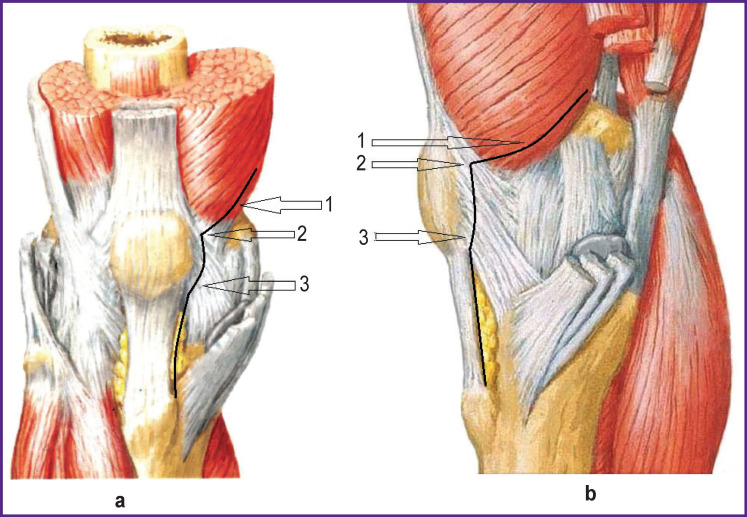
was to assess the efficiency of a developed minimally invasive (epivastus) approach in total knee arthroplasty (TKA) by comparing its early results with those of a standard medial mediapatellar approach (MMPA).
A single-center, comparative randomized prospective study involved 127 patients, who underwent TKA using MMPA (n=62) and a modified minimally invasive epivastus approach (n=65) within the period from January to December, 2022. The study groups were comparable by gender, age, BMI, gonarthrosis stage, and knee joint functioning parameters.
The surgery duration in the epivastus group was significantly lower compared to MMPA group (p<0.001). However, the interpretation of tissue trauma markers assessment appeared rather ambiguous. There were no statistically significant differences in lactate dehydrogenase (p=0.253). C-reactive protein, myoglobin, creatinine showed a significant increase in MMPA group (p<0.001; p=0.002 and p=0.048, respectively), while aspartate aminotransferase, creatine phosphokinase and ESR, in contrast, increased in the epivastus group (p<0.001; p=0.024 and p=0.010, respectively). Pain syndrome determined by VAS 3 days after the surgery was significantly lower in the epivastus group (p=0.006). The extent of blood loss appeared to be much greater in MMPA group (p=0.006). The joint function indicators on day 3 after the surgery were found to be better in the patients after TKA using an epivastus approach (p<0.001). The postoperative assessment of the endoprosthetic spatial orientation showed the indicators characterizing the correct endoprosthetic implantation to be comparable in both groups (p≥0.06).
The present study demonstrated the efficiency of the developed minimally invasive (epivastus) approach in TKA. However, it should be taken into consideration that surgeons should take a training course to be able to accomplish a high-quality approach.An ambiguous interpretation of tissue trauma markers assessment of performing minimally traumatic approaches requires terminology correction. It is probably necessary to change the approach to the approach marking and use the terms specifying minimal invasiveness and the reduction of muscle injury rather than soft tissues in general.
旨在通过比较其早期结果与标准内侧髌旁入路(MMPA)的结果,评估一种改进的微创(股外侧肌)入路在全膝关节置换术(TKA)中的效率。
一项单中心、比较性随机前瞻性研究纳入了127例患者,他们于2022年1月至12月期间接受了使用MMPA(n = 62)和改良微创股外侧肌入路(n = 65)的TKA。研究组在性别、年龄、BMI、膝关节病阶段和膝关节功能参数方面具有可比性。
股外侧肌入路组的手术时间明显低于MMPA组(p < 0.001)。然而,组织创伤标志物评估的解读似乎相当模糊。乳酸脱氢酶方面无统计学显著差异(p = 0.253)。C反应蛋白、肌红蛋白、肌酐在MMPA组显著升高(分别为p < 0.001、p = 0.002和p = 0.048),而天冬氨酸转氨酶、肌酸磷酸激酶和血沉,相比之下,在股外侧肌入路组升高(分别为p < 0.001、p = 0.024和p = 0.010)。术后3天通过视觉模拟评分法(VAS)确定的疼痛综合征在股外侧肌入路组明显更低(p = 0.006)。MMPA组的失血量似乎要多得多(p = 0.006)。发现采用股外侧肌入路进行TKA后的患者术后第3天的关节功能指标更好(p < 0.001)。假体空间定向的术后评估显示,两组中表征假体正确植入的指标具有可比性(p≥0.06)。
本研究证明了改进的微创(股外侧肌)入路在TKA中的效率。然而,应考虑到外科医生应参加培训课程,以便能够完成高质量的入路。对实施微创入路的组织创伤标志物评估的模糊解读需要术语修正。可能有必要改变入路标记的方式,使用明确最小侵入性和减少肌肉损伤而非一般软组织损伤的术语。