Yang Shiyan, Cheng Yajun, Wang Xiaolong, Yue Suyang, Wang Xi, Tang Li, Li Hailun, Zhang Jie, Xiong Qingping, Tan Shanzhong
Department of Integrated TCM and Western Medicine, Nanjing Hospital Affiliated to Nanjing University of Chinese Medicine, Nanjing, 210023, China.
Department of Gastroenterology, Huai'an Hospital Affiliated to Xuzhou Medical University, Huai'an, 223002, China.
Heliyon. 2024 Feb 22;10(5):e26129. doi: 10.1016/j.heliyon.2024.e26129. eCollection 2024 Mar 15.
Yi-Qi-Jian-Pi Formula (YQJPF) is a herbal medicine that is used to treat patients with liver failure. However, scientific evidence supporting the treatment of hepatic fibrosis with YQJPF has not been forthcoming. The present study aimed to determine the mechanisms underlying the anti-fibrotic effects of YQJPF in mouse models of hepatic fibrosis.
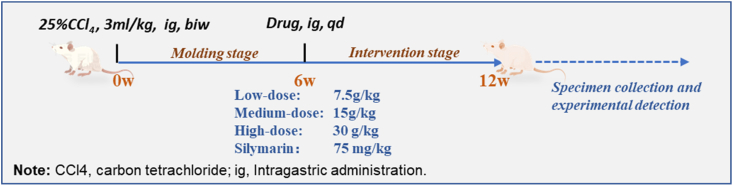
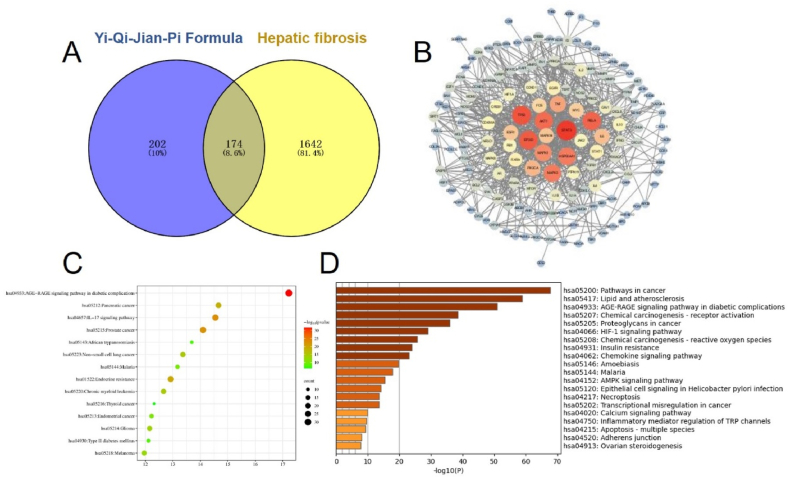
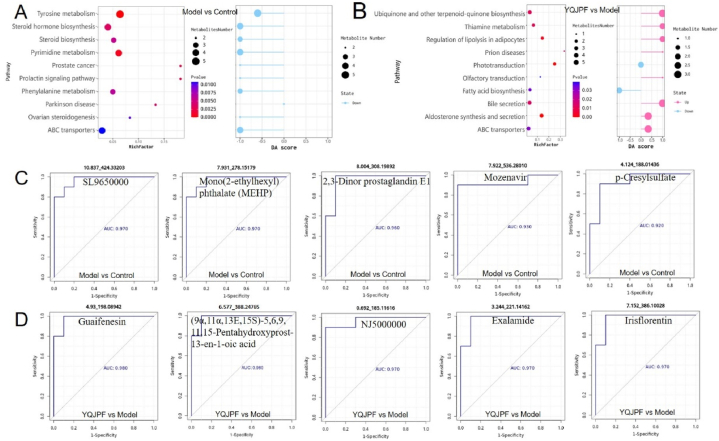
Mice were randomly assigned to control, hepatic fibrosis model, silymarin (positive treated), and low-, medium- and high-dose YQJPF (7.5, 15, and 30 g/kg, respectively) groups. Liver function, inflammatory cytokines, and oxygen stress were analyzed using ELISA kits. Sections were histopathologically stained with hematoxylin-eosin, Masson trichrome, and Sirius red. Macrophage polarization was measured by flow cytometry and immunofluorescence. Potential targets of YQJPF against hepatic fibrosis were analyzed by network pharmacology of Chinese herbal compound and the effects of YQJPF on the transforming growth factor-beta (TGF-β)/Suppressor of Mothers against Decapentaplegic family member 3 (Smad3) signaling pathway were assessed using qRT-PCR and immunohistochemical staining. Finally, metagenomics and LC-MS/MS were used to detect the intestinal flora and metabolites of the mice, and an in-depth correlation analysis was performed by spearman correlation analysis. The data were compared by one-way ANOVA and least significant differences (LSDs) or ANOVA-Dunnett's T3 method used when no homogeneity was detected.
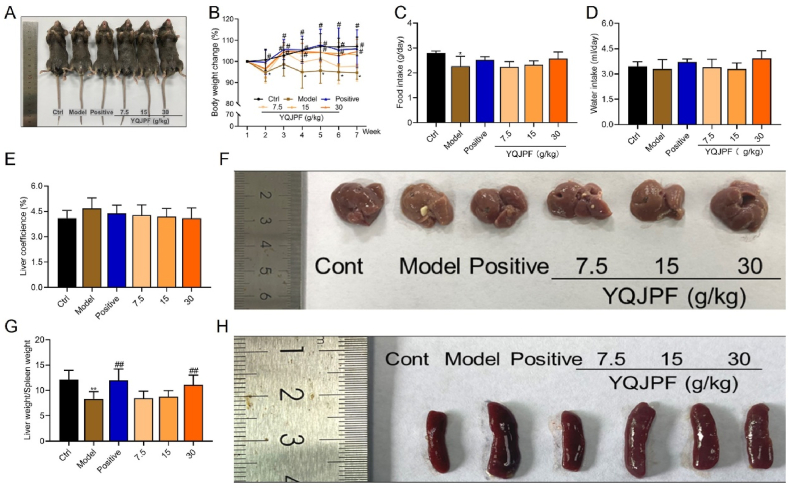
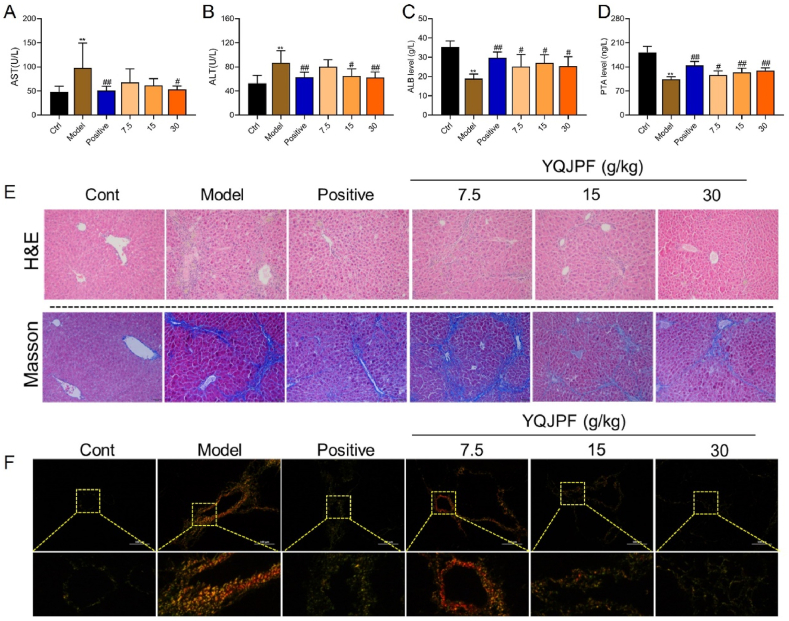
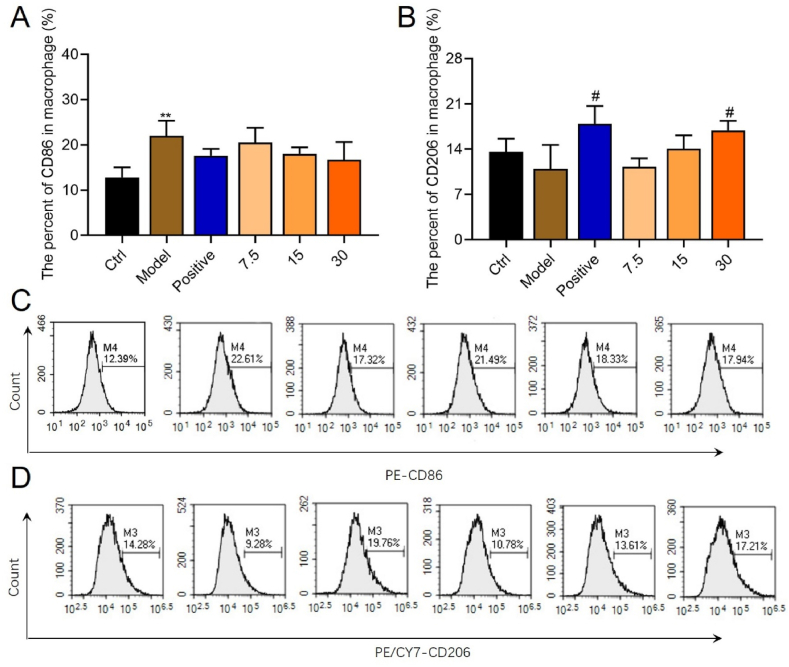
We induced hepatic fibrosis using CCl to establish mouse models and found that YQJPF dose-dependently increased body weight, improved liver function, and reversed hepatic fibrosis. Elevated levels of the pro-inflammatory factors IL-1β, IL-6, and TNF-α in the model mice were substantially decreased by YQJPF, particularly at the highest dose. Levels of serum malondialdehyde and superoxide dismutase (SOD) activity were elevated and reduced, respectively. The malondialdehyde concentration decreased and SOD activity increased in the high-dose group. M1 polarized macrophages (CD86) in the mouse models were significantly decreased and M2 polarization was mildly decreased without significance. However, high-dose YQJPF increased the numbers of M2 macrophages and inhibited TGF-β/Smad3 signaling. Metagenomic and non-targeted metabolomics detection results showed that YQJPF could regulate intestinal homeostasis, and Spearman correlation analysis showed that the abundance of Calditerrivibrio_nitroreducens was significantly negatively correlated with 18β-glycyrrhetinic acid. It is suggested that Calditerrivibrio_nitroreducens may reduce the anti-fibrosis effect of licorice and other Chinese herbs by digesting 18β-glycyrrhetinic acid.
YQJPF can reverse liver fibrosis by inhibiting inflammation, suppressing oxidative stress, regulating the immunological response initiated by macrophages, inhibiting TGF-β/Smad3 signaling and regulating intestinal flora homeostasis. Therefore, YQJPF may be included in clinical regimens to treat hepatic fibrosis.
益气健脾方(YQJPF)是一种用于治疗肝衰竭患者的草药。然而,支持YQJPF治疗肝纤维化的科学证据尚未出现。本研究旨在确定YQJPF在肝纤维化小鼠模型中抗纤维化作用的潜在机制。
将小鼠随机分为对照组、肝纤维化模型组、水飞蓟素(阳性治疗组)以及低、中、高剂量YQJPF组(分别为7.5、15和30 g/kg)。使用酶联免疫吸附测定试剂盒分析肝功能、炎性细胞因子和氧化应激。切片进行苏木精-伊红、Masson三色和天狼星红组织病理学染色。通过流式细胞术和免疫荧光测定巨噬细胞极化。采用中药复方网络药理学分析YQJPF抗肝纤维化的潜在靶点,并使用qRT-PCR和免疫组织化学染色评估YQJPF对转化生长因子-β(TGF-β)/抗五聚体蛋白3(Smad3)信号通路的影响。最后,采用宏基因组学和液相色谱-串联质谱法检测小鼠肠道菌群和代谢产物,并通过Spearman相关性分析进行深入的相关性分析。数据采用单因素方差分析和最小显著差异(LSDs)法进行比较,当未检测到齐性时采用方差分析-Dunnett's T3法。
我们使用四氯化碳诱导肝纤维化以建立小鼠模型,发现YQJPF剂量依赖性地增加体重、改善肝功能并逆转肝纤维化。YQJPF显著降低了模型小鼠中促炎因子白细胞介素-1β(IL-1β)、白细胞介素-6(IL-6)和肿瘤坏死因子-α(TNF-α)的升高水平,尤其是在高剂量时。血清丙二醛水平升高,超氧化物歧化酶(SOD)活性降低。高剂量组丙二醛浓度降低,SOD活性增加。小鼠模型中M1极化巨噬细胞(CD86)显著减少,M2极化略有减少但无统计学意义。然而,高剂量YQJPF增加了M2巨噬细胞数量并抑制TGF-β/Smad3信号通路。宏基因组学和非靶向代谢组学检测结果表明,YQJPF可调节肠道稳态,Spearman相关性分析表明,硝基还原卡尔地特里氏菌的丰度与18β-甘草次酸呈显著负相关。提示硝基还原卡尔地特里氏菌可能通过消化18β-甘草次酸降低甘草等中药的抗纤维化作用。
YQJPF可通过抑制炎症、抑制氧化应激、调节巨噬细胞引发的免疫反应、抑制TGF-β/Smad3信号通路以及调节肠道菌群稳态来逆转肝纤维化。因此,YQJPF可能被纳入治疗肝纤维化的临床方案中。