Das Khushi Rani, Zaman Farhana, Islam Md Moshiul, Siddiqui Sazada, Alshaharni Mohammed O, Algopishi Uthman Balgith
Department of Agronomy, Faculty of Agriculture, Bangabandhu Sheikh Mujibur Rahman Agricultural University, Gazipur 1706, Bangladesh.
Department of Biology, College of Science, King Khalid University, Abha 61413, Saudi Arabia.
Saudi J Biol Sci. 2024 Apr;31(4):103961. doi: 10.1016/j.sjbs.2024.103961. Epub 2024 Feb 19.
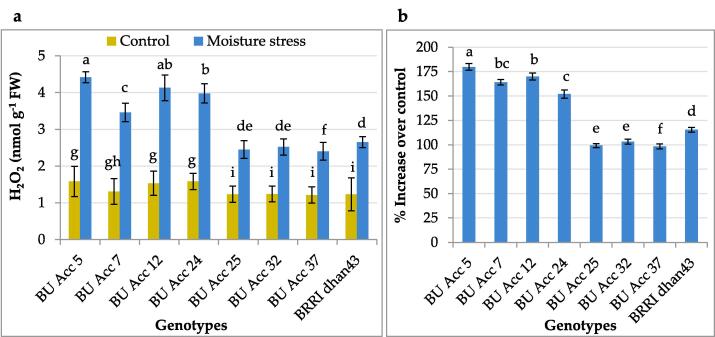
Rice is an important food crop, while it is severely affected by drought stress. Viewing this point in mind we conducted an experiment to see the physiological responses and yield potential of selected rice genotypes under inadequate moisture condition. Two soil moisture condition: one is sufficient moisture condition (control; 95-100% field capacity (FC)) and another is deficit moisture condition (moisture stress; 40-45% FC) with five replications was maintained. Six drought tolerant one susceptible genotype and one standard check variety were used. Results revealed that tolerant genotypes BU Acc 37 and BU Acc 32 showed the highest RWC, WRC, rate of photosynthesis, conductance of stomata, transpiration rate, total chlorophyll content, proline and soluble sugar content, while susceptible genotype BU Acc 5 showed the lowest value of those parameters during water stress condition. In contrast, the lowest WSD, WUC, accumulation of HO and malondialdehyde were noticed in tolerant genotypes BU Acc 37 and BU Acc 32, whereas those were the highest in susceptible genotype BU Acc 5 under deficit moisture condition. Tolerant genotype BU Acc 37 and BU Acc 32 also showed the higher antioxidant enzyme activity than the susceptible genotype BU Acc 5. Regardless of genotypes, yield contributing characteristics and yield were severely affected by deficit water stress. However, tolerant genotype BU Acc 37 showed the highest grain yield per hill, while susceptible genotype BU Acc 5 showed the lowest grain yield per hill. Hence, better accumulation ability of osmoprotectants, and the higher activity of antioxidant enzymes in the tolerant genotypes reduce the oxidative stress, enhance water relation and gas exchange attributes, and protect the yield reduction of rice.
水稻是一种重要的粮食作物,但它受到干旱胁迫的严重影响。基于这一点,我们进行了一项实验,以观察所选水稻基因型在水分不足条件下的生理反应和产量潜力。维持了两种土壤水分条件:一种是充足水分条件(对照;田间持水量的95 - 100%),另一种是水分亏缺条件(水分胁迫;田间持水量的40 - 45%),每种条件重复五次。使用了六个耐旱基因型、一个感旱基因型和一个标准对照品种。结果表明,耐旱基因型BU Acc 37和BU Acc 32在水分胁迫条件下表现出最高的相对含水量、水势、光合速率、气孔导度、蒸腾速率、总叶绿素含量、脯氨酸和可溶性糖含量,而感旱基因型BU Acc 5在这些参数上的值最低。相反,在水分亏缺条件下,耐旱基因型BU Acc 37和BU Acc 32的水分饱和亏缺、水分利用效率、过氧化氢和丙二醛的积累量最低,而感旱基因型BU Acc 5的这些指标最高。耐旱基因型BU Acc 37和BU Acc 32的抗氧化酶活性也高于感旱基因型BU Acc 5。无论基因型如何,产量构成特征和产量都受到水分亏缺胁迫的严重影响。然而,耐旱基因型BU Acc 37的单株籽粒产量最高,而感旱基因型BU Acc 5的单株籽粒产量最低。因此,耐旱基因型中更好的渗透保护剂积累能力和更高的抗氧化酶活性降低了氧化应激,增强了水分关系和气体交换特性,并保护了水稻产量的降低。