Ryu Hyo Seon, Jung Se Hoon, Cho Eun Hae, Choo Jeong Min, Kim Ji-Seon, Baek Se-Jin, Kim Jin, Kwak Jung-Myun
Division of Colon and Rectal Surgery, Department of Surgery, Korea University Anam Hospital, Korea University College of Medicine, Seoul, Korea.
Ann Surg Treat Res. 2024 Mar;106(3):133-139. doi: 10.4174/astr.2024.106.3.133. Epub 2024 Feb 22.
The coronavirus disease 2019 (COVID-19) pandemic has led to significant global casualties. This study examines the postoperative impact of COVID-19 on patients who underwent gastrointestinal surgery, considering their heightened vulnerability to infections and increased morbidity and mortality risk.
This retrospective observational study was conducted at a tertiary center and patients who underwent gastrointestinal surgery between January 2022 and February 2023 were included. Postoperative COVID-19 infection was defined as the detection of severe acute respiratory syndrome coronavirus 2 RNA by RT-PCR within 14 days after surgery. Propensity score matching was performed including age, sex, American Society of Anesthesiology physical status classification, and emergency operation between the COVID-19-negative (-) and -positive (+) groups.
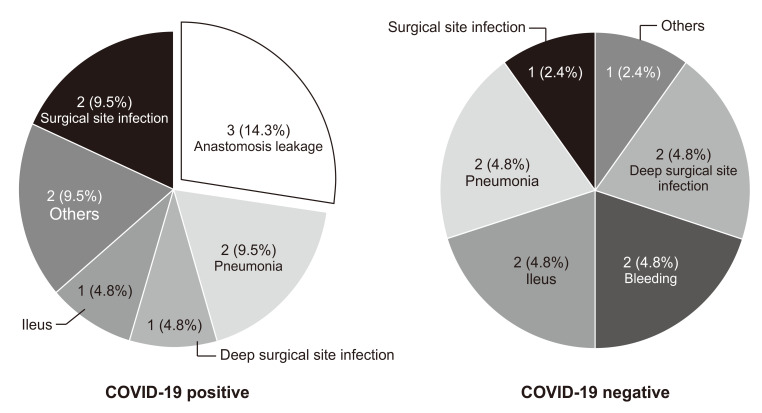
Following 1:2 propensity score matching, 21 COVID-19(+) and 42 COVID-19(-) patients were included in the study. In the COVID-19(+) group, the postoperative complication rate was significantly higher (52.4% 23.8%, P = 0.023). Mechanical ventilator requirement, intensive care unit (ICU) admission, and readmission rate did not significantly differ between the 2 groups. The median length of ICU (19 days 4 days, P < 0.001) and hospital stay (18 8 days, P = 0.015) were significantly longer in the COVID-19(+) group. Patients with COVID-19 had a 2.4 times higher relative risk (RR) of major complications than patients without COVID-19 (RR, 2.37; 95% confidence interval, 1.254-4.467; P = 0.015).
COVID-19 infection during the postoperative period in gastrointestinal surgery may have adverse outcomes which may increase the risk of major complications. Preoperative COVID-19 screening and protocols for COVID-19 prevention in surgical patients should be maintained.
2019年冠状病毒病(COVID-19)大流行已导致全球大量人员伤亡。本研究探讨了COVID-19对接受胃肠手术患者的术后影响,考虑到他们更容易感染且发病和死亡风险增加。
本回顾性观察研究在一家三级中心进行,纳入了2022年1月至2023年2月期间接受胃肠手术的患者。术后COVID-19感染定义为术后14天内通过逆转录聚合酶链反应(RT-PCR)检测到严重急性呼吸综合征冠状病毒2 RNA。进行倾向评分匹配,包括年龄、性别、美国麻醉医师协会身体状况分类以及COVID-19阴性(-)和阳性(+)组之间的急诊手术情况。
经过1:2倾向评分匹配后,研究纳入了21例COVID-19(+)患者和42例COVID-19(-)患者。在COVID-19(+)组中,术后并发症发生率显著更高(52.4%对23.8%,P = 0.023)。两组之间机械通气需求、重症监护病房(ICU)入院率和再入院率无显著差异。COVID-19(+)组的ICU中位住院时间(19天对4天,P < 0.001)和住院时间(18天对8天,P = 0.015)显著更长。COVID-19患者发生主要并发症的相对风险比未感染COVID-19的患者高2.4倍(相对风险,2.37;95%置信区间,1.254 - 4.467;P = 0.015)。
胃肠手术术后感染COVID-19可能产生不良后果,这可能增加主要并发症的风险。应维持对手术患者进行术前COVID-19筛查以及COVID-19预防方案。