Motani Ryosuke, Pyenson Nicholas D
Department of Earth and Planetary Sciences, University of California, Davis, Davis, California, United States.
Department of Paleobiology, National Museum of Natural History, Smithsonian Institution, District of Columbia, United States.
PeerJ. 2024 Feb 29;12:e16978. doi: 10.7717/peerj.16978. eCollection 2024.
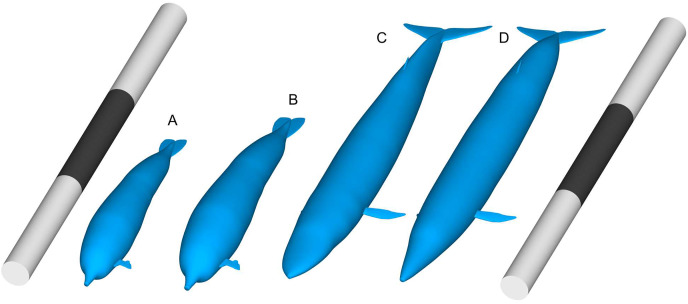
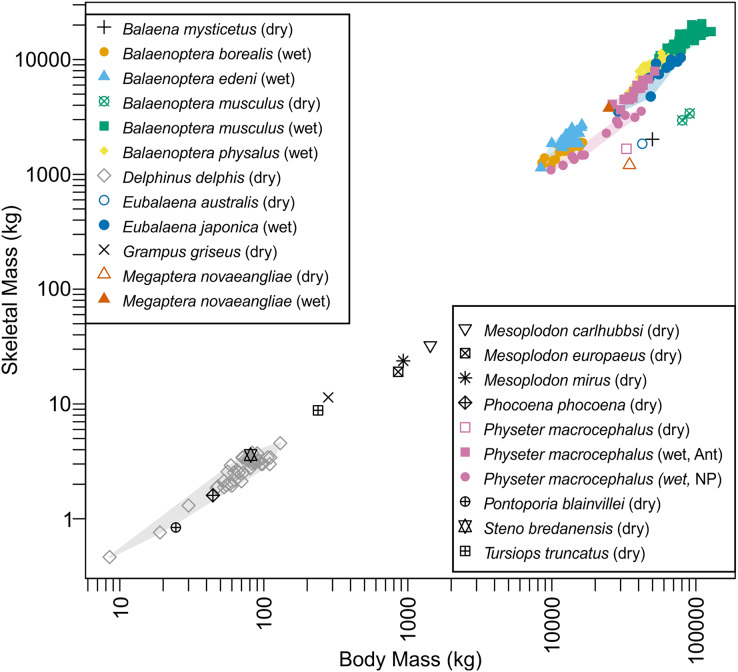
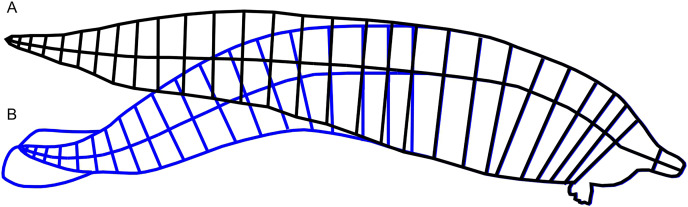
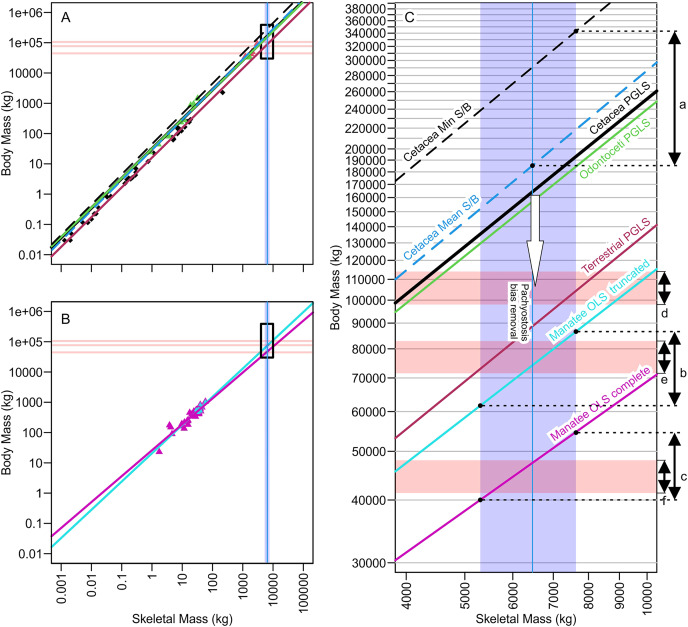
Extremes in organismal size have broad interest in ecology and evolution because organismal size dictates many traits of an organism's biology. There is particular fascination with identifying upper size extremes in the largest vertebrates, given the challenges and difficulties of measuring extant and extinct candidates for the largest animal of all time, such as whales, terrestrial non-avian dinosaurs, and extinct marine reptiles. The discovery of , a giant basilosaurid whale from the Eocene of Peru, challenged many assumptions about organismal extremes based on reconstructions of its body weight that exceeded reported values for blue whales (). Here we present an examination of a series of factors and methodological approaches to assess reconstructing body weight in , including: data sources from large extant cetaceans; fitting published body mass estimates to body outlines; testing the assumption of isometry between skeletal and body masses, even with extrapolation; examining the role of pachyostosis in body mass reconstructions; addressing method-dependent error rates; and comparing with known physiological and ecological limits for living whales, and Eocene oceanic productivity. We conclude that did not exceed the body mass of today's blue whales. Depending on assumptions and methods, we estimate that weighed 60-70 tons assuming a length 17 m. We calculated larger estimates potentially as much as 98-114 tons at 20 m in length, which is far less than the direct records of blue whale weights, or the 270 ton estimates that we calculated for body weights of the largest blue whales measured by length.
生物体大小的极端情况在生态学和进化领域引起了广泛关注,因为生物体大小决定了生物体生物学的许多特征。鉴于测量有史以来最大动物(如鲸鱼、陆地非鸟类恐龙和已灭绝的海洋爬行动物)的现存和已灭绝候选者面临挑战和困难,确定最大脊椎动物的最大体型极端情况尤其令人着迷。从秘鲁始新世发现的一种巨型龙王鲸,挑战了许多基于其体重重建的关于生物体极端情况的假设,其体重超过了报道的蓝鲸体重值。在这里,我们对一系列评估龙王鲸体重重建的因素和方法进行了研究,包括:来自大型现存鲸类的数据来源;将已发表的体重估计值与身体轮廓进行拟合;测试骨骼和体重之间等比例关系的假设,即使是外推情况下;研究骨肥厚在体重重建中的作用;解决方法依赖的错误率;以及将龙王鲸与现存鲸鱼已知的生理和生态极限以及始新世海洋生产力进行比较。我们得出结论,龙王鲸的体重没有超过当今蓝鲸的体重。根据假设和方法,我们估计体长17米的龙王鲸体重为60 - 70吨。我们计算出体长20米时更大的估计值可能高达98 - 114吨,但这远低于蓝鲸体重的直接记录,或者我们根据测量的最大蓝鲸体长计算出的270吨估计值。