Department of Psychology "Renzo Canestrari", University of Bologna, Viale Berti Pichat 5, 40127, Bologna, Italy.
Department of Medicine, Division of General Medicine, Columbia University Irving Medical Center, 622 West 168th Street, 10032, New York, NY, United States.
Curr Obes Rep. 2024 Jun;13(2):224-241. doi: 10.1007/s13679-024-00552-5. Epub 2024 Mar 4.
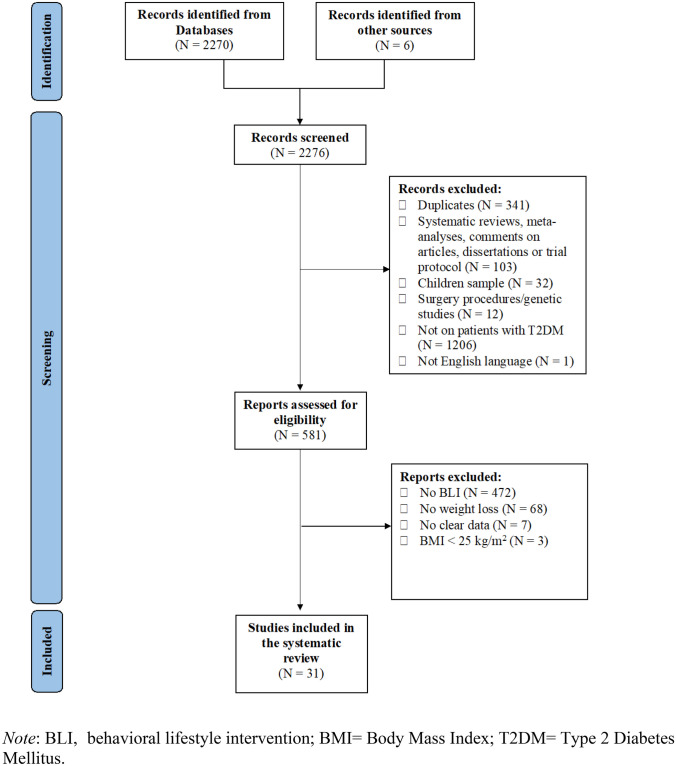
Around 80-90% of patients with type 2 diabetes mellitus (T2DM) are overweight or obese, presenting a greater risk for serious health complications and mortality. Thus, weight loss represents a main goal for T2DM management. Although behavioral lifestyle interventions (BLIs) could help promoting weight loss in T2DM patients with overweight or obesity, their effectiveness is still controversial. This systematic review offers an updated and comprehensive picture of BLIs according to Michie's classification in T2DM patients with overweight or obesity and identifies possible factors (related to both patients and interventions) associated with weight loss. The PRISMA guidelines were followed. The literature search till March 2023 indicated 31 studies involving 42 different BLIs.
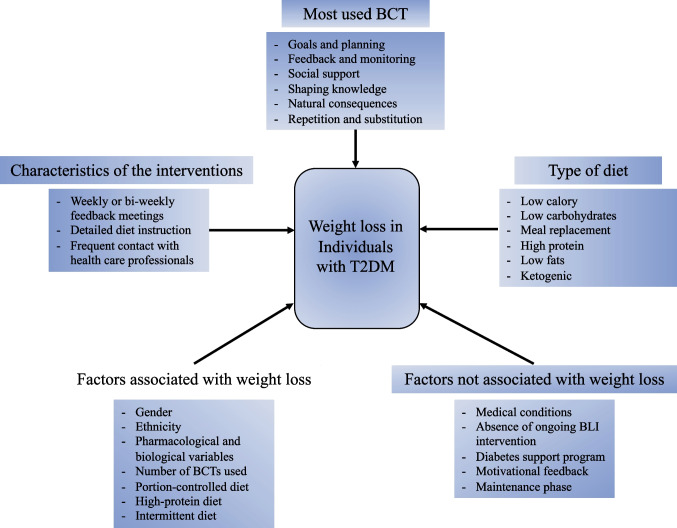
Our findings suggest that structured BLIs, characterized by frequent feedback and support, can lead to a clinically meaningful 5% weight loss, regardless of specific behavioral, diet, and physical activity components. Further research should address methodological issues and heterogeneity of interventions, also considering the effect of pharmacological therapies on weight reduction. Lastly, more attention should be paid to the long-term effectiveness of behavioral lifestyle interventions and to the relationship between weight loss and diabetes.
目的综述:约 80-90%的 2 型糖尿病(T2DM)患者超重或肥胖,面临更严重的健康并发症和死亡风险。因此,减轻体重是 T2DM 管理的主要目标。尽管行为生活方式干预(BLIs)可以帮助超重或肥胖的 T2DM 患者减轻体重,但它们的有效性仍存在争议。本系统综述根据 Michie 分类,为超重或肥胖的 T2DM 患者提供了 BLIs 的最新和全面的情况,并确定了与体重减轻相关的可能因素(与患者和干预措施均相关)。本研究遵循 PRISMA 指南。截至 2023 年 3 月的文献检索表明,有 31 项研究涉及 42 种不同的 BLIs。
最新发现:我们的研究结果表明,结构良好的 BLIs 具有频繁的反馈和支持,可以导致有临床意义的 5%的体重减轻,无论特定的行为、饮食和体力活动成分如何。进一步的研究应解决方法学问题和干预措施的异质性,同时还应考虑药物治疗对减重的影响。最后,应更加关注行为生活方式干预的长期效果,以及体重减轻与糖尿病之间的关系。