Institute of Public Health and Nursing Research, University of Bremen, Bremen, Germany.
Department of Prevention and Evaluation, Leibniz Institute for Prevention Research and Epidemiology - BIPS, Bremen, Germany.
Front Public Health. 2024 Feb 19;12:1332720. doi: 10.3389/fpubh.2024.1332720. eCollection 2024.
Experiencing financial insecurity and being underserved is often associated with low health literacy, i.e., the ability to identify, obtain, interpret and act upon health information, which may result in poor health outcomes. Little is known about effective interventions for promoting health literacy among underserved populations. The objective of this systematic review is to summarize the literature on such interventions and identify characteristics that differentiate more effective interventions.
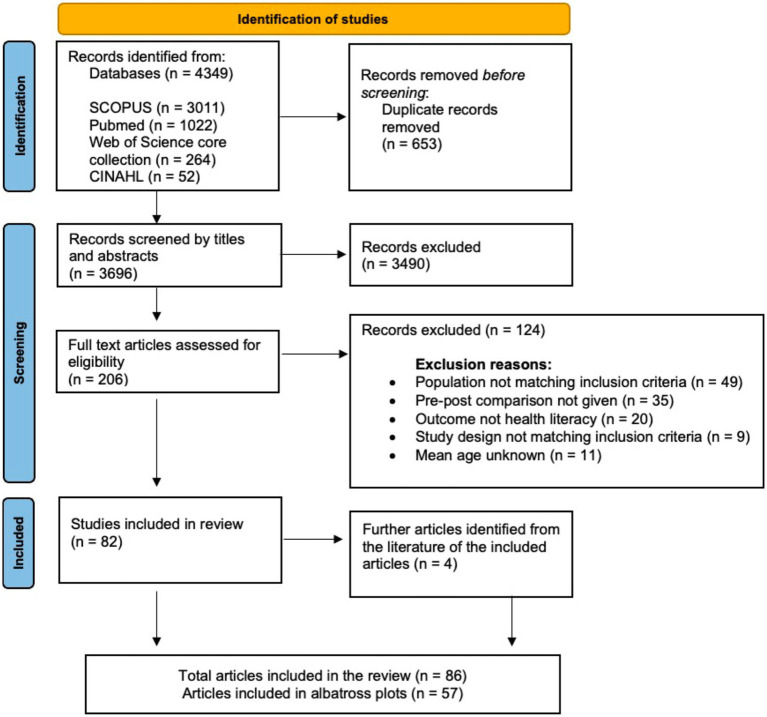
Following PRISMA guidelines we searched the databases SCOPUS, Pubmed, Web of Science core collection and CINAHL. We included primary studies with a quantitative study design and control groups testing interventions to increase health literacy or health knowledge in underserved populations between 18 and 65 years. Where possible, we converted effect sizes into Cohen's d and compared mean differences of intervention and control groups. Albatross plots were created to summarize the results according to different health literacy and health knowledge outcomes.
We screened 3,696 titles and abstracts and 206 full texts. In total, 86 articles were analyzed, of which 55 were summarized in seven albatross plots. The majority of the studies ( = 55) were conducted in the United States and had a randomized controlled study design ( = 44). More effective intervention approaches assessed needs of participants through focus group discussions prior to conducting the intervention, used bilingual educational materials, and included professionals fluent in the first languages of the study population as intervention deliverers. Additionally, the use of educational materials in video and text form, fotonovelas and interactive group education sessions with role playing exercises were observed to be effective.
Although the outcomes addressed in the included studies were heterogeneous, effective intervention approaches were often culturally sensitive and developed tailored educational materials. Interventions aiming to promote health literacy in underserved populations should hence consider applying similar approaches.: https://www.crd.york.ac.uk/prospero/display_record.php?RecordID=323801, PROSPERO registration ID: CRD42022323801.
经济不安全和服务不足通常与健康素养低下有关,即识别、获取、解释和运用健康信息的能力,这可能导致健康状况不佳。对于提高服务不足人群健康素养的有效干预措施知之甚少。本系统评价的目的是总结关于这些干预措施的文献,并确定区分更有效干预措施的特征。
我们按照 PRISMA 指南,在 SCOPUS、PubMed、Web of Science 核心合集和 CINAHL 数据库中进行了搜索。我们纳入了采用定量研究设计和对照组的原始研究,以测试提高服务不足人群健康素养或健康知识的干预措施,研究对象年龄在 18 至 65 岁之间。在可能的情况下,我们将效应大小转换为 Cohen's d,并比较干预组和对照组的平均差异。我们创建了 Albatross 图来根据不同的健康素养和健康知识结果总结结果。
我们筛选了 3696 篇标题和摘要以及 206 篇全文。总共分析了 86 篇文章,其中 55 篇总结在七个 Albatross 图中。大多数研究( = 55)在美国进行,采用随机对照研究设计( = 44)。更有效的干预方法在进行干预之前通过焦点小组讨论评估参与者的需求,使用双语教育材料,并让精通研究人群第一语言的专业人员作为干预者。此外,观察到使用视频和文本形式、照片小说和互动小组教育课程以及角色扮演练习的教育材料是有效的。
尽管纳入研究的结果存在异质性,但有效的干预方法通常具有文化敏感性,并开发了量身定制的教育材料。旨在提高服务不足人群健康素养的干预措施应考虑采用类似方法。https://www.crd.york.ac.uk/prospero/display_record.php?RecordID=323801,PROSPERO 注册 ID:CRD42022323801。