University of Central Florida College of Medicine, University of Central Florida, Orlando, USA.
Equal Access Research, College of Medicine, University of Florida, 1549 Gale Lemerand Drive, 4 Floor, Suite 4592, Gainesville, FL, 32610-3008, USA.
BMC Public Health. 2024 Jun 27;24(1):1713. doi: 10.1186/s12889-024-19166-6.
While many populations struggle with health literacy, those who speak Spanish preferentially or exclusively, including Hispanic, immigrant, or migrant populations, may face particular barriers, as they navigate a predominantly English-language healthcare system. This population also faces greater morbidity and mortality from treatable chronic diseases, such as hypertension and diabetes. The aim of this systematic review was to describe existing health literacy interventions for patients with a Spanish-language preference and present their effectiveness.
We carried out a systematic review where Web of Science, EMBASE, and PubMed were queried using MeSH terms to identify relevant literature. Included articles described patients with a Spanish-language preference participating in interventions to improve health literacy levels in the United States. Screening and data abstraction were conducted independently and in pairs. Risk of bias assessments were conducted using validated appraisal tools.
A total of 2823 studies were identified, of which 62 met our eligibility criteria. The studies took place in a variety of community and clinical settings and used varied tools for measuring health literacy. Of the interventions, 28 consisted of in-person education and 27 implemented multimedia education, with 89% of studies in each category finding significant results. The remaining seven studies featured multimodal interventions, all of which achieved significant results.
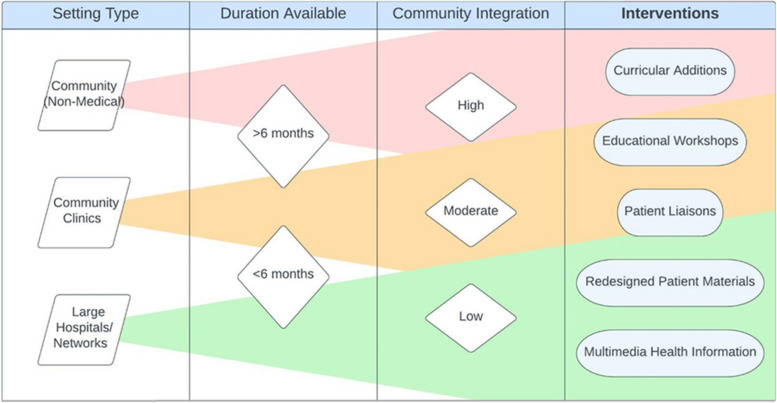
Successful strategies included the addition of liaison roles, such as promotores (Hispanic community health workers), and the use of multimedia fotonovelas (photo comics) with linguistic and cultural adaptations. In some cases, the external validity of the results was limited. Improving low health literacy in patients with a Spanish-language preference, a population with existing barriers to high quality of care, may help them better navigate health infrastructure and make informed decisions regarding their health.
PROSPERO (available at https://www.crd.york.ac.uk/prospero/display_record.php?ID=CRD42021257655.t ).
许多人群都在努力提高健康素养,而那些偏好或仅使用西班牙语的人群,包括西班牙裔、移民或流动人口,在使用以英语为主导的医疗保健系统时,可能会面临特殊的障碍。这些人群还面临着更高的可治疗慢性疾病(如高血压和糖尿病)的发病率和死亡率。本系统评价的目的是描述针对偏好西班牙语的患者的现有健康素养干预措施,并介绍其效果。
我们进行了一项系统评价,通过使用 MeSH 术语在 Web of Science、EMBASE 和 PubMed 上进行查询,以确定相关文献。纳入的文章描述了参与干预措施以提高美国偏好西班牙语的患者健康素养水平的患者。筛选和数据提取是独立进行的,然后由两人进行核对。使用经过验证的评估工具进行偏倚风险评估。
共确定了 2823 项研究,其中 62 项符合我们的入选标准。这些研究发生在各种社区和临床环境中,使用了不同的工具来衡量健康素养。在干预措施中,28 项是面对面教育,27 项是多媒体教育,这两类干预措施中有 89%的研究结果具有统计学意义。其余七项研究采用了多模式干预措施,所有这些研究都取得了显著的结果。
成功的策略包括增加联络角色,如 promotores(西班牙裔社区卫生工作者),以及使用具有语言和文化适应性的多媒体 fotonovelas(照片漫画)。在某些情况下,结果的外部有效性受到限制。提高偏好西班牙语的患者的低健康素养水平,这是一个在获得高质量医疗保健方面存在固有障碍的人群,可能有助于他们更好地驾驭医疗保健基础设施,并就其健康做出明智的决策。
PROSPERO(可在 https://www.crd.york.ac.uk/prospero/display_record.php?ID=CRD42021257655.t 上获得)。