Nathaniel Solomon Prince, Ahmed Zahoor, Shamansurova Zilola, Fakher Hossein Ali
Department of Economics, University of Lagos, Akoka, Nigeria.
Lagos State University School of Basic and Advanced Studies (LASUSBAS), Topo, Badagry, Nigeria.
Heliyon. 2024 Feb 24;10(5):e27095. doi: 10.1016/j.heliyon.2024.e27095. eCollection 2024 Mar 15.
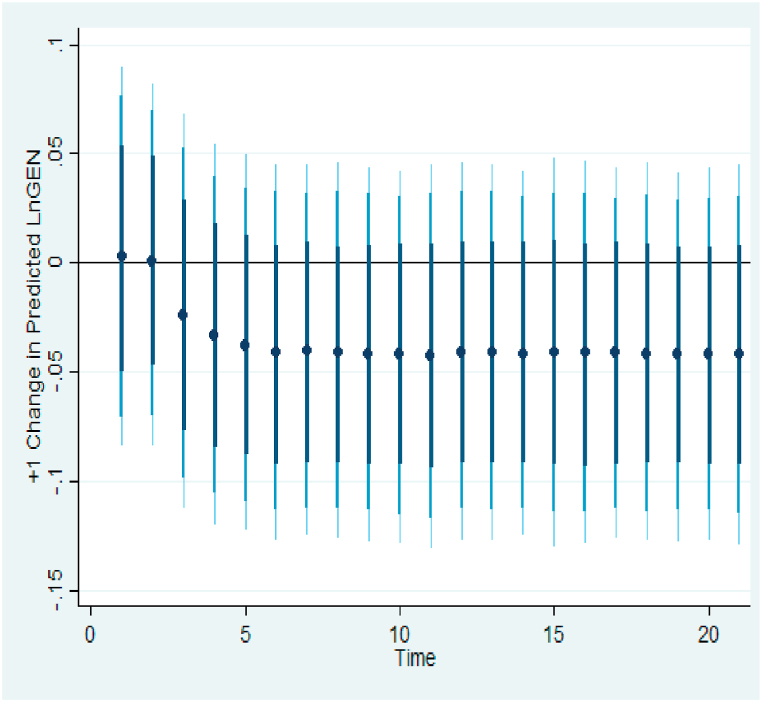
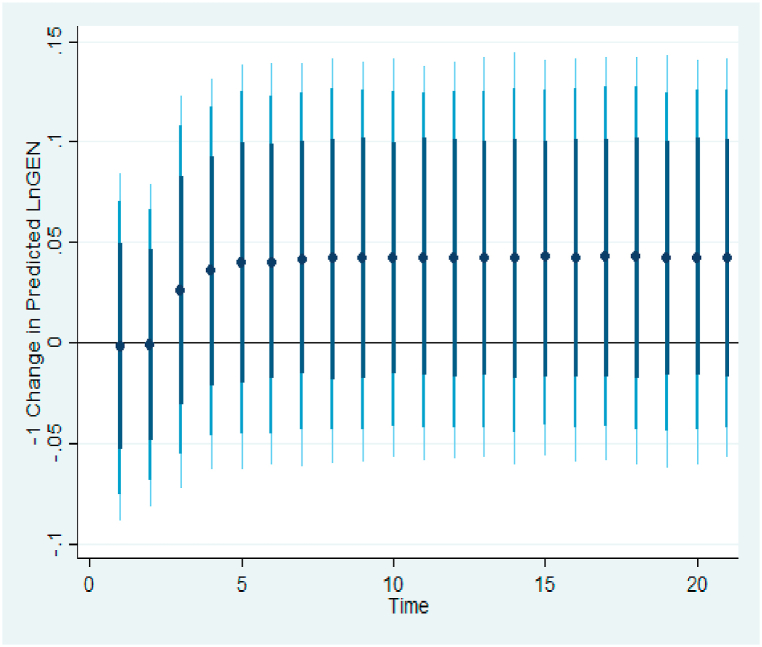
Developing countries have been facing economic difficulties for over three and a half decades due to numerous factors, including fossil fuel consumption and dwindling biocapacity. It is necessary to pinpoint the factors that may be culpable for poor environmental quality leading to a rising ecological footprint (EFP). This study explores the effect of clean energy, financial development (FDV), and globalization on the EFP in a developing country using the novel dynamic ARDL simulation techniques and the bootstrap causality test. The findings suggest that green energy has no meaningful impact on the EFP. Globalization and FDV significantly reduce the EFP by 0.25% and 0.08%, respectively. Besides, the findings confirm the existence of the EKC hypothesis. Furthermore, the causality results affirm a unidirectional causality from globalization and FDV to EFP, while economic growth drives globalization. Also, a one-way causality flows from globalization to FDV, just as FDV Granger causes green energy. In line with the findings, the study recommends that public policies focus on funding environmental-friendly technologies and green innovations. The funding must be on recently developed energy-saving technologies that can ensure complementarity between increased economic growth and environmental deterioration.
三十多年来,由于包括化石燃料消耗和生物承载力下降在内的众多因素,发展中国家一直面临经济困难。有必要找出可能导致环境质量不佳从而导致生态足迹(EFP)上升的因素。本研究采用新颖的动态自回归分布滞后模拟技术和自举因果检验,探讨清洁能源、金融发展(FDV)和全球化对一个发展中国家生态足迹的影响。研究结果表明,绿色能源对生态足迹没有显著影响。全球化和金融发展分别使生态足迹显著降低0.25%和0.08%。此外,研究结果证实了环境库兹涅茨曲线(EKC)假说的存在。此外,因果关系结果证实了从全球化和金融发展到生态足迹的单向因果关系,而经济增长推动全球化。同样,从全球化到金融发展存在单向因果关系,就像金融发展格兰杰导致绿色能源一样。根据研究结果,该研究建议公共政策应专注于为环保技术和绿色创新提供资金。资金必须用于最近开发的节能技术,这些技术可以确保经济增长与环境恶化之间的互补性。