Lumian Jessica, Sumner Dawn Y, Grettenberger Christen L, Jungblut Anne D, Irber Luiz, Pierce-Ward N Tessa, Brown C Titus
Department of Earth and Planetary Sciences, Microbiology Graduate Group, University of California Davis, Davis, CA, United States.
Department of Earth and Planetary Sciences, University of California Davis, Davis, CA, United States.
Front Microbiol. 2024 Feb 19;15:1328083. doi: 10.3389/fmicb.2024.1328083. eCollection 2024.
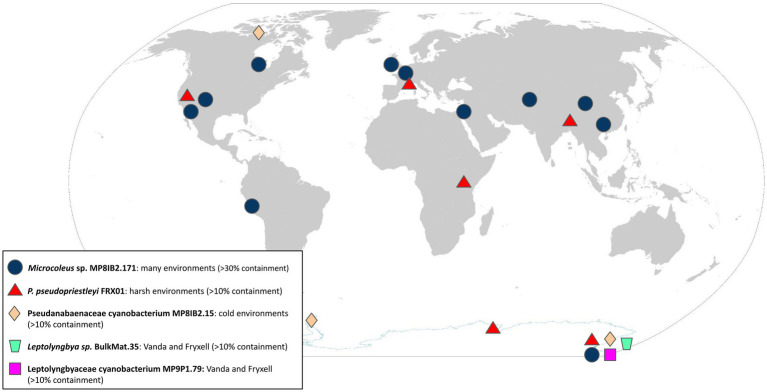
Cyanobacteria form diverse communities and are important primary producers in Antarctic freshwater environments, but their geographic distribution patterns in Antarctica and globally are still unresolved. There are however few genomes of cultured cyanobacteria from Antarctica available and therefore metagenome-assembled genomes (MAGs) from Antarctic cyanobacteria microbial mats provide an opportunity to explore distribution of uncultured taxa. These MAGs also allow comparison with metagenomes of cyanobacteria enriched communities from a range of habitats, geographic locations, and climates. However, most MAGs do not contain 16S rRNA gene sequences, making a 16S rRNA gene-based biogeography comparison difficult. An alternative technique is to use large-scale k-mer searching to find genomes of interest in public metagenomes. This paper presents the results of k-mer based searches for 5 Antarctic cyanobacteria MAGs from Lake Fryxell and Lake Vanda, assigned the names FRX01, sp. MP8IB2.171, sp. BulkMat.35, MP8IB2.15, and MP9P1.79 in 498,942 unassembled metagenomes from the National Center for Biotechnology Information (NCBI) Sequence Read Archive (SRA). The sp. MP8IB2.171 MAG was found in a wide variety of environments, the MAG was found in environments with challenging conditions, the MP9P1.79 MAG was only found in Antarctica, and the sp. BulkMat.35 and MP8IB2.15 MAGs were found in Antarctic and other cold environments. The findings based on metagenome matches and global comparisons suggest that these Antarctic cyanobacteria have distinct distribution patterns ranging from locally restricted to global distribution across the cold biosphere and other climatic zones.
蓝细菌形成了多样的群落,是南极淡水环境中重要的初级生产者,但其在南极洲及全球的地理分布模式仍未明确。然而,目前来自南极洲的培养蓝细菌基因组数量稀少,因此,来自南极蓝细菌微生物垫的宏基因组组装基因组(MAG)为探索未培养分类群的分布提供了契机。这些MAG还能与来自一系列栖息地、地理位置和气候条件的蓝细菌富集群落的宏基因组进行比较。然而,大多数MAG不包含16S rRNA基因序列,这使得基于16S rRNA基因的生物地理学比较变得困难。另一种技术是使用大规模k-mer搜索在公共宏基因组中寻找感兴趣的基因组。本文展示了基于k-mer搜索在来自弗里克塞尔湖和万达湖的5个南极蓝细菌MAG中的结果,这些MAG在国家生物技术信息中心(NCBI)序列读取存档(SRA)的498,942个未组装宏基因组中被命名为FRX01、sp. MP8IB2.171、sp. BulkMat.35、MP8IB2.15和MP9P1.79。sp. MP8IB2.171 MAG在多种环境中被发现,该MAG在具有挑战性的条件下的环境中被发现,MP9P1.79 MAG仅在南极洲被发现,而sp. BulkMat.35和MP8IB2.15 MAG在南极和其他寒冷环境中被发现。基于宏基因组匹配和全球比较的研究结果表明,这些南极蓝细菌具有不同的分布模式,从局部受限到跨越寒冷生物圈和其他气候带的全球分布。