Spec Andrej, Thompson George R, Miceli Marisa H, Hayes Justin, Proia Laurie, McKinsey David, Arauz Ana Belen, Mullane Kathleen, Young Jo-Ann, McGwin Gerald, McMullen Rachel, Plumley Tyler, Moore Mary K, McDowell Lee Ann, Jones Carolynn, Pappas Peter G
Division of Infectious Disease, Washington University in St Louis School of Medicine, St Louis, Missouri, USA.
Department of Internal Medicine, Division of Infectious Diseases and Department of Medical Microbiology and Immunology, University of California Davis Medical Center, Sacramento, California, USA.
Open Forum Infect Dis. 2024 Jan 29;11(3):ofae010. doi: 10.1093/ofid/ofae010. eCollection 2024 Mar.
Invasive fungal disease caused by dimorphic fungi is associated with significant morbidity and mortality. Super-bioavailability itraconazole (SUBA-itra) is a novel antifungal agent with pharmacokinetic advantages over currently available formulations. In this prospective comparative study, we report the outcomes of patients with endemic fungal infections (histoplasmosis, blastomycosis, coccidioidomycosis, and sporotrichosis).
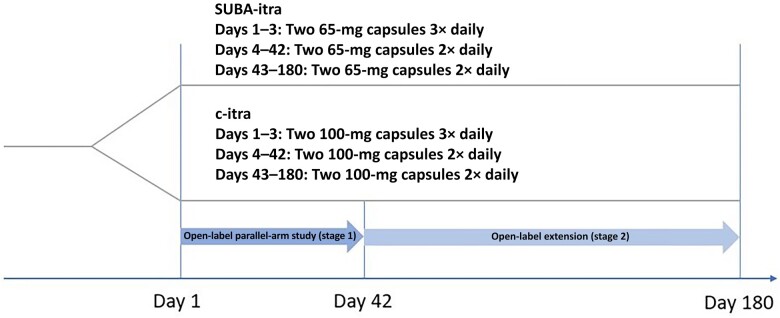
This open-label randomized trial evaluated the efficacy, safety, and pharmacokinetics SUBA-itra compared with conventional itraconazole (c-itra) treatment for endemic fungal infections. An independent data review committee determined responses on treatment days 42 and 180.
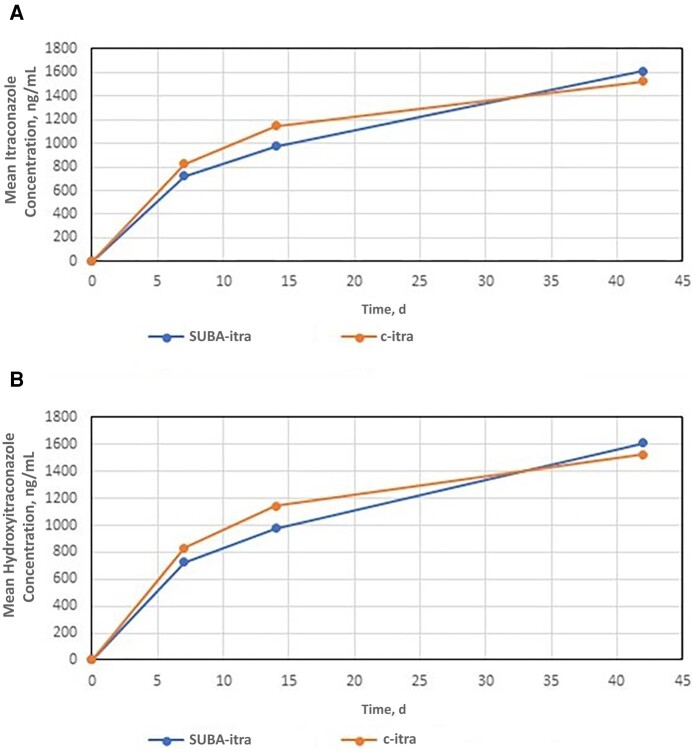
Eighty-eight patients were enrolled for IFD (SUBA-itra, n = 42; c-itra, n = 46) caused by (n = 51), (n = 18), (n = 13), or (n = 6). On day 42, clinical success was observed with SUBA-itra and c-itra on day 42 (in 69% and 67%, respectively, and on day 180 (in 60% and 65%). Patients treated with SUBA-itra exhibited less drug-level variability at days 7 ( = .03) and 14 ( = .06) of randomized treatment. The concentrations of itraconazole and hydroxyitraconazole were comparable between the 2 medications ( = .77 and = .80, respectively). There was a trend for fewer adverse events (AEs; 74% vs 87%, respectively; = .18) and serious AEs (10% vs 26%; = .06) in the SUBA-itra-treated patients than in those receiving c-itra. Serious treatment-emergent AEs were less common in SUBA-itra-treated patients (12% vs 50%, respectively; < .001).
SUBA-itra was bioequivalent, well tolerated, and efficacious in treating endemic fungi, with a more favorable safety profile than c-itra.
NCT03572049.
由双相真菌引起的侵袭性真菌病与显著的发病率和死亡率相关。超生物利用度伊曲康唑(SUBA-itra)是一种新型抗真菌药物,在药代动力学方面优于现有制剂。在这项前瞻性比较研究中,我们报告了地方性真菌感染(组织胞浆菌病、芽生菌病、球孢子菌病和孢子丝菌病)患者的治疗结果。
这项开放标签随机试验评估了SUBA-itra与传统伊曲康唑(c-itra)治疗地方性真菌感染的疗效、安全性和药代动力学。一个独立的数据审查委员会在治疗第42天和第180天确定治疗反应。
88例侵袭性真菌病患者入组(SUBA-itra组,n = 42;c-itra组,n = 46),病因分别为[此处原文缺失具体病因信息](n = 51)、[此处原文缺失具体病因信息](n = 18)、[此处原文缺失具体病因信息](n = 13)或[此处原文缺失具体病因信息](n = 6)。在第42天,SUBA-itra组和c-itra组均观察到临床成功(分别为69%和67%),在第180天(分别为60%和65%)。接受SUBA-itra治疗的患者在随机治疗第7天(P = 0.03)和第14天(P = 0.06)的药物水平变异性较小。两种药物的伊曲康唑和羟基伊曲康唑浓度相当(分别为P = 0.77和P = 0.80)。与接受c-itra治疗的患者相比,SUBA-itra治疗的患者发生不良事件(AEs)的趋势较少(分别为74%对87%;P = 0.18),严重不良事件较少(10%对26%;P = 0.06)。在SUBA-itra治疗的患者中,严重的治疗中出现的不良事件较少见(分别为12%对50%;P < 0.001)。
SUBA-itra在治疗地方性真菌方面具有生物等效性、耐受性良好且有效,安全性优于c-itra。
NCT03572049。