Lim Daniel P, Lazaro Lionel E, Kyhos Justin F, Chau Michael M, Ladnier Karen J, Nelson Trevor J, Eberlein Samuel A, Banffy Michael B, Metzger Melodie F
Kerlan-Jobe Institute, Cedars-Sinai Medical Center, Los Angeles, California, USA.
Orthopaedic Biomechanics Laboratory, Cedars-Sinai Medical Center, Los Angeles, California, USA.
Orthop J Sports Med. 2024 Mar 4;12(3):23259671241231984. doi: 10.1177/23259671241231984. eCollection 2024 Mar.
The gluteus minimus (GMin) and gluteus medius (GMed) are important dynamic stabilizers of the hip, but quantitative data on their biomechanical roles in stabilizing the hip are currently lacking.
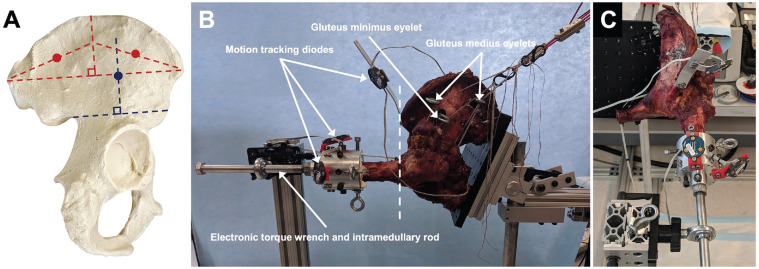
To (1) establish a reproducible biomechanical cadaveric model of the hip abductor complex and (2) characterize the effects of loading the GMin and GMed on extraneous femoral rotation and distraction.
Controlled laboratory study.
A total of 10 hemipelvises were tested in 4 muscle loading states: (1) unloaded, (2) the GMin loaded, (3) the GMed loaded, and (4) both the GMin and GMed loaded. Muscle loads were applied via cables, pulleys, and weights attached to the tendons to replicate the anatomic lines of action. Specimens were tested under internal rotation; external rotation; and axial traction forces at 0°, 15°, 30°, 60°, and 90° of hip flexion.
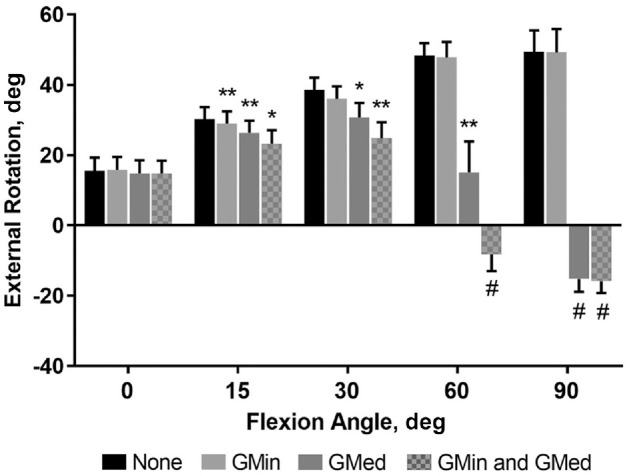
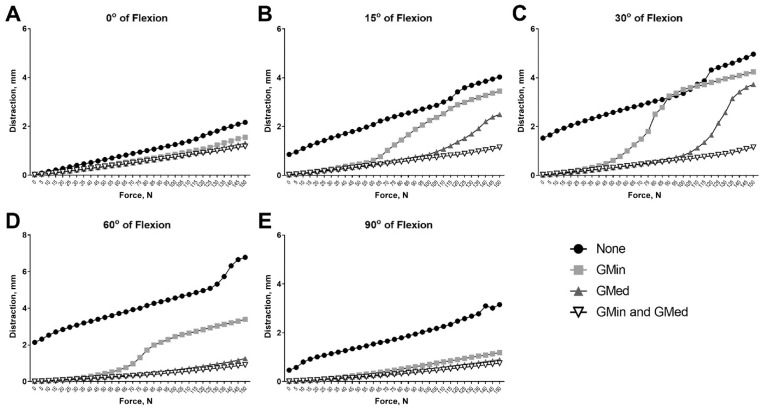
When loaded together, the GMin and GMed reduced internal rotation motion at all hip flexion angles ( < .05) except 60° and reduced external rotation motion at all hip flexion angles ( < .05) except 0°. Likewise, when both the GMin and GMed were loaded, femoral distraction was decreased at all angles of hip flexion ( < .05).
The results of this study demonstrated that the GMin and GMed provide stability against rotational torques and distractive forces and that the amount of contribution depends on the degree of hip flexion.
Improved understanding of the roles of the GMin and GMed in preventing rotational and distractive instability of the hip will better guide treatment of hip pathologies and optimize nonoperative and operative therapies.
臀小肌(GMin)和臀中肌(GMed)是髋关节重要的动态稳定器,但目前缺乏关于它们在稳定髋关节方面生物力学作用的定量数据。
(1)建立一种可重复的髋关节外展肌复合体生物力学尸体模型;(2)描述加载GMin和GMed对股骨额外旋转和牵张的影响。
对照实验室研究。
对10个半骨盆在4种肌肉加载状态下进行测试:(1)未加载;(2)加载GMin;(3)加载GMed;(4)同时加载GMin和GMed。通过连接到肌腱的缆绳、滑轮和重物施加肌肉负荷,以复制解剖作用线。在髋关节屈曲0°、15°、30°、60°和90°时,对标本进行内旋、外旋和轴向牵引力测试。
当同时加载时,GMin和GMed在除60°外的所有髋关节屈曲角度均减少内旋运动(P <.05),在除0°外的所有髋关节屈曲角度均减少外旋运动(P <.05)。同样,当同时加载GMin和GMed时,在所有髋关节屈曲角度股骨牵张均减少(P <.05)。
本研究结果表明,GMin和GMed可抵抗旋转扭矩和牵张力提供稳定性,且贡献量取决于髋关节屈曲程度。
更好地理解GMin和GMed在预防髋关节旋转和牵张不稳定中的作用,将更好地指导髋关节疾病的治疗,并优化非手术和手术治疗方法。