Li Feng, Yin Hui, Zhu Tianqiang, Zhuang Wen
School of Environmental Science and Engineering, Shandong University, Qingdao, Shandong 266237, China.
Institute of Marine Science and Technology, Shandong University, Qingdao 266237, China.
Eco Environ Health. 2024 Jan 23;3(1):89-106. doi: 10.1016/j.eehl.2024.01.002. eCollection 2024 Mar.
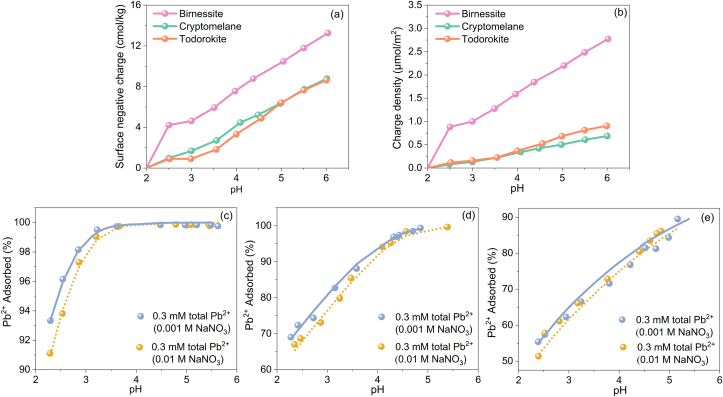
The increasing intensity of human activities has led to a critical environmental challenge: widespread metal pollution. Manganese (Mn) oxides have emerged as potentially natural scavengers that perform crucial functions in the biogeochemical cycling of metal elements. Prior reviews have focused on the synthesis, characterization, and adsorption kinetics of Mn oxides, along with the transformation pathways of specific layered Mn oxides. This review conducts a meticulous investigation of the molecular-level adsorption and oxidation mechanisms of Mn oxides on hazardous metals, including adsorption patterns, coordination, adsorption sites, and redox processes. We also provide a comprehensive discussion of both internal factors (surface area, crystallinity, octahedral vacancy content in Mn oxides, and reactant concentration) and external factors (pH, presence of doped or pre-adsorbed metal ions) affecting the adsorption/oxidation of metals by Mn oxides. Additionally, we identify existing gaps in understanding these mechanisms and suggest avenues for future research. Our goal is to enhance knowledge of Mn oxides' regulatory roles in metal element translocation and transformation at the microstructure level, offering a framework for developing effective metal adsorbents and pollution control strategies.
广泛的金属污染。锰(Mn)氧化物已成为潜在的天然清除剂,在金属元素的生物地球化学循环中发挥着关键作用。先前的综述主要集中在锰氧化物的合成、表征和吸附动力学,以及特定层状锰氧化物的转化途径。本综述对锰氧化物对有害金属的分子水平吸附和氧化机制进行了细致研究,包括吸附模式、配位、吸附位点和氧化还原过程。我们还全面讨论了影响锰氧化物对金属吸附/氧化的内部因素(表面积、结晶度、锰氧化物中的八面体空位含量和反应物浓度)和外部因素(pH值、掺杂或预吸附金属离子的存在)。此外,我们指出了在理解这些机制方面存在的差距,并提出了未来研究的方向。我们的目标是加强对锰氧化物在微观结构水平上对金属元素迁移和转化的调节作用的认识,为开发有效的金属吸附剂和污染控制策略提供一个框架。