Department of General Surgery, The Third Hospital of Nanchang, No. 2, Xiangshan South Road, Xihu District, Nanchang, Jiangxi, China.
Department of pediatrics, The Third Hospital of Nanchang, Nanchang, China.
Sci Rep. 2024 Mar 6;14(1):5486. doi: 10.1038/s41598-024-55812-0.
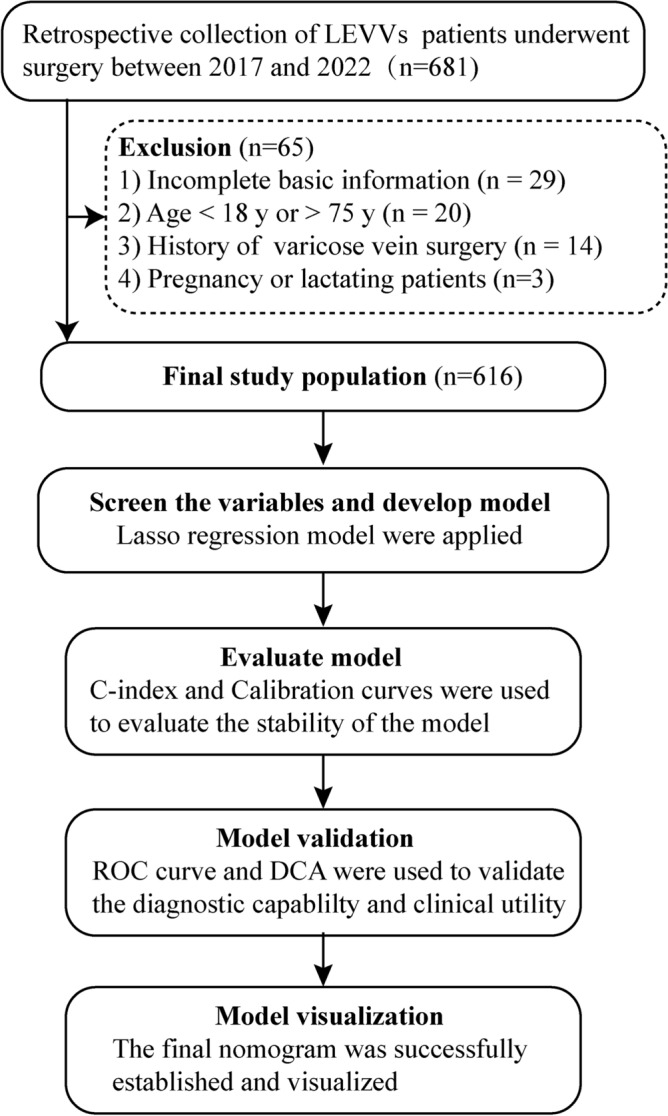
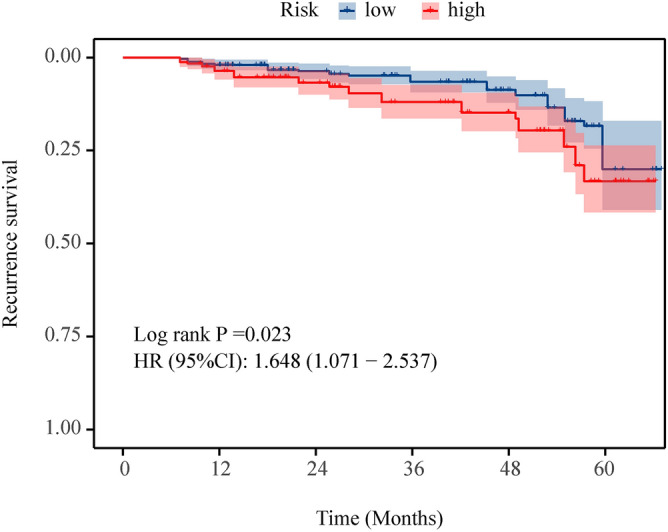
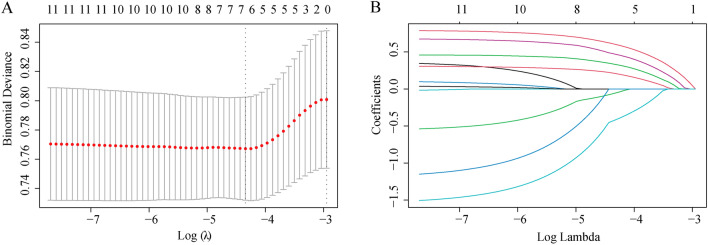
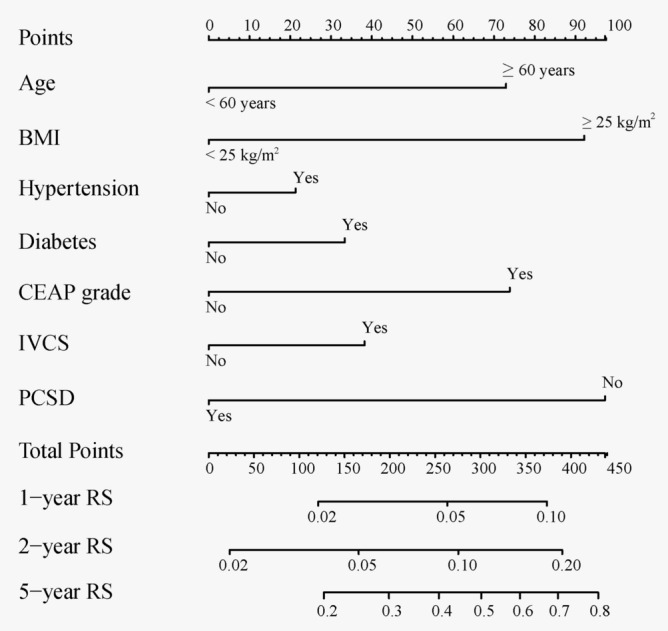
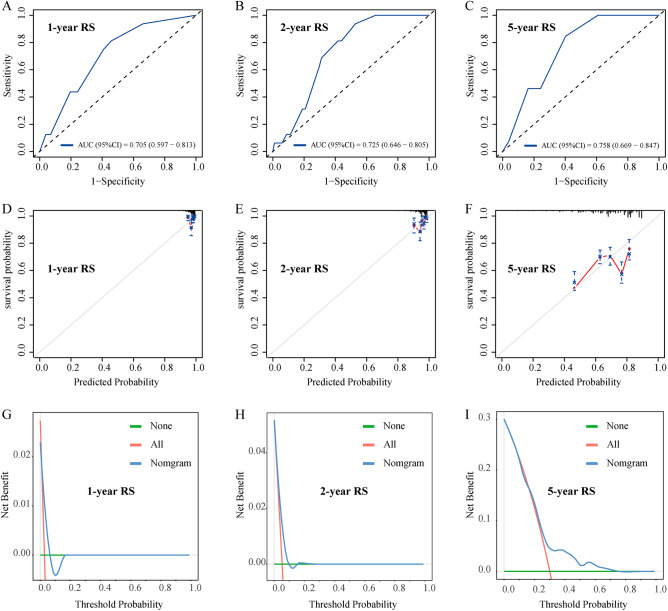
Varicose veins of the lower extremities (VVLEs) are prevalent globally. This study aims to identify prognostic factors and develop a prediction model for recurrence survival (RS) in VVLEs patients after surgery. A retrospective analysis of VVLEs patients from the Third Hospital of Nanchang was conducted between April 2017 and March 2022. A LASSO (Least Absolute Shrinkage and Selection Operator) regression model pinpointed significant recurrence predictors, culminating in a prognostic nomogram. The model's performance was evaluated by C-index, receiver operating characteristic (ROC) curves, calibration plots, and decision curve analysis (DCA). The LASSO regression identified seven predictors for the nomogram predicting 1-, 2-, and 5-year RS. These predictors were age, body mass index (BMI), hypertension, diabetes, the Clinical Etiological Anatomical Pathophysiological (CEAP) grade, iliac vein compression syndrome (IVCS), and postoperative compression stocking duration (PCSD). The nomogram's C-index was 0.716, with AUCs (Area Under the Curve scores) of 0.705, 0.725, and 0.758 for 1-, 2-, and 5-year RS, respectively. Calibration and decision curve analyses validated the model's predictive accuracy and clinical utility. Kaplan-Meier analysis distinguished between low and high-risk groups with significant prognostic differences (P < 0.05). This study has successfully developed and validated a nomogram for predicting RS in patients with VVLEs after surgery, enhancing personalized care and informing clinical decision-making.
下肢静脉曲张(VVLEs)在全球范围内普遍存在。本研究旨在确定下肢静脉曲张患者手术后复发生存(RS)的预后因素,并建立预测模型。对 2017 年 4 月至 2022 年 3 月南昌三院的 VVLEs 患者进行了回顾性分析。LASSO(最小绝对值收缩和选择算子)回归模型确定了显著的复发预测因素,最终得出了预测诺模图。通过 C 指数、接收者操作特征(ROC)曲线、校准图和决策曲线分析(DCA)评估模型的性能。LASSO 回归确定了用于预测 1 年、2 年和 5 年 RS 的 nomogram 的七个预测因子。这些预测因子是年龄、体重指数(BMI)、高血压、糖尿病、临床病因解剖病理生理(CEAP)分级、髂静脉压迫综合征(IVCS)和术后压迫弹力袜持续时间(PCSD)。诺模图的 C 指数为 0.716,1 年、2 年和 5 年 RS 的 AUC(曲线下面积评分)分别为 0.705、0.725 和 0.758。校准和决策曲线分析验证了模型的预测准确性和临床实用性。Kaplan-Meier 分析区分了低风险和高风险组,两组之间存在显著的预后差异(P<0.05)。本研究成功地为下肢静脉曲张患者手术后的 RS 预测建立了 nomogram,增强了个性化护理,并为临床决策提供了信息。