Hermanns Thomas, Wettstein Marian S, Kaufmann Basil, Lautenbach Noémie, Kaufmann Ernest, Saba Karim, Schmid Florian A, Hötker Andreas M, Müntener Michael, Umbehr Martin, Poyet Cédric
Department of Urology, University Hospital Zürich, University of Zürich, Zürich, Switzerland.
Institute of Diagnostic and Interventional Radiology, University Hospital Zurich, University of Zurich, Zurich, Switzerland.
Front Oncol. 2024 Feb 21;14:1343999. doi: 10.3389/fonc.2024.1343999. eCollection 2024.
To develop a novel biopsy prostate cancer (PCa) prevention calculator (BioPrev-C) using data from a prospective cohort all undergoing mpMRI targeted and transperineal template saturation biopsy.
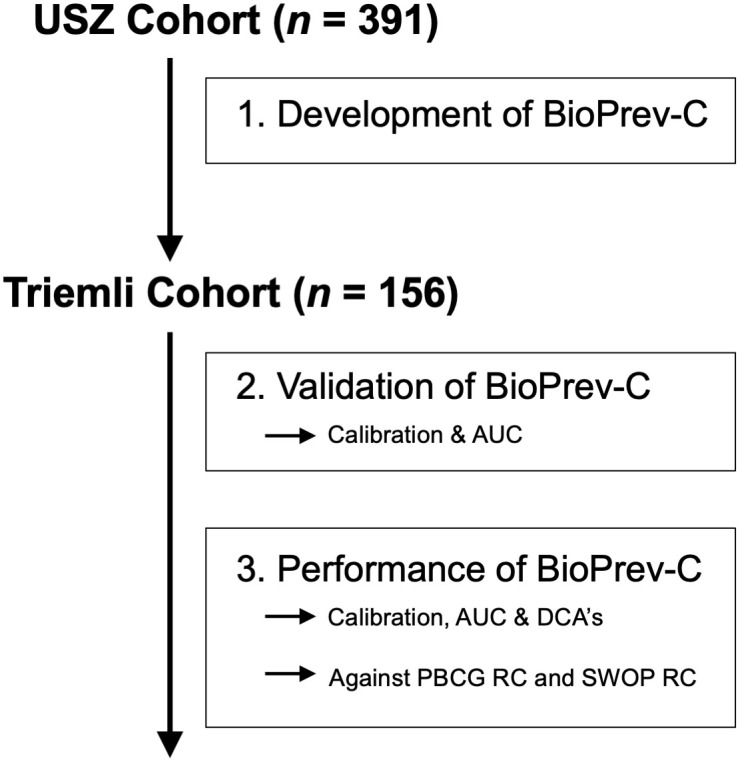
Data of all men who underwent prostate biopsy in our academic tertiary care center between 11/2016 and 10/2019 was prospectively collected. We developed a clinical prediction model for the detection of high-grade PCa (Gleason score ≥7) based on a multivariable logistic regression model incorporating age, PSA, prostate volume, digital rectal examination, family history, previous negative biopsy, 5-alpha-reductase inhibitor use and MRI PI-RADS score. BioPrev-C performance was externally validated in another prospective Swiss cohort and compared with two other PCa risk-calculators (SWOP-RC and PBCG-RC).
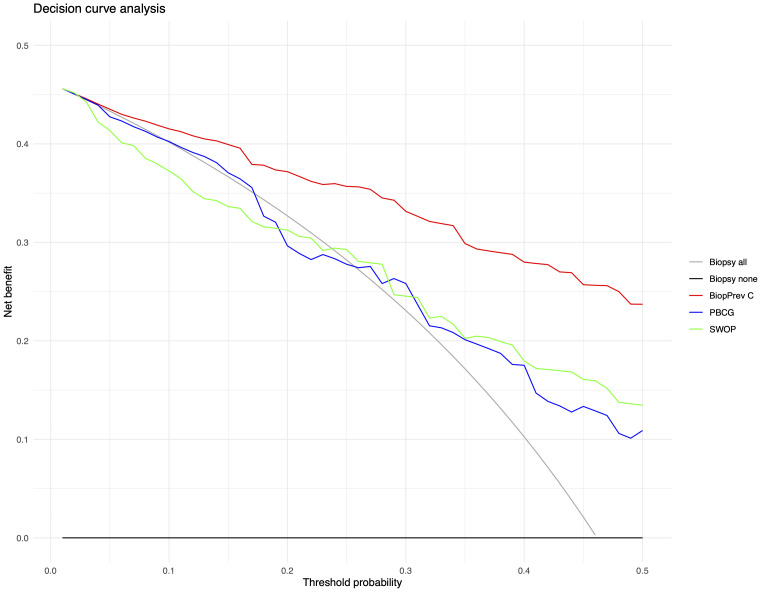
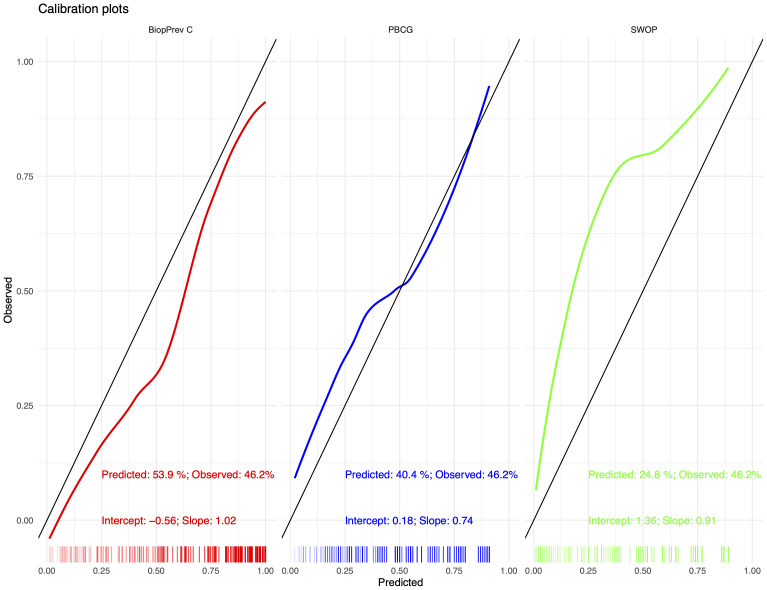
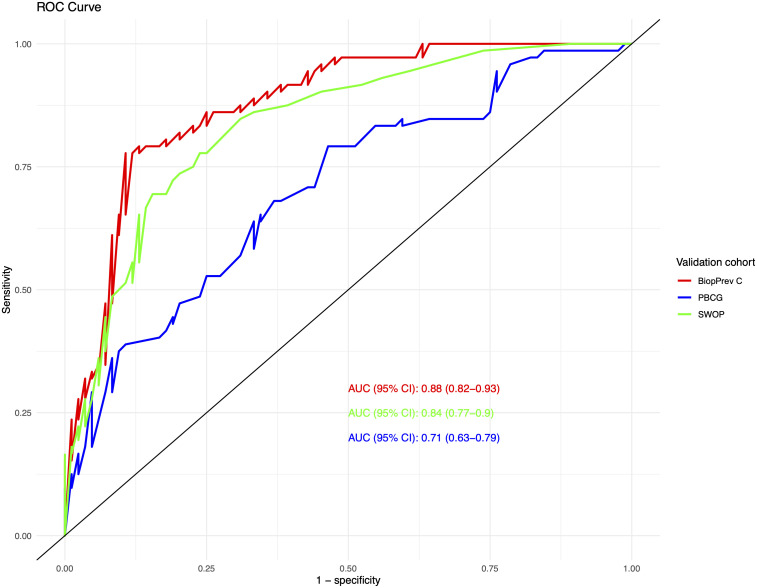
Of 391 men in the development cohort, 157 (40.2%) were diagnosed with high-grade PCa. Validation of the BioPrev C revealed good discrimination with an area under the curve for high-grade PCa of 0.88 (95% Confidence Interval 0.82-0.93), which was higher compared to the other two risk calculators (0.71 for PBCG and 0.84 for SWOP). The BioPrev-C revealed good calibration in the low-risk range (0 - 0.25) and moderate overestimation in the intermediate risk range (0.25 - 0.75). The PBCG-RC showed good calibration and the SWOP-RC constant underestimation of high-grade PCa over the whole prediction range. Decision curve analyses revealed a clinical net benefit for the BioPrev-C at a clinical meaningful threshold probability range (≥4%), whereas PBCG and SWOP calculators only showed clinical net benefit above a 30% threshold probability.
BiopPrev-C is a novel contemporary risk calculator for the prediction of high-grade PCa. External validation of the BioPrev-C revealed relevant clinical benefit, which was superior compared to other well-known risk calculators. The BioPrev-C has the potential to significantly and safely reduce the number of men who should undergo a prostate biopsy.
利用来自一个前瞻性队列的数据开发一种新型活检前列腺癌(PCa)预防计算器(BioPrev-C),该队列中的所有患者均接受了多参数磁共振成像(mpMRI)靶向和经会阴模板饱和活检。
前瞻性收集了2016年11月至2019年10月期间在我们学术性三级医疗中心接受前列腺活检的所有男性的数据。我们基于多变量逻辑回归模型开发了一种用于检测高级别PCa(Gleason评分≥7)的临床预测模型,该模型纳入了年龄、前列腺特异性抗原(PSA)、前列腺体积、直肠指检、家族史、既往活检阴性、5α-还原酶抑制剂使用情况和MRI前列腺影像报告和数据系统(PI-RADS)评分。BioPrev-C的性能在另一个前瞻性瑞士队列中进行了外部验证,并与其他两种PCa风险计算器(SWOP-RC和PBCG-RC)进行了比较。
在开发队列的391名男性中,157名(40.2%)被诊断为高级别PCa。BioPrev C的验证显示出良好的区分度,高级别PCa的曲线下面积为0.88(95%置信区间0.82 - 0.93),高于其他两种风险计算器(PBCG为0.71,SWOP为0.84)。BioPrev-C在低风险范围(0 - 0.25)显示出良好的校准,在中等风险范围(0.25 - 0.75)存在中度高估。PBCG-RC显示出良好的校准,而SWOP-RC在整个预测范围内持续低估高级别PCa。决策曲线分析显示,在具有临床意义的阈值概率范围(≥4%)内,BioPrev-C具有临床净效益,而PBCG和SWOP计算器仅在阈值概率高于30%时显示出临床净效益。
BioPrev-C是一种用于预测高级别PCa的新型当代风险计算器。BioPrev-C的外部验证显示出相关的临床益处,优于其他知名风险计算器。BioPrev-C有可能显著且安全地减少应接受前列腺活检的男性人数。