Köser Andrea, Eimer Christine, Feth Maximilian, Lorenzen Ulf, Seewald Stephan, Lehn Henrik, Corzillius Michael, Schmalbach Bjarne, Reifferscheid Florian
Klinik für Anästhesiologie und operative Intensivmedizin, Campus Kiel, Universitätsklinikum Schleswig-Holstein, Arnold-Heller-Straße 3, 24105, Kiel, Deutschland.
Interdisziplinäre Notaufnahme und Aufnahmestation, Campus Kiel, Universitätsklinikum Schleswig-Holstein, Arnold-Heller-Straße 3, 24105, Kiel, Deutschland.
Med Klin Intensivmed Notfmed. 2025 Feb;120(1):57-64. doi: 10.1007/s00063-024-01119-x. Epub 2024 Mar 7.
The need for interhospital transport (IHT) of intensive care patients is increasing due to changes in the hospital environment. Interhospital transports are challenging and require careful operational planning of personnel and rescue vehicles.
To investigate the need for IHT, an analysis was conducted in the service area of the emergency medical service central dispatch center (IRLS) in Schleswig-Holstein.
Emergency physician-assisted IHT were analyzed in the period from 01.10.2021 to 30.09.2022.
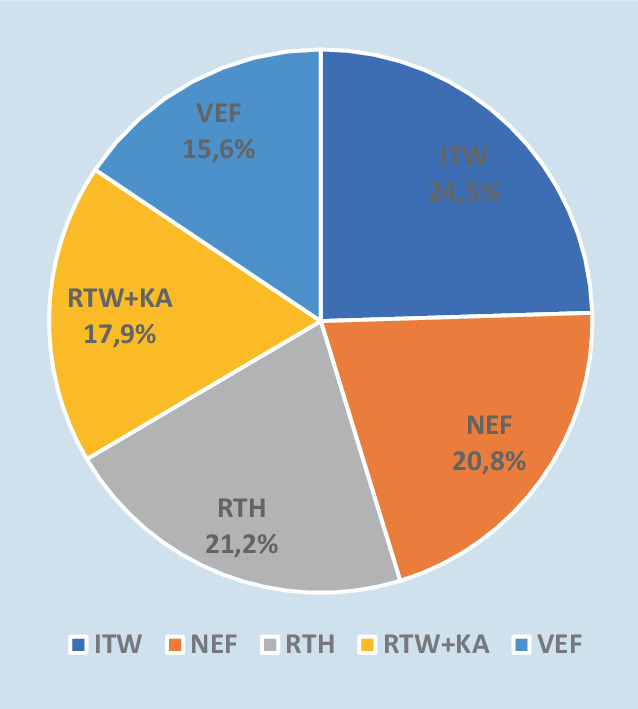
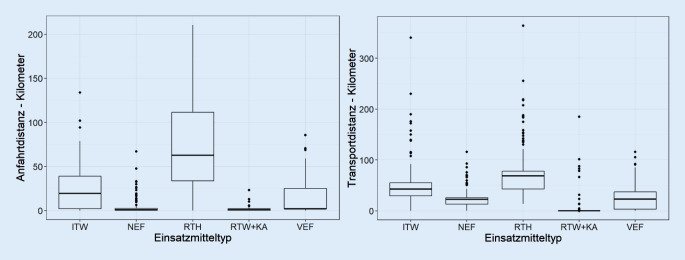
Of a total of 158,823 documented IRLS missions, 2264 (1.4%) records could be identified and included as IHT: 1389 IHT (61.4%) were managed by specialized ambulances, 875 (38.6%) by primary care ambulances. Primary care ambulances were mainly used for time-critical transfers and outside the duty hours of the intensive care ambulances, 21.2 % were by air. Of all IHT, 43.1% were required to hospitals with a higher level of medical care.
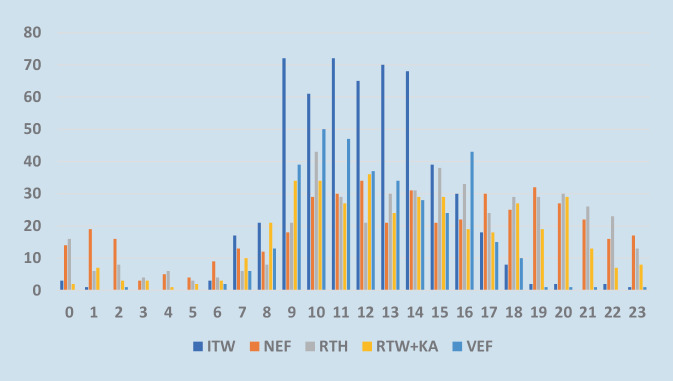
Emergency physician-assisted IHT are a relevant part of the emergency service's operational spectrum and concern both primary care and specialized rescue vehicles. A relevant number of urgent IHT were recorded outside the duty hours of the intensive care ambulances. For emergency transports during nighttime, an expansion of air-based transfer capacities should be considered due to the time advantage. For less urgent IHT, an adjustment of the capacities of specialized ground-based vehicles in Schleswig-Holstein seems reasonable.
由于医院环境的变化,重症监护患者的院际转运(IHT)需求不断增加。院际转运具有挑战性,需要对人员和救援车辆进行精心的运营规划。
为调查院际转运的需求,在石勒苏益格-荷尔斯泰因州紧急医疗服务中央调度中心(IRLS)的服务区域内进行了一项分析。
对2021年10月1日至2022年9月30日期间由急诊医生协助的院际转运进行了分析。
在总共158,823次记录在案的IRLS任务中,有2264条记录(1.4%)可被识别并纳入院际转运:1389次院际转运(61.4%)由专业救护车管理,875次(38.6%)由初级保健救护车管理。初级保健救护车主要用于时间紧迫的转运以及重症监护救护车工作时间之外的转运,21.2%的转运通过空中进行。在所有院际转运中,43.1%是前往医疗护理水平更高的医院。
急诊医生协助的院际转运是紧急服务运营范围的一个相关组成部分,涉及初级保健和专业救援车辆。在重症监护救护车工作时间之外记录到了相当数量的紧急院际转运。对于夜间的紧急转运,由于时间优势,应考虑扩大空中转运能力。对于不太紧急的院际转运,调整石勒苏益格-荷尔斯泰因州专业地面车辆的运力似乎是合理的。