Usman Ifrah, Sana Saima, Afzaal Muhammad, Imran Ali, Saeed Farhan, Ahmed Aftab, Shah Yasir Abbas, Munir Muniba, Ateeq Huda, Afzal Atka, Azam Iqra, Ejaz Afaf, Nayik Gulzar Ahmad, Khan Mahbubar Rahman
Department of Food Sciences Government College University Faisalabad Faisalabad Pakistan.
University Institute of Food Science and Technology, The University of Lahore Lahore Pakistan.
Food Sci Nutr. 2023 Dec 7;12(3):1430-1443. doi: 10.1002/fsn3.3870. eCollection 2024 Mar.
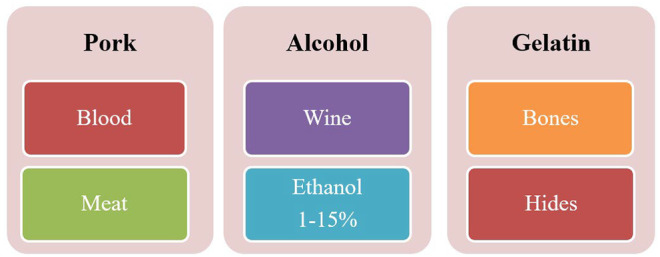
Food is one of the most necessary needs since human civilization. For Muslims, it is mandatory to consume halal food. From a halal authentication perspective, adulteration of food products is an emerging challenge worldwide. The demand for halal food consumption has resulted in an ever-increasing need for halal product validity. In the market, there are several food products in which actual ingredients and their source are not mentioned on the label and cannot be observed by the naked eye. Commonly nonhalal items include pig derivatives like lard, pork, and gelatin derivatives, dead meats, alcohol, blood, and prohibited animals. Purposely, various conventional and modern methods offer precise approaches to ensure the halalness and wholesomeness of food products. Conventional methods are physiochemical (dielectric) and electrophoresis. At the same time, modern techniques include high-pressure liquid chromatography (HPLC), gas chromatography (GC), electronic nose (E-Nose), polymerase chain reaction (PCR), enzyme-linked immunosorbent assay (ELISA), differential scanning calorimetry (DSC), nuclear magnetic resonance (NMR), near-infrared (NIR) spectroscopy, and Fourier transform infrared (FTIR) spectroscopy. This review intends to give an extensive and updated overview of conventional and modern analytical methods for ensuring food halal authenticity.
自人类文明以来,食物就是最基本的需求之一。对于穆斯林而言,食用清真食品是必须的。从清真认证的角度来看,食品掺假是全球范围内一个新出现的挑战。对清真食品消费的需求导致对清真产品有效性的需求不断增加。在市场上,有几种食品的标签上没有提及实际成分及其来源,肉眼也无法观察到。常见的非清真物品包括猪油、猪肉和明胶衍生物等猪的衍生物、死肉、酒精、血液以及禁食动物。有意地,各种传统和现代方法提供了精确的途径来确保食品的清真性和安全性。传统方法有物理化学(介电)法和电泳法。同时,现代技术包括高压液相色谱法(HPLC)、气相色谱法(GC)、电子鼻(E-Nose)、聚合酶链反应(PCR)、酶联免疫吸附测定(ELISA)、差示扫描量热法(DSC)、核磁共振(NMR)、近红外(NIR)光谱法和傅里叶变换红外(FTIR)光谱法。本综述旨在对确保食品清真真实性的传统和现代分析方法进行广泛且最新的概述。