Istituto Nazionale Tumori di Napoli, IRCCS "G. Pascale", Napoli, Italy.
Medical Oncology Unit, Ospedale del Mare, Napoli, Italy.
Cancer Med. 2024 Feb;13(4):e6892. doi: 10.1002/cam4.6892.
Cholangiocarcinoma (CCA), a rare and aggressive hepatobiliary malignancy, presents significant clinical management challenges. Despite rising incidence and evolving treatment options, prognosis remains poor, motivating the exploration of real-world data for enhanced understanding and patient care.
This multicenter study analyzed data from 120 metastatic CCA patients at three institutions from 2016 to 2023. Kaplan-Meier curves assessed overall survival (OS), while univariate and multivariate analyses evaluated links between clinical variables (age, gender, tumor site, metastatic burden, ECOG performance status, response to first-line chemotherapy) and OS. Genetic profiling was conducted selectively.
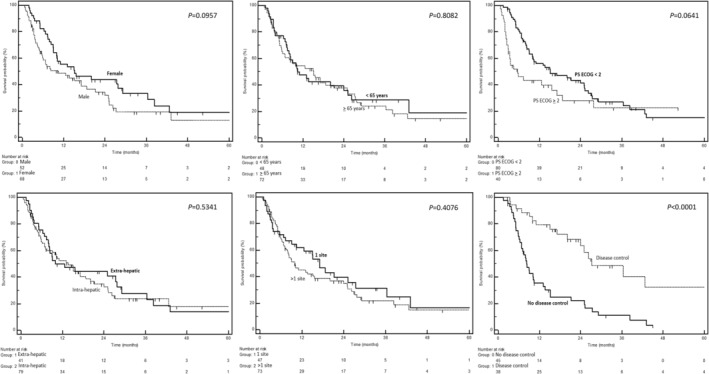
Enrolled patients had a median age of 68.5 years, with intrahepatic tumors predominant in 79 cases (65.8%). Among 85 patients treated with first-line chemotherapy, cisplatin and gemcitabine (41.1%) was the most common regimen. Notably, one-third received no systemic treatment. After a median 14-month follow-up, 81 CCA-related deaths occurred, with a median survival of 13.1 months. Two clinical variables independently predicted survival: response to first-line chemotherapy (disease control vs. no disease control; HR: 0.27; 95% CI: 0.14-0.50; p < 0.0001) and metastatic involvement (>1 site vs. 1 site; HR: 1.99; 95% CI: 1.04-3.80; p = 0.0366). The three most common genetic alterations involved the ARID1A, tp53, and CDKN2A genes.
Advanced CCA displays aggressive clinical behavior, emphasizing the need for treatments beyond chemotherapy. Genetic diversity supports potential personalized therapies. Collaborative research and deeper CCA biology understanding are crucial to enhance patient outcomes in this challenging malignancy.
胆管癌(CCA)是一种罕见且侵袭性的肝胆恶性肿瘤,其临床管理极具挑战性。尽管发病率不断上升且治疗选择不断发展,但其预后仍然较差,这促使我们探索真实世界的数据以增进理解并改善患者的护理。
这项多中心研究分析了 2016 年至 2023 年来自三个机构的 120 例转移性 CCA 患者的数据。通过 Kaplan-Meier 曲线评估总生存期(OS),同时进行单变量和多变量分析,以评估临床变量(年龄、性别、肿瘤部位、转移负担、ECOG 表现状态、一线化疗反应)与 OS 之间的关联。有选择地进行了基因谱分析。
入组患者的中位年龄为 68.5 岁,其中 79 例(65.8%)为肝内肿瘤。在 85 例接受一线化疗治疗的患者中,顺铂和吉西他滨(41.1%)是最常见的方案。值得注意的是,有三分之一的患者未接受任何系统治疗。在中位随访 14 个月后,发生了 81 例与 CCA 相关的死亡,中位生存期为 13.1 个月。有两个临床变量独立地预测了生存情况:一线化疗的反应(疾病控制与无疾病控制;HR:0.27;95%CI:0.14-0.50;p<0.0001)和转移受累部位(>1 个部位与 1 个部位;HR:1.99;95%CI:1.04-3.80;p=0.0366)。涉及 ARID1A、tp53 和 CDKN2A 基因的三种最常见的基因改变。
晚期 CCA 表现出侵袭性的临床行为,强调需要超越化疗的治疗方法。基因多样性支持潜在的个体化治疗。协作研究和对 CCA 生物学的更深入理解对于改善这种具有挑战性的恶性肿瘤患者的预后至关重要。