Department of Gastrointestinal Surgery, The First Affiliated Hospital, Sun Yat-sen University, Guangzhou, Guangdong, 510080, China.
Department of Gastrointestinal Surgery, Xiang'an Hospital of Xiamen University, School of Medicine, Xiamen University, Xiamen, Fujian, 361000, China.
Cell Death Dis. 2024 Mar 8;15(3):196. doi: 10.1038/s41419-024-06584-y.
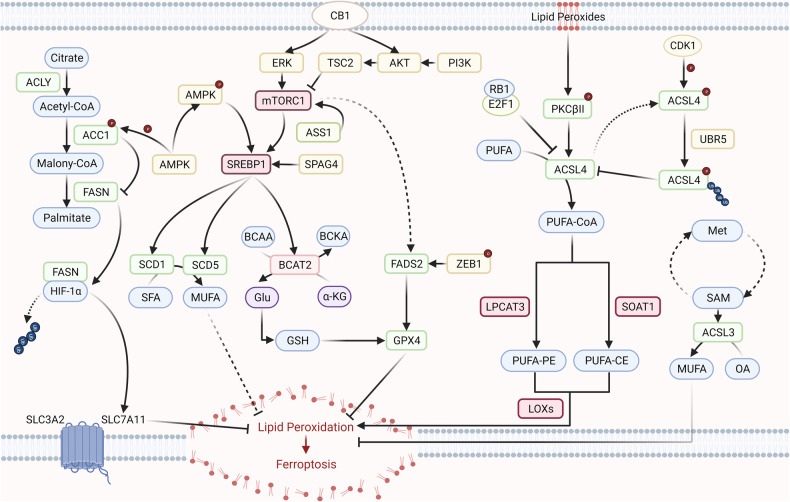
Cancer metabolism mainly includes carbohydrate, amino acid and lipid metabolism, each of which can be reprogrammed. These processes interact with each other to adapt to the complicated microenvironment. Ferroptosis is a regulated cell death induced by iron-dependent lipid peroxidation, which is morphologically different from apoptosis, necrosis, necroptosis, pyroptosis, autophagy-dependent cell death and cuprotosis. Cancer metabolism plays opposite roles in ferroptosis. On the one hand, carbohydrate metabolism can produce NADPH to maintain GPX4 and FSP1 function, and amino acid metabolism can provide substrates for synthesizing GPX4; on the other hand, lipid metabolism might synthesize PUFAs to trigger ferroptosis. The mechanisms through which cancer metabolism affects ferroptosis have been investigated extensively for a long time; however, some mechanisms have not yet been elucidated. In this review, we summarize the interaction between cancer metabolism and ferroptosis. Importantly, we were most concerned with how these targets can be utilized in cancer therapy.
癌症代谢主要包括碳水化合物、氨基酸和脂质代谢,它们都可以被重新编程。这些过程相互作用,以适应复杂的微环境。铁死亡是一种由铁依赖性脂质过氧化引起的受调控的细胞死亡,其形态与细胞凋亡、坏死、坏死性凋亡、细胞焦亡、自噬依赖性细胞死亡和铜死亡不同。癌症代谢在铁死亡中起着相反的作用。一方面,碳水化合物代谢可以产生 NADPH 来维持 GPX4 和 FSP1 的功能,氨基酸代谢可以为合成 GPX4 提供底物;另一方面,脂质代谢可能会合成多不饱和脂肪酸以引发铁死亡。长期以来,人们一直在广泛研究癌症代谢影响铁死亡的机制;然而,有些机制尚未阐明。在这篇综述中,我们总结了癌症代谢与铁死亡之间的相互作用。重要的是,我们最关注的是这些靶点如何能被应用于癌症治疗。