Department of Biostatistics, University of Kentucky, Lexington, Kentucky, USA.
Sanders-Brown Center on Aging, University of Kentucky, Lexington, Kentucky, USA.
Alzheimers Dement. 2024 Apr;20(4):2906-2921. doi: 10.1002/alz.13741. Epub 2024 Mar 9.
Although dementia-related proteinopathy has a strong negative impact on public health, and is highly heritable, understanding of the related genetic architecture is incomplete.
We applied multidimensional generalized partial credit modeling (GPCM) to test genetic associations with dementia-related proteinopathies. Data were analyzed to identify candidate single nucleotide variants for the following proteinopathies: Aβ, tau, α-synuclein, and TDP-43.
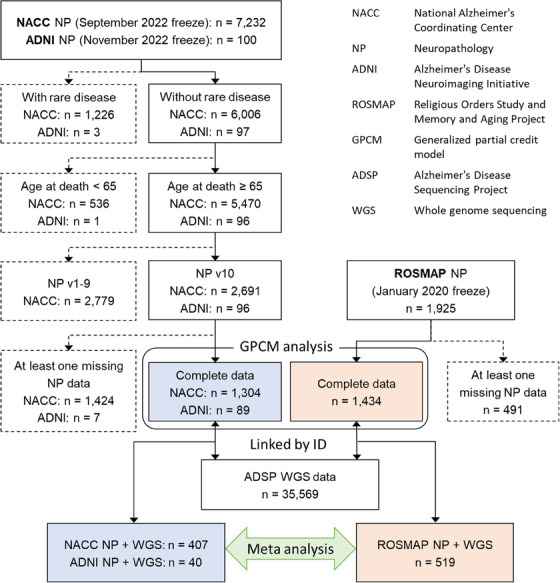
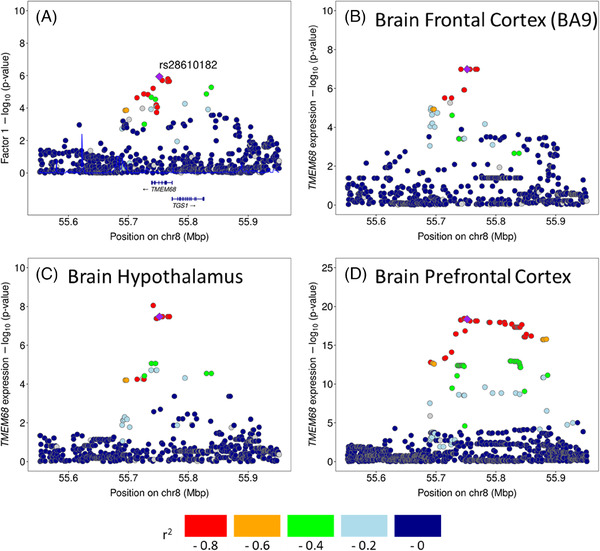
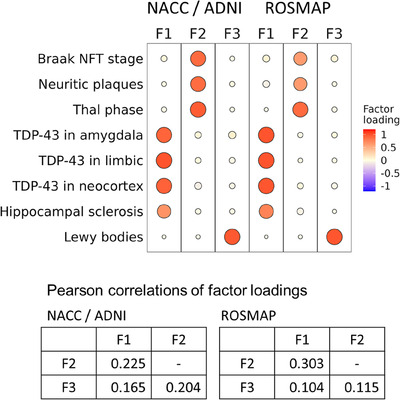
Final included data comprised 966 participants with neuropathologic and WGS data. Three continuous latent outcomes were constructed, corresponding to TDP-43-, Aβ/Tau-, and α-synuclein-related neuropathology endophenotype scores. This approach helped validate known genotype/phenotype associations: for example, TMEM106B and GRN were risk alleles for TDP-43 pathology; and GBA for α-synuclein/Lewy bodies. Novel suggestive proteinopathy-linked alleles were also discovered, including several (SDHAF1, TMEM68, and ARHGEF28) with colocalization analyses and/or high degrees of biologic credibility.
A novel methodology using GPCM enabled insights into gene candidates for driving misfolded proteinopathies.
Latent factor scores for proteinopathies were estimated using a generalized partial credit model. The three latent continuous scores corresponded well with proteinopathy severity. Novel genes associated with proteinopathies were identified. Several genes had high degrees of biologic credibility for dementia risk factors.
尽管与痴呆相关的蛋白病变对公共健康有很强的负面影响,且具有高度遗传性,但相关遗传结构的理解仍不完整。
我们应用多维广义部分信用模型(GPCM)来测试与痴呆相关蛋白病变的遗传关联。通过数据分析,确定了以下蛋白病变的候选单核苷酸变异:Aβ、tau、α-synuclein 和 TDP-43。
最终纳入的数据分析包括 966 名具有神经病理学和 WGS 数据的参与者。构建了三个连续的潜在结果,分别对应于 TDP-43、Aβ/Tau-和 α-synuclein 相关神经病理学表型评分。这种方法有助于验证已知的基因型/表型关联:例如,TMEM106B 和 GRN 是 TDP-43 病变的风险等位基因;GBA 是α-synuclein/Lewy 体的风险等位基因。还发现了新的提示蛋白病变相关的等位基因,包括几个(SDHAF1、TMEM68 和 ARHGEF28),这些基因与共定位分析和/或高度的生物学可信度相关。
使用 GPCM 的新方法能够深入了解驱动错误折叠蛋白病变的候选基因。
使用广义部分信用模型估计蛋白病变的潜在因子分数。三个潜在的连续分数与蛋白病变的严重程度很好地对应。确定了与蛋白病变相关的新基因。几个基因对痴呆风险因素具有高度的生物学可信度。