Sol Joaquim, Jové Mariona, Povedano Monica, Sproviero William, Domínguez Raul, Piñol-Ripoll Gerard, Romero-Guevara Ricardo, Hye Abdul, Al-Chalabi Ammar, Torres Pascual, Andres-Benito Pol, Area-Gómez Estela, Pamplona Reinald, Ferrer Isidro, Ayala Victòria, Portero-Otín Manuel
Metabolic Physiopathology Research Group, Experimental Medicine Department, Lleida University-Lleida Biochemical Research Institute (UdL-IRBLleida), Lleida, Spain.
Institut Català de la Salut, Atenció Primària, Lleida, Spain.
Brain Commun. 2021 Jun 26;3(3):fcab143. doi: 10.1093/braincomms/fcab143. eCollection 2021.
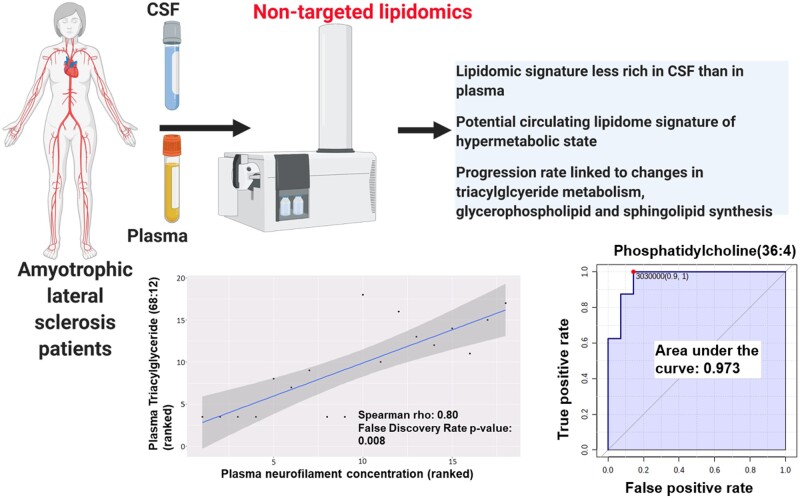
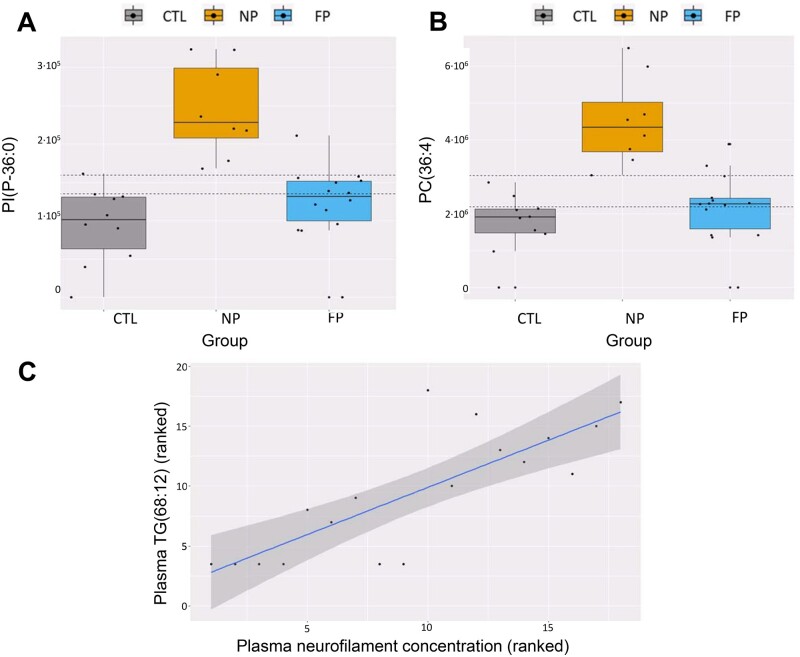
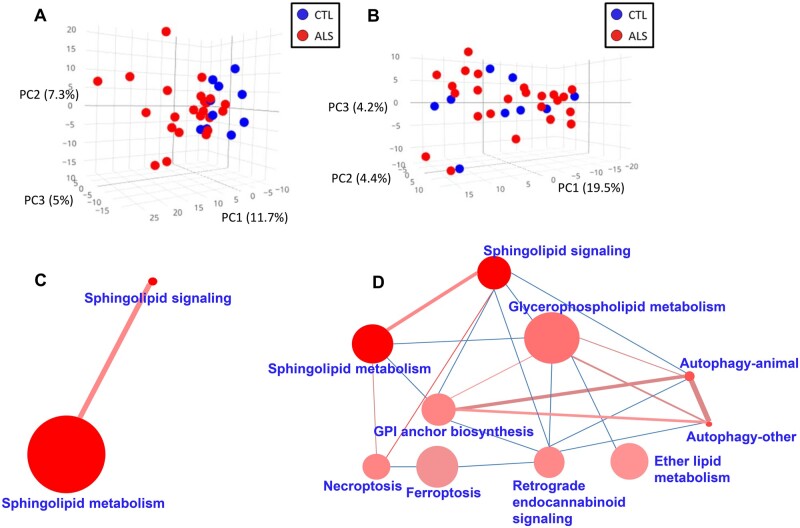
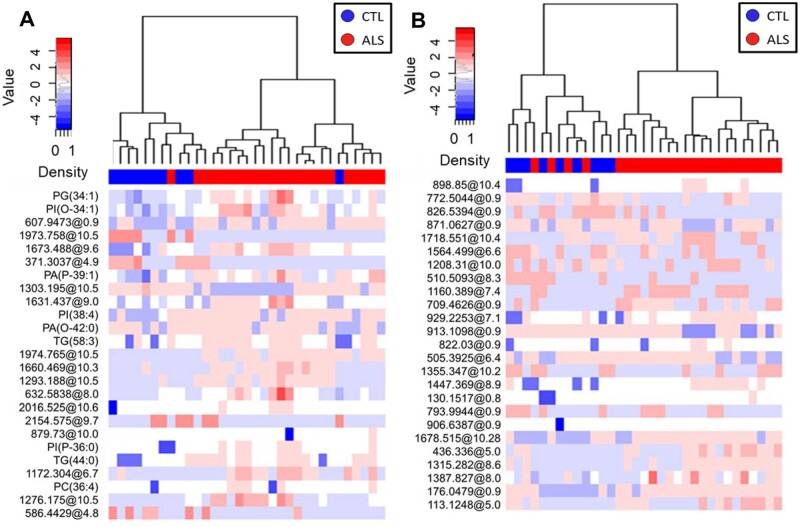
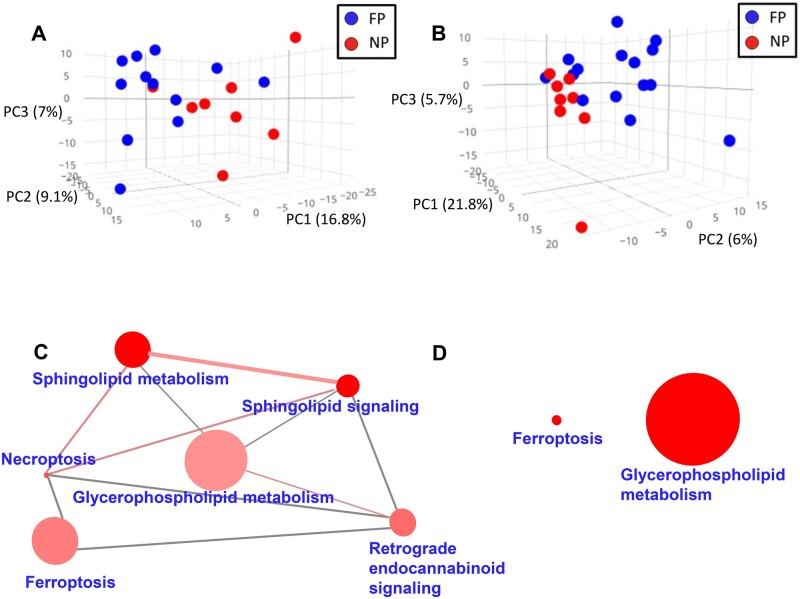
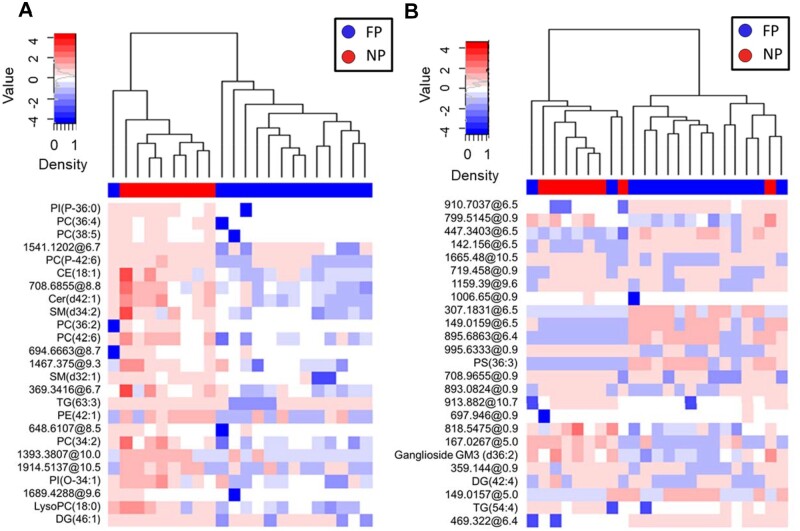
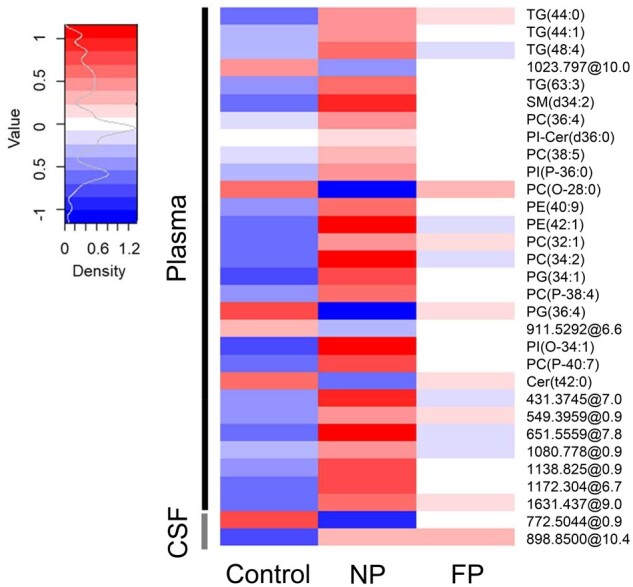
Since amyotrophic lateral sclerosis cases exhibit significant heterogeneity, we aim to investigate the association of lipid composition of plasma and CSF with amyotrophic lateral sclerosis diagnosis, its progression and clinical characteristics. Lipidome analyses would help to stratify patients on a molecular basis. For this reason, we have analysed the lipid composition of paired plasma and CSF samples from amyotrophic lateral sclerosis cases and age-matched non-amyotrophic lateral sclerosis individuals (controls) by comprehensive liquid chromatography coupled to mass spectrometry. The concentrations of neurofilament light chain-an index of neuronal damage-were also quantified in CSF samples and plasma. Amyotrophic lateral sclerosis versus control comparison, in a moderate stringency mode, showed that plasma from cases contains more differential lipids ( = 122 for raw < 0.05; = 27 for < 0.01) than CSF ( = 17 for raw < 0.05; = 4 for < 0.01), with almost no overlapping differential species, mainly characterized by an increased content of triacylglyceride species in plasma and decreased in CSF. Of note, false discovery rate correction indicated that one of the CSF lipids (monoacylglycerol 18:0) had high statistic robustness (false discovery rate- < 0.01). Plasma lipidomes also varied significantly with the main involvement at onset (bulbar, spinal or respiratory). Notably, faster progression cases showed particular lipidome fingerprints, featured by decreased triacylclycerides and specific phospholipids in plasma, with 11 lipids with false discovery rate- < 0.1 ( = 56 lipids in plasma for raw < 0.01). Lipid species associated with progression rate clustered in a relatively low number of metabolic pathways, mainly triacylglyceride metabolism and glycerophospholipid and sphingolipid biosynthesis. A specific triacylglyceride (68:12), correlated with neurofilament content ( = 0.8, < 0.008). Thus, the present findings suggest that systemic hypermetabolism-potentially sustained by increased triacylglyceride content-and CNS alterations of specific lipid pathways could be associated as modifiers of disease progression. Furthermore, these results confirm biochemical lipid heterogeneity in amyotrophic lateral sclerosis with different presentations and progression, suggesting the use of specific lipid species as potential disease classifiers.
由于肌萎缩侧索硬化症病例表现出显著的异质性,我们旨在研究血浆和脑脊液的脂质组成与肌萎缩侧索硬化症诊断、病情进展及临床特征之间的关联。脂质组分析将有助于在分子基础上对患者进行分层。因此,我们通过综合液相色谱-质谱联用技术,分析了肌萎缩侧索硬化症病例及年龄匹配的非肌萎缩侧索硬化症个体(对照)的配对血浆和脑脊液样本的脂质组成。还对脑脊液样本和血浆中的神经丝轻链浓度(神经元损伤指标)进行了定量分析。在中等严格模式下,肌萎缩侧索硬化症与对照组的比较显示,病例组血浆中含有的差异脂质更多(原始P<0.05时为122种;P<0.01时为27种),而脑脊液中的差异脂质较少(原始P<0.05时为17种;P<0.01时为4种),几乎没有重叠的差异物种,主要特征是血浆中三酰甘油物种含量增加,而脑脊液中减少。值得注意的是,错误发现率校正表明,脑脊液中的一种脂质(单酰甘油18:0)具有较高的统计稳健性(错误发现率<0.01)。血浆脂质组也因发病时的主要受累部位(延髓、脊髓或呼吸)而有显著差异。值得注意的是,进展较快的病例表现出特定的脂质组指纹,其特征是血浆中三酰甘油和特定磷脂减少,有11种脂质的错误发现率<0.1(原始P<0.01时血浆中有56种脂质)。与进展速度相关的脂质物种聚集在相对较少的代谢途径中,主要是三酰甘油代谢以及甘油磷脂和鞘脂生物合成。一种特定的三酰甘油(68:12)与神经丝含量相关(r=0.8,P<0.008)。因此,目前的研究结果表明,全身代谢亢进(可能由三酰甘油含量增加维持)和特定脂质途径的中枢神经系统改变可能作为疾病进展的调节因素相关联。此外,这些结果证实了肌萎缩侧索硬化症在不同表现和进展中的生化脂质异质性,提示使用特定的脂质物种作为潜在的疾病分类指标。