Department of Oncology, The First Affiliated Hospital of Anhui Medical University, Hefei, Anhui, China; Innovation and Entrepreneurship Laboratory for College Students, Anhui Medical University, Hefei, Anhui, China; Inflammation and Immune-Mediated Diseases Laboratory of Anhui Province, Anhui Medical University, Hefei, Anhui, China.
Innovation and Entrepreneurship Laboratory for College Students, Anhui Medical University, Hefei, Anhui, China; The First School of Clinical Medicine, Anhui Medical University, Hefei, Anhui, China.
Cell Mol Gastroenterol Hepatol. 2024;18(1):41-52. doi: 10.1016/j.jcmgh.2024.03.001. Epub 2024 Mar 8.
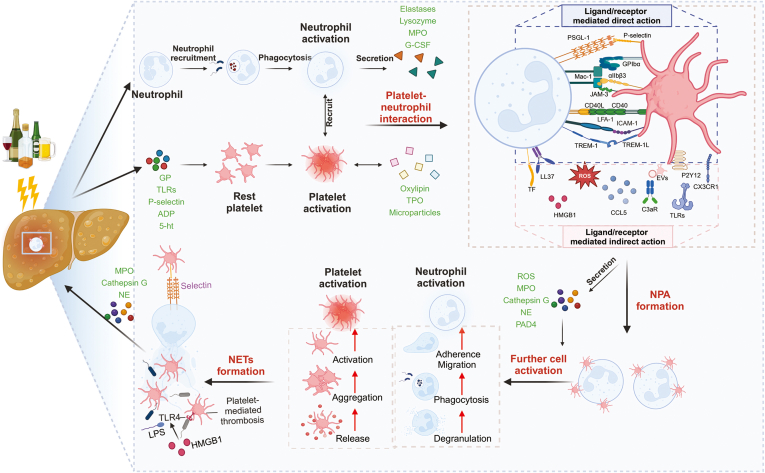
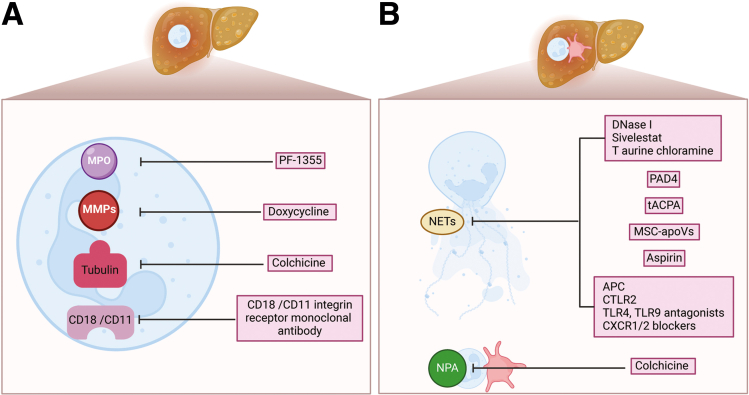
Alcohol-associated liver disease (ALD) is a major contributor to liver-related mortality globally. An increasing body of evidence underscores the pivotal role of platelets throughout the spectrum of liver injury and recovery, offering unique insights into liver homeostasis and pathobiology. Alcoholic-associated steatohepatitis is characterized by the infiltration of hepatic neutrophils. Recent studies have highlighted the extensive distance neutrophils travel through sinusoids to reach the liver injury site, relying on a platelet-paved endothelium for efficient crawling. The adherence of platelets to neutrophils is crucial for accurate migration from circulation to the inflammatory site. A gradual decline in platelet levels leads to diminished neutrophil recruitment. Platelets exhibit the ability to activate neutrophils. Platelet activation is heightened upon the release of platelet granule contents, which synergistically activate neutrophils through their respective receptors. The sequence culminates in the formation of platelet-neutrophil complexes and the release of neutrophil extracellular traps intensifies liver damage, fosters inflammatory immune responses, and triggers hepatotoxic processes. Neutrophil infiltration is a hallmark of alcohol-associated steatohepatitis, and the roles of neutrophils in ALD pathogenesis have been studied extensively, however, the involvement of platelets in ALD has received little attention. The current review consolidates recent findings on the intricate and diverse roles of platelets and neutrophils in liver pathophysiology and in ALD. Potential therapeutic strategies are highlighted, focusing on targeting platelet-neutrophil interactions and activation in ALD. The anticipation is that innovative methods for manipulating platelet and neutrophil functions will open promising avenues for future ALD therapy.
酒精相关性肝病 (ALD) 是全球范围内导致与肝脏相关死亡的主要原因之一。越来越多的证据强调了血小板在整个肝损伤和恢复过程中的关键作用,为肝脏稳态和病理生理学提供了独特的见解。酒精相关性脂肪性肝炎的特征是肝中性粒细胞浸润。最近的研究强调了中性粒细胞通过窦状隙长距离迁移到达肝损伤部位的广泛距离,依赖于血小板铺成的内皮细胞进行有效的爬行。血小板与中性粒细胞的黏附对于从循环准确迁移到炎症部位至关重要。血小板水平逐渐下降会导致中性粒细胞募集减少。血小板具有激活中性粒细胞的能力。当血小板颗粒内容物释放时,血小板会被激活,通过各自的受体协同激活中性粒细胞。这一系列反应最终导致血小板-中性粒细胞复合物的形成,中性粒细胞细胞外陷阱的释放会加剧肝损伤,促进炎症免疫反应,并引发肝毒性过程。中性粒细胞浸润是酒精相关性脂肪性肝炎的一个标志,中性粒细胞在 ALD 发病机制中的作用已经得到了广泛研究,然而,血小板在 ALD 中的作用却很少受到关注。本综述整合了最近关于血小板和中性粒细胞在肝脏病理生理学和 ALD 中的复杂和多样化作用的发现。强调了针对 ALD 中血小板-中性粒细胞相互作用和激活的潜在治疗策略。预期操纵血小板和中性粒细胞功能的创新方法将为未来的 ALD 治疗开辟有前景的途径。