Cornthwaite Katie R, Bahl Rachna, Lattey Katherine, Draycott Tim
University of Bristol and Royal College of Obstetricians and Gynaecologists, Bristol, United Kingdom.
University Hospitals Bristol NHS Trust and Royal College of Obstetricians and Gynaecologists, Bristol, United Kingdom.
Am J Obstet Gynecol. 2024 Mar;230(3S):S980-S987. doi: 10.1016/j.ajog.2022.10.037. Epub 2023 Aug 5.
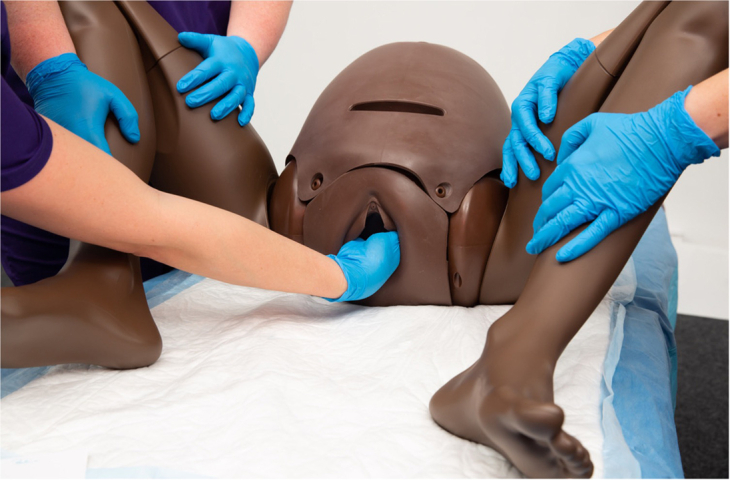
Globally, more than 1 in 5 women give birth by cesarean delivery, and at least 5% of these births are at full cervical dilatation. In these circumstances, and when labor has been prolonged in the first stage of labor, the fetal head can become low and wedged deep in the woman's pelvis, making it difficult to deliver the baby. This emergency is known as impacted fetal head. These are technically challenging births associated with serious risks to both the woman and the baby. The difficulty in disimpacting the fetal head increases maternal risks of hemorrhage and injury to adjacent organs and may have long-term consequences for future pregnancies. In addition, there can be associated neonatal consequences, such as skull fractures, brain hemorrhage, hypoxic brain injury, and, rarely, perinatal death. Globally, maternity staff are increasingly encountering this emergency, with studies in the United Kingdom suggesting that impacted fetal head may complicate as many as 1 in 10 emergency cesarean deliveries. Moreover, there has been a sharp increase in reports of perinatal brain injuries associated with impaction of the fetal head at cesarean delivery. When an impacted fetal head occurs, the maternity team can employ a range of approaches to help deliver the fetal head, including an assistant (another obstetrician or midwife) pushing the head up from the vagina, delivering the baby feet first (reverse breech extraction), administering tocolysis to relax the uterus, and using a balloon cephalic elevation device (Fetal Pillow) to elevate the baby's head. However, there is currently no consensus on how best to manage these births, resulting in a lack of confidence among maternity staff, variable practice, and potentially avoidable harm in some circumstances. This article examined the evidence for the prevention and management of this critical obstetrical emergency and outlined recommendations for best practices and training.
在全球范围内,超过五分之一的女性通过剖宫产分娩,其中至少5%的分娩发生在宫颈完全扩张时。在这种情况下,以及当第一产程的产程延长时,胎儿头部可能会低垂并深深楔入女性骨盆,导致胎儿难以娩出。这种紧急情况被称为嵌顿性胎头。这些分娩在技术上具有挑战性,对母婴都有严重风险。娩出嵌顿胎头的困难会增加产妇出血和邻近器官损伤的风险,并且可能对未来的妊娠产生长期影响。此外,还可能出现相关的新生儿后果,如颅骨骨折、脑出血、缺氧性脑损伤,以及罕见的围产期死亡。在全球范围内,产科工作人员越来越多地遇到这种紧急情况,英国的研究表明,嵌顿性胎头可能使十分之一的急诊剖宫产分娩复杂化。此外,与剖宫产时胎头嵌顿相关的围产期脑损伤报告急剧增加。当出现嵌顿性胎头时,产科团队可以采用一系列方法来帮助娩出胎头,包括助手(另一位产科医生或助产士)从阴道向上推胎头、足先露娩出胎儿(倒转臀牵引术)、使用宫缩抑制剂使子宫松弛,以及使用球囊胎头抬高装置(胎儿枕)抬高胎儿头部。然而,目前对于如何最好地处理这些分娩尚无共识,导致产科工作人员缺乏信心、操作方式不一,并且在某些情况下可能造成可避免的伤害。本文研究了预防和处理这一关键产科紧急情况的证据,并概述了最佳实践和培训建议。