Singh Balpartap, Saykar Nilesh G, Kumar Boddeda Sai, Afria Dikshant, C K Sangeetha, Rondiya Sachin R
Department of Materials Engineering, Indian Institute of Science, Bangalore 560012, India.
ACS Omega. 2024 Feb 23;9(9):10000-10016. doi: 10.1021/acsomega.3c08936. eCollection 2024 Mar 5.
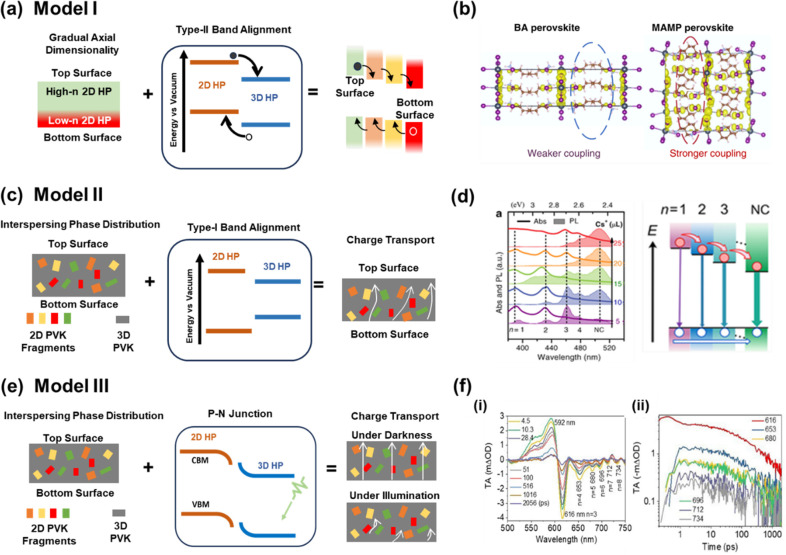
In recent years, organic-inorganic metal halide perovskite solar cells (PSCs) have attracted considerable interest due to their remarkable and rapidly advancing efficiencies. Over the past decade, PSC efficiencies have significantly approached those of state-of-the-art silicon-based photovoltaics, making them a promising material. Currently, the scientific community widely recognizes the performance of 3D-PSCs and 2D-PSCs individually. However, when both are combined to form a heterostructure, the lattice and charge dynamics at the interface undergo a multitude of mechanisms that affect their performance. The interface between heterostructures facilitates the degradation of PSCs. The degradation pathways can be attributed to lattice distortions, inhomogeneous energy landscapes, interlayer ion migration, nonradiative recombination, and charge accumulation. This Review is dedicated to examining the phenomena that arise at the interface of 3D/2D halide perovskites and their related photophysical properties and loss mechanism processes. We mainly focus on the impact of lattice mismatch, energy level alignment, anomalous carrier dynamics, and loss mechanisms. We propose a "cause-impact-identify-rectify" approach to gain a comprehensive understanding of the ultrafast processes occurring within the material. Finally, we highlight the importance of advanced spectroscopic and imaging techniques in unraveling these intricate mechanisms. This discussion delves into the future possibilities of fabricating 3D/2D heterostructure-based optoelectronic devices, pushing the boundaries of performance across diverse fields. It envisions the creation of devices with unparalleled capabilities, exceeding the limitations of current technologies.
近年来,有机-无机金属卤化物钙钛矿太阳能电池(PSCs)因其卓越且迅速提高的效率而备受关注。在过去十年中,PSCs的效率已大幅接近最先进的硅基光伏电池,使其成为一种有前途的材料。目前,科学界广泛认可3D-PSCs和2D-PSCs各自的性能。然而,当两者结合形成异质结构时,界面处的晶格和电荷动力学经历多种影响其性能的机制。异质结构之间的界面会加速PSCs的降解。降解途径可归因于晶格畸变、不均匀的能量分布、层间离子迁移、非辐射复合和电荷积累。本综述致力于研究3D/2D卤化物钙钛矿界面处出现的现象及其相关的光物理性质和损耗机制过程。我们主要关注晶格失配、能级对齐、异常载流子动力学和损耗机制的影响。我们提出一种“原因-影响-识别-纠正”方法,以全面了解材料内部发生的超快过程。最后,我们强调先进的光谱和成像技术在揭示这些复杂机制方面的重要性。本讨论深入探讨了制造基于3D/2D异质结构的光电器件的未来可能性,突破了各个领域性能的界限。它设想创造出具有无与伦比能力的器件,超越当前技术的局限性。