Liu Hanxiao, Zhao Xiangning, Bi Jingxin, Dong Xiaochang, Zhang Chunmei
State Forestry and Grassland Administration Key Laboratory of Silviculture in Downstream Areas of the Yellow River, College of Forestry, Shandong Agricultural University, Tai'an, Shandong, 271018, China.
Shandong Institute of Pomology, Shandong Academy of Agricultural Sciences, Tai'an, 271000, China.
Hortic Res. 2024 Jan 3;11(3):uhae003. doi: 10.1093/hr/uhae003. eCollection 2024 Mar.
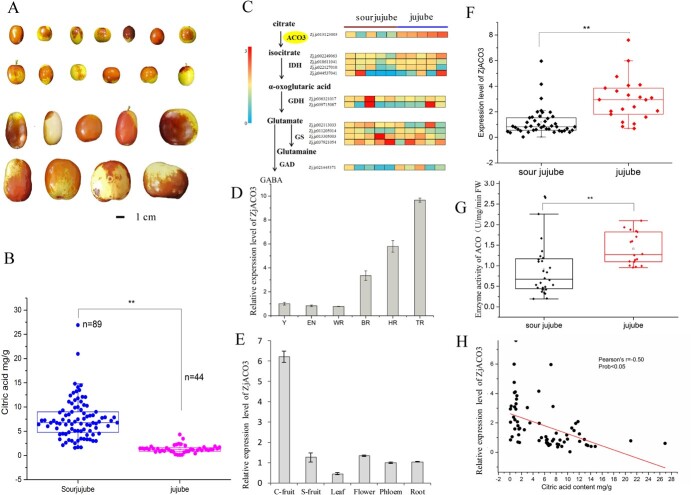
Jujube ( Mill.) is the most economically important fruit tree of the Rhamnaceae and was domesticated from wild or sour jujube ( Mill. var. Hu). During the process of domestication, there was a substantial reduction in the content of organic acids, particularly malate and citrate, which greatly influence the taste and nutritional value of the fruit. We previously demonstrated that is crucial for malate accumulation. However, the mechanism of citrate degradation in jujube remains poorly understood. In the present study, aconitase was shown to participate in citric acid degradation in the cytoplasm through the GABA pathway. Interestingly, we discovered an E-box mutation in the promoter (-484A > G; CAAGTG in sour jujube mutated to CAGGTG in cultivated jujube) that was strongly correlated with fruit citrate content; 'A' represented a high-citrate genotype and 'G' represented a low-citrate genotype. We developed and validated an ACO-based Kompetitive allele-specific PCR (KASP) marker for determining citric acid content. Yeast one-hybrid screening, transient dual-luciferase assays, and overexpression analyses showed that the transcription factor ZjbHLH113 protein directly binds to CAGGTG in the promoter of in cultivated jujube plants, transcriptionally activating expression, and enhancing citric acid degradation. Conversely, binding ability of the ZjbHLH113 protein to CAAGTG was weakened in sour jujube, thereby promoting citrate accumulation in the fruit. These findings will assist in elucidating the mechanism by which ZjACO3 modulates citrate accumulation in sour jujube and its cultivars.
枣(Mill.)是鼠李科中经济价值最重要的果树,由野生酸枣或酸刺(Mill. var. Hu)驯化而来。在驯化过程中,有机酸含量大幅降低,尤其是苹果酸和柠檬酸,这极大地影响了果实的口感和营养价值。我们之前证明 对苹果酸积累至关重要。然而,枣中柠檬酸降解的机制仍知之甚少。在本研究中,乌头酸酶 被证明通过GABA途径参与细胞质中的柠檬酸降解。有趣的是,我们在 启动子中发现了一个E-box突变(-484A>G;酸枣中的CAAGTG突变为栽培枣中的CAGGTG),该突变与果实柠檬酸含量密切相关;“A”代表高柠檬酸基因型,“G”代表低柠檬酸基因型。我们开发并验证了一种基于ACO的竞争性等位基因特异性PCR(KASP)标记,用于测定柠檬酸含量。酵母单杂交筛选、瞬时双荧光素酶测定和过表达分析表明,转录因子ZjbHLH113蛋白直接与栽培枣植株中 启动子中的CAGGTG结合,转录激活 表达,并增强柠檬酸降解。相反,酸枣中ZjbHLH113蛋白与CAAGTG的结合能力减弱,从而促进果实中柠檬酸的积累。这些发现将有助于阐明ZjACO3调节酸枣及其栽培品种中柠檬酸积累的机制。