Trinchese Giovanna, Cimmino Fabiano, Catapano Angela, Cavaliere Gina, Mollica Maria Pina
Department of Biology, University of Naples Federico II, Naples, Italy.
Department of Pharmaceutical Sciences, University of Perugia, Perugia, Italy.
Front Immunol. 2024 Feb 23;15:1334006. doi: 10.3389/fimmu.2024.1334006. eCollection 2024.
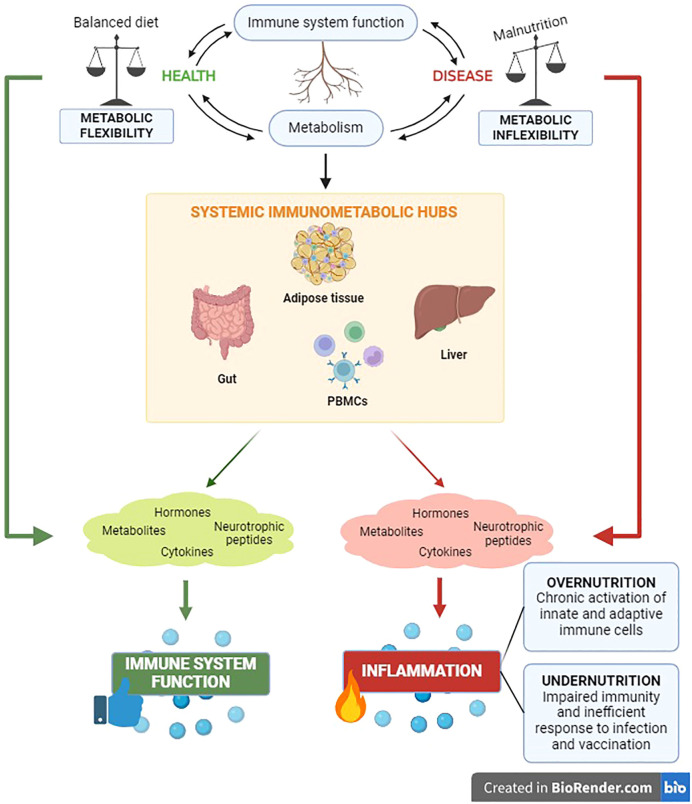
Metabolism and immunity are crucial monitors of the whole-body homeodynamics. All cells require energy to perform their basic functions. One of the most important metabolic skills of the cell is the ability to optimally adapt metabolism according to demand or availability, known as metabolic flexibility. The immune cells, first line of host defense that circulate in the body and migrate between tissues, need to function also in environments in which nutrients are not always available. The resilience of immune cells consists precisely in their high adaptive capacity, a challenge that arises especially in the framework of sustained immune responses. Pubmed and Scopus databases were consulted to construct the extensive background explored in this review, from the Kennedy and Lehninger studies on mitochondrial biochemistry of the 1950s to the most recent findings on immunometabolism. In detail, we first focus on how metabolic reconfiguration influences the action steps of the immune system and modulates immune cell fate and function. Then, we highlighted the evidence for considering mitochondria, besides conventional cellular energy suppliers, as the powerhouses of immunometabolism. Finally, we explored the main immunometabolic hubs in the organism emphasizing in them the reciprocal impact between metabolic and immune components in both physiological and pathological conditions.
新陈代谢和免疫是全身动态平衡的关键监测机制。所有细胞都需要能量来执行其基本功能。细胞最重要的代谢技能之一是能够根据需求或可利用性最佳地调整新陈代谢,即所谓的代谢灵活性。免疫细胞作为宿主防御的第一道防线,在体内循环并在组织间迁移,它们也需要在营养物质并非总是可获取的环境中发挥作用。免疫细胞的韧性恰恰在于它们具有很高的适应能力,这一挑战尤其出现在持续免疫反应的背景下。我们查阅了PubMed和Scopus数据库,以构建本综述中所探讨的广泛背景,从20世纪50年代肯尼迪和莱宁格关于线粒体生物化学的研究到免疫代谢的最新发现。具体而言,我们首先关注代谢重编程如何影响免疫系统的作用步骤并调节免疫细胞的命运和功能。然后,我们强调了除传统的细胞能量供应者外,将线粒体视为免疫代谢动力源的证据。最后,我们探讨了机体中的主要免疫代谢枢纽,着重阐述了在生理和病理条件下代谢和免疫成分之间的相互影响。