Machlab Salvador, Martínez-Bauer Eva, López Pilar, Ruiz-Ramirez Pablo, Gómez Bárbara, Gimeno-Garcia Antonio Z, Pujals María Del Mar, Tanco Sara, Sargatal Lluïsa, Pérez Betty, Justicia Reyes, Enguita Mónica, Piqué Nùria, Valero Oliver, Calvet Xavier, Campo Rafel
Digestive Endoscopy Unit, Gastroenterology Department, Institut d'Investigació i Innovació Parc Taulí I3PT, Parc Taulí Hospital Universitari, Sabadell, Spain.
Departament de Medicina, Universitat Autònoma de Barcelona, Bellaterra, Spain.
Endosc Int Open. 2024 Mar 7;12(3):E352-E360. doi: 10.1055/a-2256-5356. eCollection 2024 Mar.
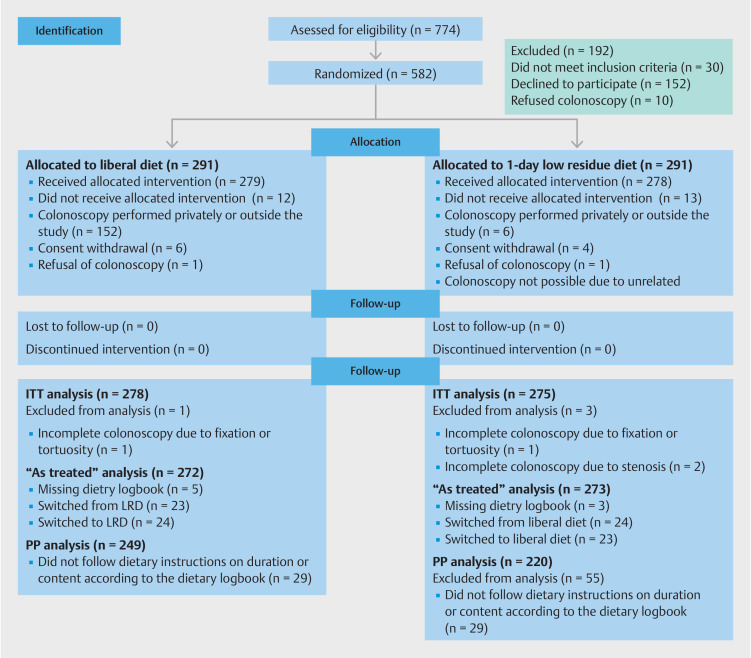
In colonoscopy, preparation is often regarded as the most burdensome part of the intervention. Traditionally, specific diets have been recommended, but the evidence to support this policy is insufficient. The aim of this study was to evaluate the impact of the decision not to follow a restrictive diet on bowel preparation and colonoscopy outcomes. This was a multicenter, controlled, non-inferiority randomized trial with FIT-positive screening colonoscopy. The subjects were assigned to follow the current standard (1-day low residue diet [LRD]) or a liberal diet. The allocation was balanced for the risk of inadequate cleansing using the Dik et al. score. All participants received the same instructions for morning colonoscopy preparation. The primary outcome was the rate of adequate preparations as defined by the Boston Bowel Preparation Scale. Secondary outcomes included tolerability and measures of colonoscopy performance and quality. A total of 582 subjects were randomized. Of these, 278 who received the liberal diet and 275 who received the 1-day LRD were included in the intent-to-treat analysis. Non-inferiority was demonstrated with adequate preparation rates of 97.8% in the 1-day LRD and 96.4% in the liberal diet group. Tolerability was higher with the liberal diet (94.7% vs. 83.2%). No differences were found with respect to cecal intubation time, aspirated volume, or length of the examination. Global and right colon average adenoma detection rates per colonoscopy were similar. The liberal diet was non-inferior to the 1-day LRD, and increased tolerability. Colonoscopy performance and quality were not affected. (NCT05032794).
在结肠镜检查中,肠道准备通常被认为是该干预措施中最繁琐的部分。传统上,一直推荐特定的饮食,但支持这一策略的证据并不充分。本研究的目的是评估不遵循限制性饮食的决定对肠道准备和结肠镜检查结果的影响。这是一项针对粪便免疫化学试验(FIT)阳性筛查结肠镜检查的多中心、对照、非劣效性随机试验。将受试者分为遵循现行标准(1天低渣饮食[LRD])或宽松饮食组。使用迪克等人的评分法对清洁不充分的风险进行了均衡分配。所有参与者都收到了相同的早晨结肠镜检查准备说明。主要结局是由波士顿肠道准备量表定义的充分准备率。次要结局包括耐受性以及结肠镜检查性能和质量的指标。共有582名受试者被随机分组。其中,278名接受宽松饮食的受试者和275名接受1天LRD的受试者被纳入意向性分析。1天LRD组的充分准备率为97.8%,宽松饮食组为96.4%,证明了非劣效性。宽松饮食的耐受性更高(94.7%对83.2%)。在盲肠插管时间、吸出量或检查长度方面未发现差异。每次结肠镜检查的整体和右半结肠平均腺瘤检出率相似。宽松饮食不劣于1天LRD,且耐受性增加。结肠镜检查性能和质量未受影响。(NCT05032794)