Summa K C, Jiang P, González-Rodríguez P, Huang X, Lin X, Vitaterna M H, Dan Y, Surmeier D J, Turek F W
Department of Medicine, Feinberg School of Medicine, Northwestern University, Chicago, IL, USA.
Center for Sleep & Circadian Biology, Northwestern University, Evanston, IL, USA.
NPJ Parkinsons Dis. 2024 Mar 11;10(1):54. doi: 10.1038/s41531-024-00670-w.
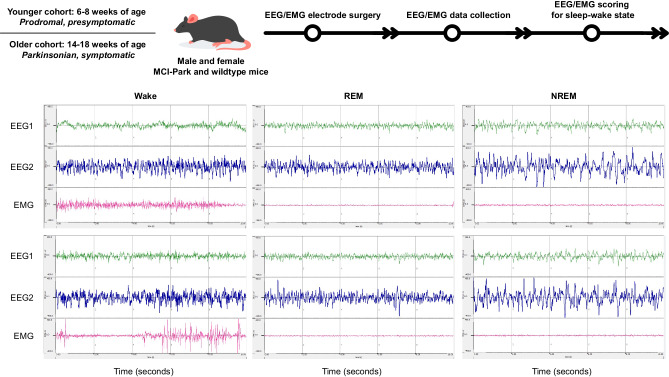
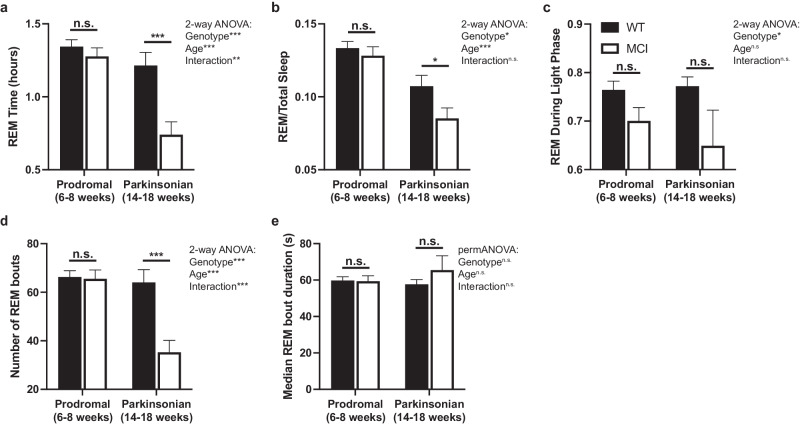
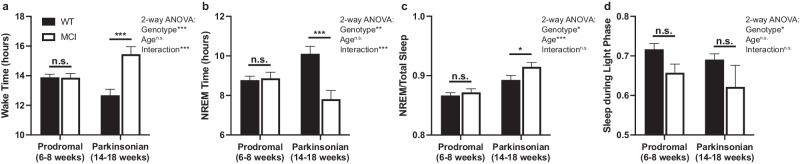
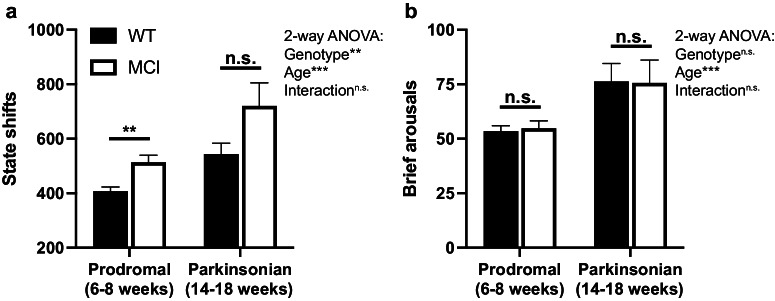
Disrupted sleep has a profound adverse impact on lives of Parkinson's disease (PD) patients and their caregivers. Sleep disturbances are exceedingly common in PD, with substantial heterogeneity in type, timing, and severity. Among the most common sleep-related symptoms reported by PD patients are insomnia, excessive daytime sleepiness, and sleep fragmentation, characterized by interruptions and decreased continuity of sleep. Alterations in brain wave activity, as measured on the electroencephalogram (EEG), also occur in PD, with changes in the pattern and relative contributions of different frequency bands of the EEG spectrum to overall EEG activity in different vigilance states consistently observed. The mechanisms underlying these PD-associated sleep-wake abnormalities are poorly understood, and they are ineffectively treated by conventional PD therapies. To help fill this gap in knowledge, a new progressive model of PD - the MCI-Park mouse - was studied. Near the transition to the parkinsonian state, these mice exhibited significantly altered sleep-wake regulation, including increased wakefulness, decreased non-rapid eye movement (NREM) sleep, increased sleep fragmentation, reduced rapid eye movement (REM) sleep, and altered EEG activity patterns. These sleep-wake abnormalities resemble those identified in PD patients. Thus, this model may help elucidate the circuit mechanisms underlying sleep disruption in PD and identify targets for novel therapeutic approaches.
睡眠中断对帕金森病(PD)患者及其照料者的生活有着深远的不利影响。睡眠障碍在PD患者中极为常见,在类型、时间和严重程度上存在很大的异质性。PD患者报告的最常见的与睡眠相关的症状包括失眠、日间过度嗜睡和睡眠片段化,其特征为睡眠中断和睡眠连续性下降。通过脑电图(EEG)测量发现,PD患者的脑电波活动也会发生改变,不同警觉状态下EEG频谱的不同频段对整体EEG活动的模式和相对贡献的变化始终可见。这些与PD相关的睡眠 - 觉醒异常的潜在机制尚不清楚,并且传统的PD治疗方法对其治疗效果不佳。为了填补这一知识空白,研究了一种新的PD渐进模型——MCI - Park小鼠。在接近帕金森状态转变时,这些小鼠表现出明显改变的睡眠 - 觉醒调节,包括清醒增加、非快速眼动(NREM)睡眠减少、睡眠片段化增加、快速眼动(REM)睡眠减少以及EEG活动模式改变。这些睡眠 - 觉醒异常与在PD患者中发现的异常相似。因此,该模型可能有助于阐明PD中睡眠中断的神经回路机制,并确定新治疗方法的靶点。