Banabazi Mohammad Hossein, Freimanis Graham, Goatley Lynnette C, Netherton Christopher L, de Koning Dirk-Jan
Department of Animal Biosciences, Swedish University of Agricultural Sciences, Box 7023, 750 07, Uppsala, Sweden.
The Pirbright Institute, Ash Road, Woking, Surrey, GU24 0NF, UK.
Sci Rep. 2024 Mar 11;14(1):5944. doi: 10.1038/s41598-024-56569-2.
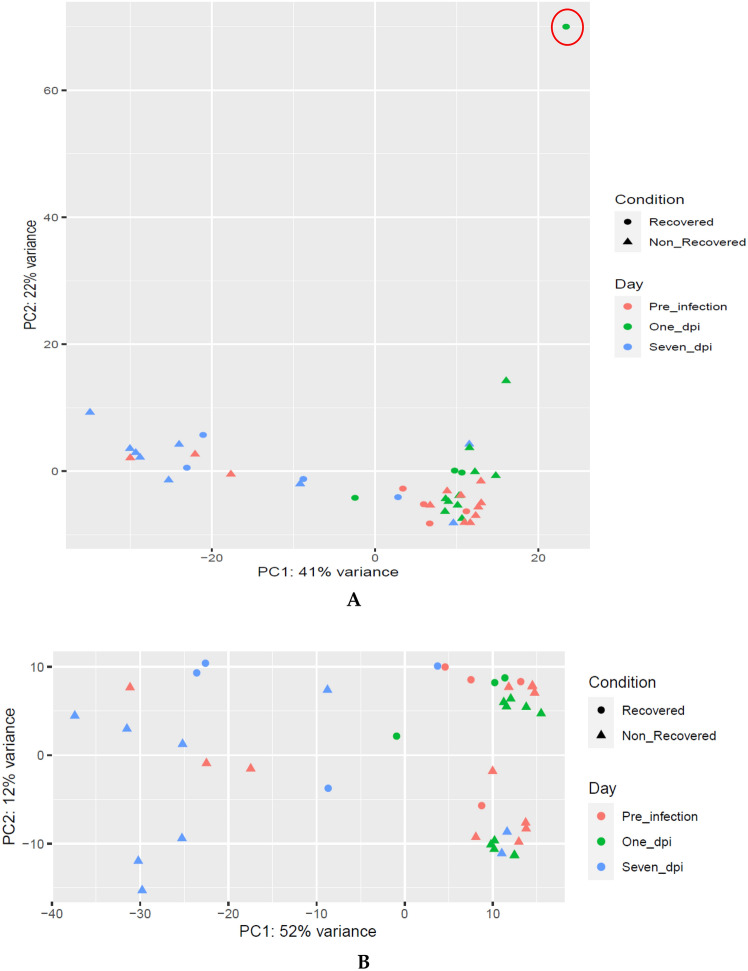
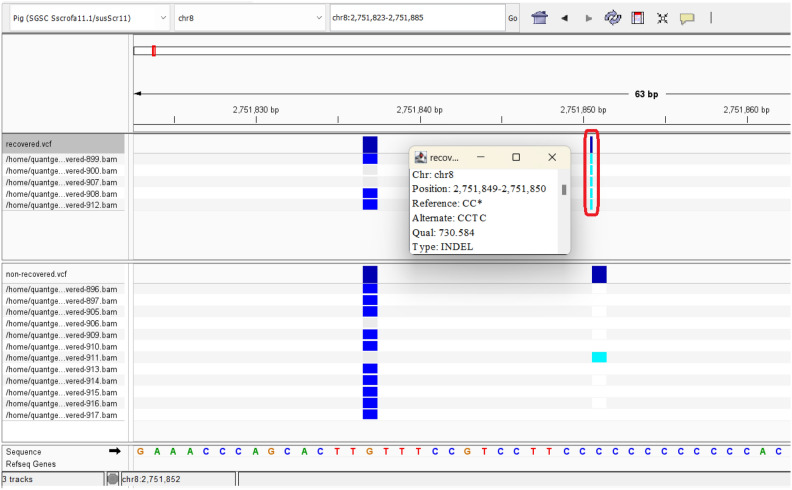
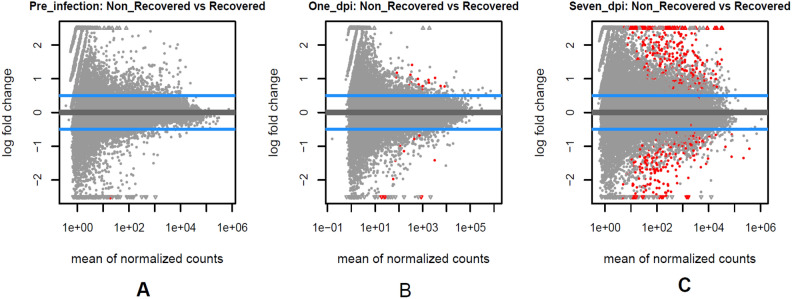
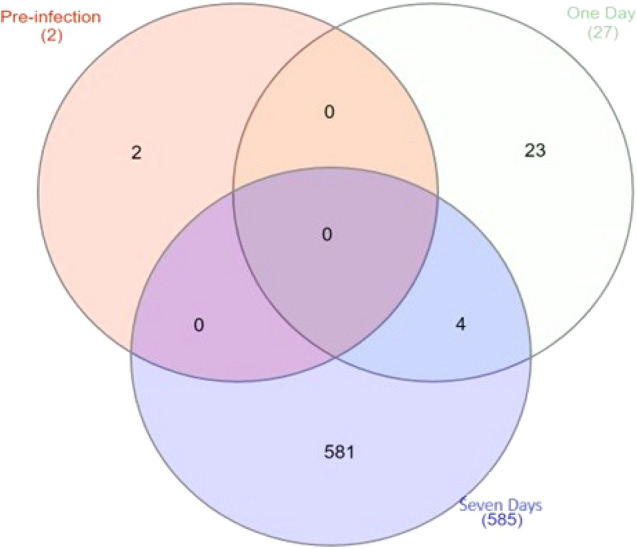
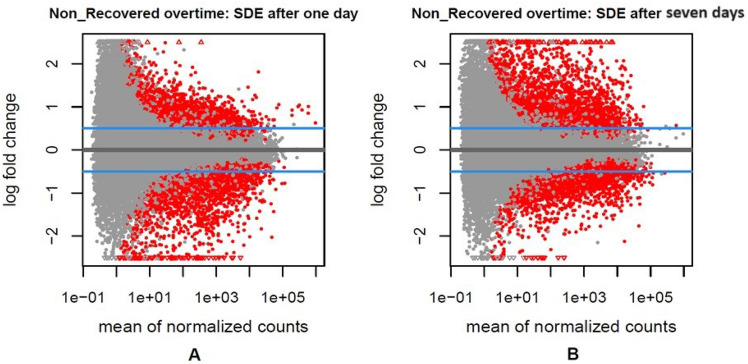
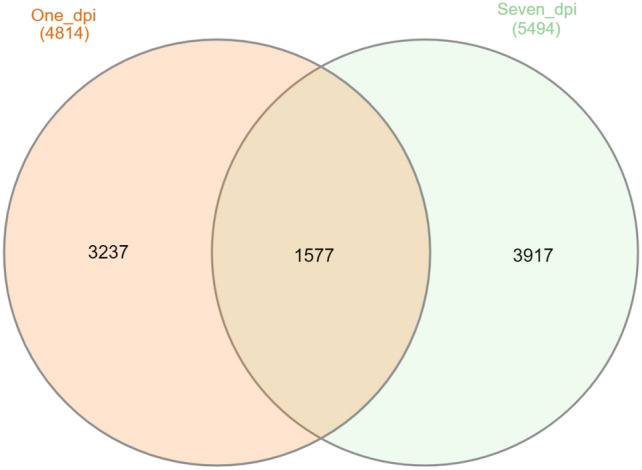
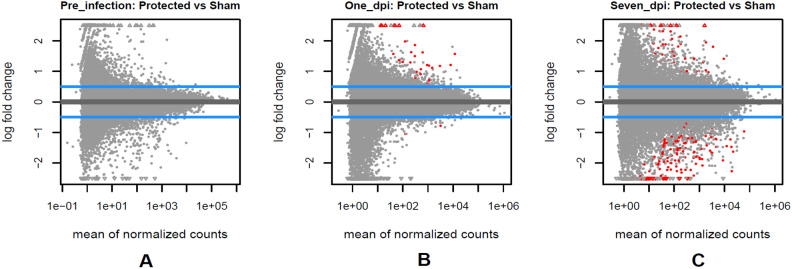
African swine fever (ASF) is a global threat to animal health and food security. ASF is typically controlled by strict biosecurity, rapid diagnosis, and culling of affected herds. Much progress has been made in developing modified live virus vaccines against ASF. There is host variation in response to ASF infection in the field and under controlled conditions. To better understand the dynamics underlying this host differential morbidity, whole transcriptome profiling was carried out in twelve immunized and five sham immunized pigs. Seventeen MHC homozygous inbred Large white Babraham pigs were sampled at three time points before and after the challenge. The changes in the transcriptome profiles of infected animals were surveyed over time. In addition, the immunization effect on the host response was studied as well among the contrasts of all protection subgroups. The results showed two promising candidate genes to distinguish between recovered and non-recovered pigs after infection with a virulent African swine fever virus (ASFV) pre-infection: HTRA3 and GFPT2 (padj < 0.05). Variant calling on the transcriptome assemblies showed a two-base pair insertion into the ACOX3 gene closely located to HTRA3 that may regulate its expression as a putative genomic variant for ASF. Several significant DGEs, enriched gene ontology (GO) terms, and KEGG pathways at 1 day and 7 days post-infection, compared to the pre-infection, indicate a significant inflammation response immediately after ASF infection. The presence of the virus was confirmed by the mapping of RNA-Seq reads on two whole viral genome sequences. This was concordant with a higher virus load in the non-recovered animals 7 days post-infection. There was no transcriptome signature on the immunization at pre-infection and 1 day post-infection. More samples and data from additional clinical trials may support these findings.
非洲猪瘟(ASF)是对动物健康和食品安全的全球威胁。ASF通常通过严格的生物安全措施、快速诊断以及扑杀受感染猪群来控制。在开发针对ASF的改良活病毒疫苗方面已取得很大进展。在田间和受控条件下,宿主对ASF感染的反应存在差异。为了更好地理解这种宿主发病率差异背后的动态机制,对12头免疫猪和5头假免疫猪进行了全转录组分析。在17头MHC纯合近交大白猪巴布拉姆猪攻毒前后的三个时间点进行采样。随时间调查感染动物转录组图谱的变化。此外,还在所有保护亚组的对比中研究了免疫对宿主反应的影响。结果显示,有两个有前景的候选基因可区分在感染强毒非洲猪瘟病毒(ASFV)预感染后康复和未康复的猪:HTRA3和GFPT2(padj < 0.05)。对转录组组装进行变异检测显示,在与HTRA3紧密相邻的ACOX3基因中有一个两碱基对的插入,这可能作为ASF的推定基因组变异调节其表达。与感染前相比,感染后第1天和第7天的几个显著差异基因表达、富集的基因本体(GO)术语和KEGG通路表明,ASF感染后立即出现显著的炎症反应。通过将RNA-Seq读数映射到两个完整病毒基因组序列上证实了病毒的存在。这与感染后7天未康复动物中较高的病毒载量一致。在感染前和感染后第1天没有免疫的转录组特征。更多样本和来自其他临床试验的数据可能支持这些发现。