Cao Hong, Chen Yan, Yang Zhihao, Lan Junjie, Sum-Wing Kwong Joey, Zhang Rui, Zhao Huaye, Hu Linfang, Wang Jiaxue, Sun Shuimei, Tan Songsong, Cao Jinyong, He Rui, Zheng Wenyi, Zhang Jiaxing
School of Pharmaceutical Sciences, Guizhou University, 2708 South of Huaxi Avenue Road, Guiyang, China.
Department of Pharmacy, Guizhou Provincial People's Hospital, No.83 Zhongshandong Road, Guiyang, Guizhou Province, China.
BMC Med Res Methodol. 2024 Mar 11;24(1):65. doi: 10.1186/s12874-024-02182-w.
The Core Outcome Measures in Effectiveness Trials (COMET) working group proposed core outcome sets (COS) to address the heterogeneity in outcome measures in clinical studies. According to the recommendations of COMET, performing systematic reviews (SRs) usually was the first step for COS development. However, the SRs that serve as a basis for COS are not specifically appraised by organizations such as COMET regarding their quality. Here, we investigated the status of SRs related to development of COS and evaluated their methodological quality.
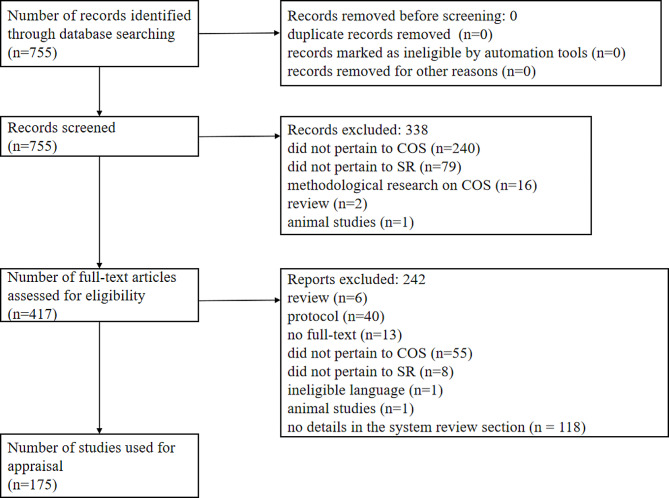
We conducted a search on PubMed to identify SRs related to COS development published from inception to May 2022. We qualitatively summarized the disease included in SR topics, and the studies included in the SRs. We evaluated the methodological quality of the SRs using AMSTAR 2.0 and compared the overall quality of SRs with and without protocols using the Mann-Whitney U test.
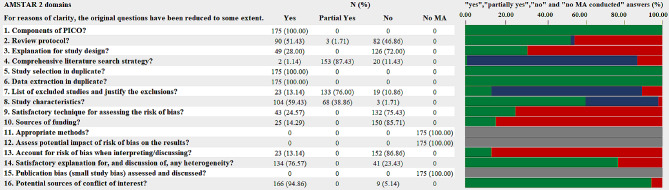
We included 175 SRs from 23 different countries or regions, and they mainly focused on five diseases: musculoskeletal system or connective tissue disease (n = 19, 10.86%), injury, poisoning, or certain other consequences of external causes (n = 18, 10.29%), digestive system disease (n = 16, 9.14%), nervous system disease (n = 15, 8.57%), and genitourinary system disease (n = 15, 8.57%). Although 88.00% of SRs included randomized controlled trials (RCTs), only a few SRs (23.38%) employed appropriate tools to assess the risk of bias in RCTs. The assessment results on the basis of AMSTAR 2.0 indicated that most SRs (93.71%) were rated as ''critically low'' to ''low'' in terms of overall confidence. The overall confidence of SRs with protocols was significantly higher than that without protocols (P <.001). Compared to the SRs with protocols on Core Outcome Measures in Effectiveness Trials (COMET), SRs with protocols on PROSPERO were of better overall confidence (P = .017).
The overall quality of published SRs regarding COS development was poor. Our findings emphasize the need for researchers to carefully select the disease topic and strictly adhere to the requirements of optimal methodology when conducting a SR for the establishment of a COS.
有效性试验核心结局指标(COMET)工作组提出了核心结局集(COS),以解决临床研究中结局指标的异质性问题。根据COMET的建议,开展系统评价(SR)通常是COS制定的第一步。然而,作为COS基础的SR并未得到COMET等组织对其质量的专门评估。在此,我们调查了与COS制定相关的SR的现状,并评估了它们的方法学质量。
我们在PubMed上进行检索,以识别从创刊至2022年5月发表的与COS制定相关的SR。我们对SR主题中包含的疾病以及SR中纳入的研究进行了定性总结。我们使用AMSTAR 2.0评估SR的方法学质量,并使用曼-惠特尼U检验比较有方案和无方案的SR的总体质量。
我们纳入了来自23个不同国家或地区的175篇SR,它们主要聚焦于五种疾病:肌肉骨骼系统或结缔组织疾病(n = 19,10.86%)、损伤、中毒或外部原因的某些其他后果(n = 18,10.29%)、消化系统疾病(n = 16,9.14%)、神经系统疾病(n = 15,8.57%)和泌尿生殖系统疾病(n = 15,8.57%)。尽管88.00%的SR纳入了随机对照试验(RCT),但只有少数SR(23.38%)采用了适当的工具来评估RCT中的偏倚风险。基于AMSTAR 2.0的评估结果表明,大多数SR(93.71%)在总体可信度方面被评为“极低”至“低”。有方案的SR的总体可信度显著高于无方案的SR(P <.001)。与有效性试验核心结局指标(COMET)有方案的SR相比,PROSPERO有方案的SR总体可信度更高(P = 0.017)。
已发表的关于COS制定的SR的总体质量较差。我们的研究结果强调,研究人员在为建立COS进行SR时,需要仔细选择疾病主题并严格遵守最佳方法学的要求。