Meta-Analysis Group, Institute of Clinical Trials and Methodology, MRC Clinical Trials Unit at UCL, London, England, United Kingdom.
Women's Health Research Unit, Queen Mary University of London, London, England, United Kingdom.
PLoS One. 2020 Jul 8;15(7):e0235485. doi: 10.1371/journal.pone.0235485. eCollection 2020.
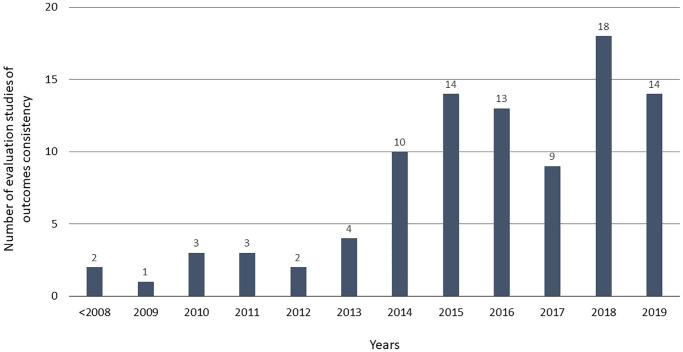
Evaluation studies of outcomes used in clinical research and their consistency are appearing more frequently in the literature, as a key part of the core outcome set (COS) development. Current guidance suggests such evaluation studies should use systematic review methodology as their default. We aimed to examine the methods used. We searched the Core Outcome Measures in Effectiveness Trials (COMET) database (up to May 2019) supplementing it with additional resources. We included evaluation studies of outcome consistency in clinical studies across health subjects and used a subset of A MeaSurement Tool to Assess systematic Reviews (AMSTAR) 2 (items 1-9) to assess their methods. Of 93 included evaluation studies of outcome consistency (90 full reports, three summaries), 91% (85/93) reported performing literature searches in at least one bibliographic database, and 79% (73/93) was labelled as a "systematic review". The evaluations varied in terms of satisfying AMSTAR 2 criteria, such that 81/93 (87%) had implemented PICO in the research question, whereas only 5/93 (6%) had included the exclusions list. None of the evaluation studies explained how inconsistency of outcomes was detected, however, 80/90 (88%) concluded inconsistency in individual outcomes (66%, 55/90) or outcome domains (20%, 18/90). Methods used in evaluation studies of outcome consistency in clinical studies differed considerably. Despite frequent being labelled as a "systematic review", adoption of systematic review methodology is selective. While the impact on COS development is unknown, authors of these studies should refrain from labelling them as "systematic review" and focus on ensuring that the methods used to generate the different outcomes and outcome domains are reported transparently.
临床研究中结局指标的评估研究及其一致性越来越多地出现在文献中,这是核心结局指标集(COS)开发的关键部分。目前的指南建议此类评估研究应默认使用系统评价方法。我们旨在检查所使用的方法。我们在核心结局测量在有效性试验(COMET)数据库中进行了搜索(截至 2019 年 5 月),并通过其他资源进行了补充。我们纳入了对跨健康学科临床研究中结局一致性的评估研究,并使用了评估系统评价的测量工具(AMSTAR 2)的一个子集(项目 1-9)来评估其方法。在纳入的 93 项结局一致性评估研究(90 项完整报告,3 项摘要)中,91%(85/93)报告在至少一个文献数据库中进行了文献检索,79%(73/93)被标记为“系统评价”。这些评估在满足 AMSTAR 2 标准方面存在差异,例如 81/93(87%)在研究问题中实施了 PICO,而只有 5/93(6%)包括了排除列表。尽管 80/90(88%)评估研究未解释如何检测结局的不一致性,但有 80/90(88%)评估研究在个体结局(66%,55/90)或结局领域(20%,18/90)中得出了不一致的结论。在临床研究中评估结局一致性的方法差异很大。尽管经常被标记为“系统评价”,但系统评价方法的采用是有选择性的。虽然这些研究对 COS 发展的影响尚不清楚,但这些研究的作者应避免将其标记为“系统评价”,而应专注于确保透明地报告生成不同结局和结局领域的方法。