Zahid Fahad, Memon Ayesha, Siddiqui Moghira, Deewani Muhammad Hammad, Asif Osama, Javer Amin, Khan Ahsan Ali
Section of Neurosurgery, Department of Surgery, Aga Khan University, Karachi, Pakistan.
Department of Surgery, Aga Khan University, Karachi, Pakistan.
Surg Neurol Int. 2024 Feb 16;15:44. doi: 10.25259/SNI_743_2023. eCollection 2024.
3-Dimensional (3D) printing has proven its role in various fields. Recently, 3D printing has also been introduced in the otolaryngology domain. The nasopharynx, paranasal sinuses, and the anterior skull base have a complex anatomy. Critical structures must be delicately protected and preserved during a surgical procedure. It is, therefore, very important for the surgeon to have an excellent spatial understanding of the complex surgical field that is being traversed.
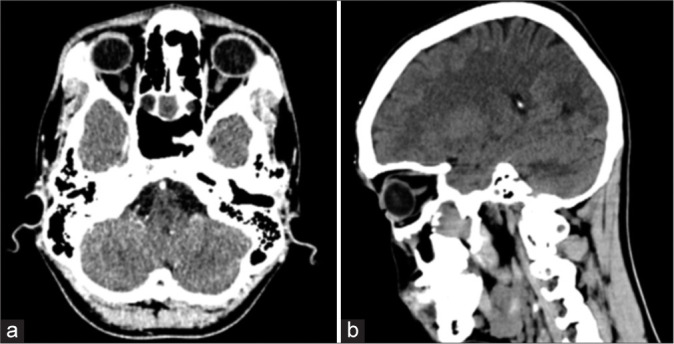
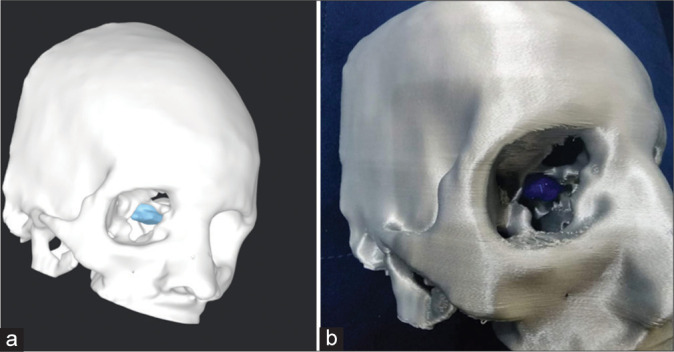
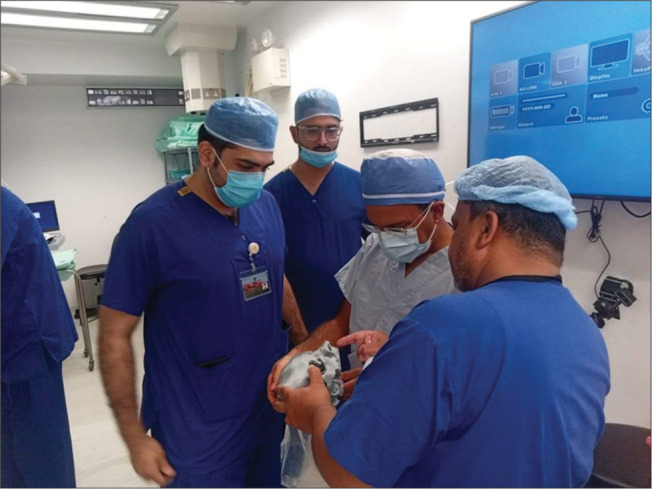
Our case is of a 19-year-old male with a 2-month history of recurrent epistaxis, nasal blockage, and headache. Based on the computed tomography scan and the clinical presentation, the patient was diagnosed with juvenile nasopharyngeal angiofibroma. The patient underwent angioembolization of the tumor followed by endoscopic surgical resection. The patient remained stable postoperatively and demonstrated a good recovery in the follow-up visit with no signs of cranial deficits. This case report highlights the use of a patient-specific 3D-printed biomodel to visualize this rare tumor of the nasopharynx. The benefits of using the model in surgical planning, patient education, and resident training are reported. We found that the ability to visualize the tumor on a tangible model, viewing its actual size in relation to the adjacent anatomy and all the structures associated with it, greatly enhances the surgeon's capacity to tackle such a difficult tumor endoscopically.
Incorporating 3D-printed biomodels in surgical practice should result in improved outcomes for the patients.
三维(3D)打印已在各个领域证明了其作用。最近,3D打印也已引入耳鼻喉科领域。鼻咽、鼻窦和前颅底解剖结构复杂。在手术过程中必须小心保护关键结构。因此,对于外科医生来说,对所涉及的复杂手术区域有出色的空间理解非常重要。
我们的病例是一名19岁男性,有2个月反复鼻出血、鼻塞和头痛的病史。根据计算机断层扫描和临床表现,该患者被诊断为青少年鼻咽血管纤维瘤。患者先接受了肿瘤血管栓塞术,随后进行了内镜手术切除。患者术后情况稳定,随访时恢复良好,无颅神经缺损迹象。本病例报告强调了使用患者特异性3D打印生物模型来可视化这种罕见的鼻咽肿瘤。报告了在手术规划、患者教育和住院医师培训中使用该模型的益处。我们发现,能够在实体模型上可视化肿瘤,查看其相对于相邻解剖结构及与之相关的所有结构的实际大小,极大地增强了外科医生通过内镜处理此类困难肿瘤的能力。
将3D打印生物模型纳入手术实践应能改善患者的治疗效果。