Sander Ian M, Liepert Taimi T, Doney Evan L, Leevy W Matthew, Liepert Douglas R
Department of Biological Sciences, University of Notre Dame, South Bend, IN 46556, USA.
Michiana Sleep Solutions and Allied ENT Speciality Center, South Bend, IN 46635, USA.
J Funct Biomater. 2017 Apr 7;8(2):13. doi: 10.3390/jfb8020013.
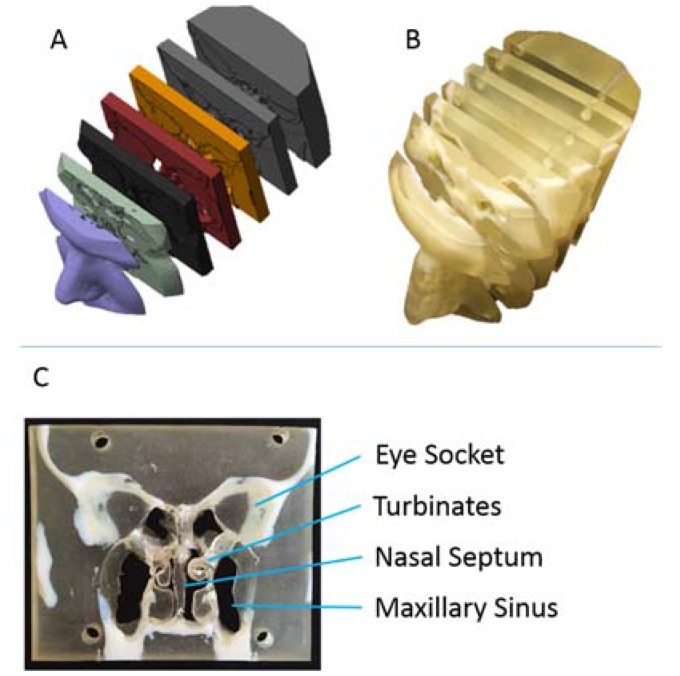
Within the Ear, Nose, and Throat (ENT) medical space, a relatively small fraction of patients follow through with elective surgeries to fix ailments such as a deviated septum or occluded sinus passage. Patient understanding of their diagnosis and treatment plan is integral to compliance, which ultimately yields improved medical outcomes and better quality of life. Here we report the usage of advanced, polyjet 3D printing methods to develop a multimaterial replica of human nasal sinus anatomy, derived from clinical X-ray computed tomography (CT) data, to be used as an educational aid during physician consultation. The final patient education model was developed over several iterations to optimize material properties, anatomical accuracy and overall display. A two-arm, single-center, randomized, prospective study was then performed in which 50 ENT surgical candidates (and an associated control group, = 50) were given an explanation of their anatomy, disease state, and treatment options using the education model as an aid. Statistically significant improvements in patient ratings of their physician's explanation of their treatment options ( = 0.020), self-rated anatomical understanding ( = 0.043), self-rated understanding of disease state ( = 0.016), and effectiveness of the visualization ( = 0.007) were noted from the population that viewed the 3D education model, indicating it is an effective tool which ENT surgeons may use to educate and interact with patients.
在耳鼻喉(ENT)医学领域,只有相对一小部分患者会接受诸如鼻中隔偏曲或鼻窦通道堵塞等疾病的择期手术。患者对其诊断和治疗方案的理解对于依从性至关重要,而依从性最终会带来更好的医疗结果和更高的生活质量。在此,我们报告了使用先进的多喷射3D打印方法,根据临床X射线计算机断层扫描(CT)数据制作人体鼻窦解剖结构的多材料复制品,用作医生会诊时的教育辅助工具。最终的患者教育模型经过多次迭代开发而成,以优化材料特性、解剖准确性和整体展示效果。随后进行了一项双臂、单中心、随机、前瞻性研究,其中50名耳鼻喉科手术候选人(以及一个相关对照组,n = 50)在教育模型的辅助下,接受了关于其解剖结构、疾病状态和治疗选择的解释。观察到观看3D教育模型的人群在对医生对其治疗选择的解释的患者评分(p = 0.020)、自我评定的解剖学理解(p = 0.043)、自我评定的疾病状态理解(p = 0.016)以及可视化效果(p = 0.007)方面有统计学上的显著改善,表明它是耳鼻喉科外科医生可用于教育患者并与患者互动的有效工具。