Department of Geriatrics, The First Affiliated Hospital, Zhejiang University School of Medicine, Hangzhou, China.
Department of General Practice, The Second Affiliated Hospital, Jiangxi Medical College, Nanchang University, Nanchang, China.
J Gerontol A Biol Sci Med Sci. 2024 May 1;79(5). doi: 10.1093/gerona/glae080.
It is imperative for public health to identify the factors that contribute to the progression of sarcopenia among middle-aged and older adults. Our study aimed to investigate the association between pain characteristics and the progression to sarcopenia and its subcomponents among middle-aged and older adults in China.
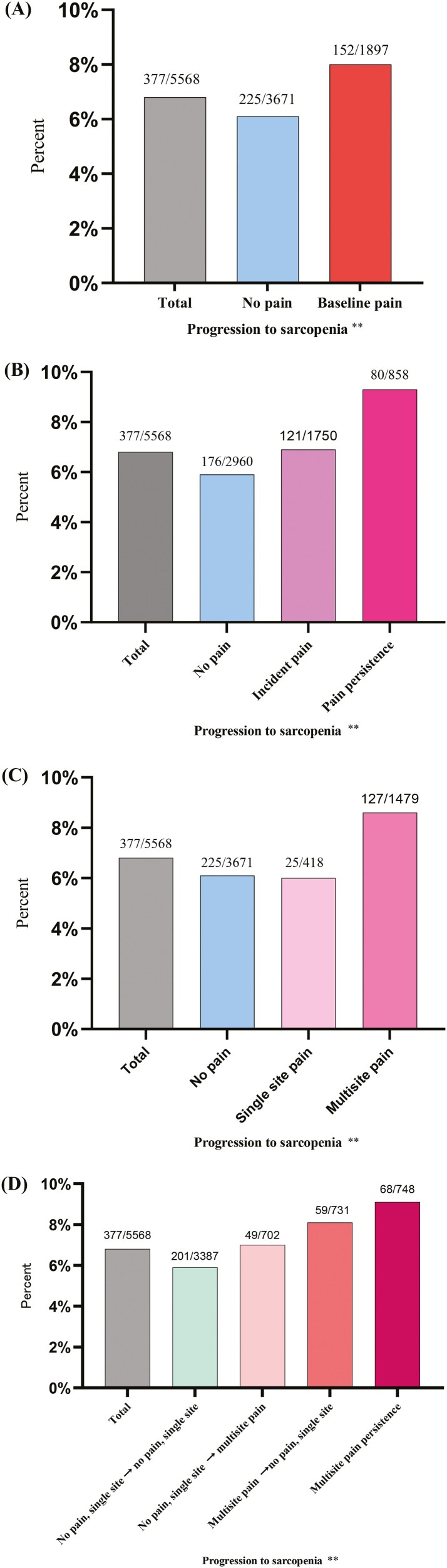
We included 5 568 participants from the China Health and Retirement Longitudinal Study. All participants completed assessments for pain characteristics and sarcopenia. Pain assessment included pain status (baseline pain, incident pain, and pain persistence) and pain distribution (single-site pain and multisite pain) using a self-report questionnaire. Diagnosis of sarcopenia followed The Asian Working Group for Sarcopenia 2019 consensus. The odds ratios (ORs) and 95% confidence intervals (CIs) were obtained by logical regression analysis.
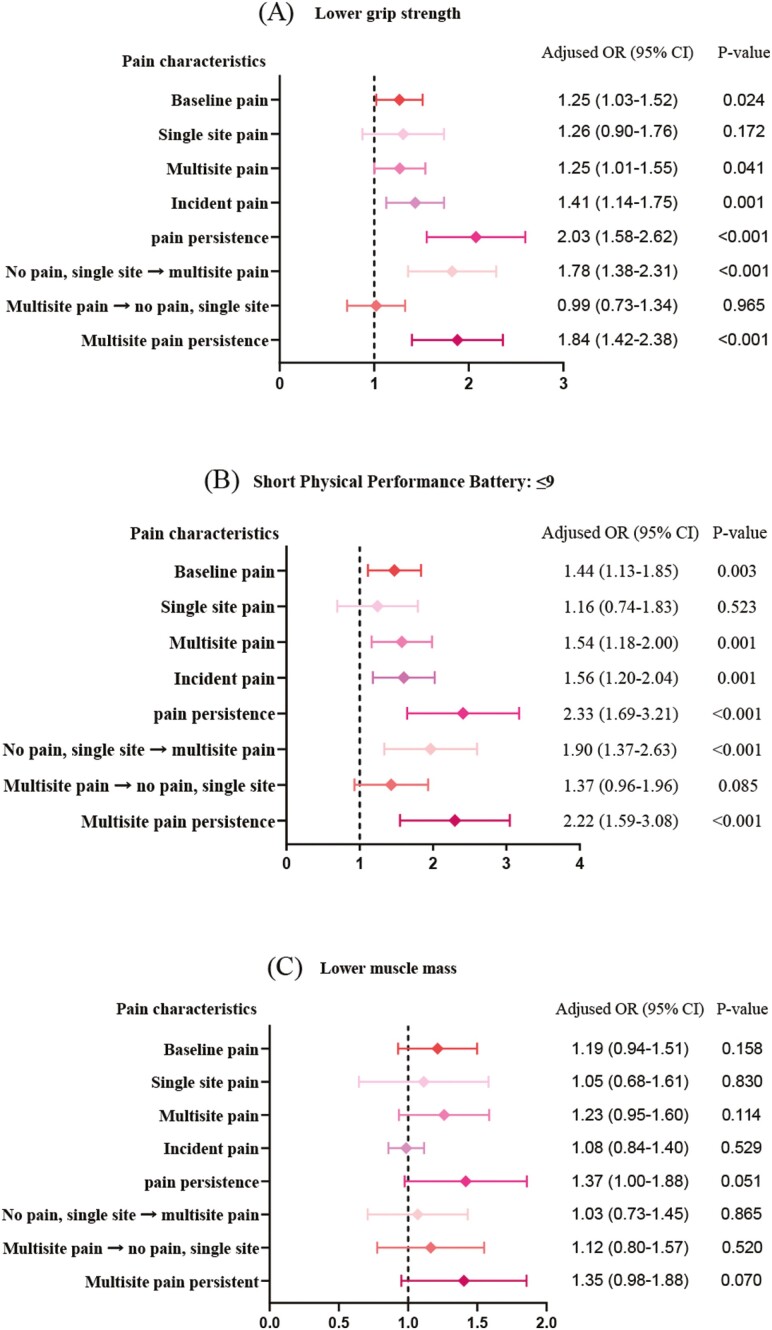
Participants who reported baseline pain, multisite pain, pain persistence, or multisite pain persistence were more likely to progress to sarcopenia than those without pain, with ORs of 1.33 (95% CI: 1.08-1.65), 1.44 (95% CI: 1.15-1.80), 1.63 (95% CI: 1.23-2.14), and 1.59 (95% CI: 1.19-2.11), respectively. Even after adjusting for other covariates such as gender, age, residential area, education level, marital status, smoking, alcohol consumption, comorbidities, and falls, these associations remained significant. Additionally, pain persistence and multisite pain persistence were significantly associated with low grip strength and clinically meaningful Short Physical Performance Battery decline, but not with low muscle mass.
Our study showed that pain, especially pain persistence, was closely correlated to the increased risk of progression to sarcopenia in Chinese middle-aged and older adults.
识别导致中年和老年人肌肉减少症进展的因素对公共卫生至关重要。我们的研究旨在调查中国中年和老年人中疼痛特征与肌肉减少症及其亚组分进展之间的关系。
我们纳入了来自中国健康与退休纵向研究的 5568 名参与者。所有参与者均完成了疼痛特征和肌肉减少症评估。疼痛评估包括使用自我报告问卷评估疼痛状况(基线疼痛、新发疼痛和疼痛持续存在)和疼痛分布(单部位疼痛和多部位疼痛)。肌肉减少症的诊断遵循 2019 年亚洲肌肉减少症工作组共识。使用逻辑回归分析获得比值比(OR)和 95%置信区间(CI)。
报告基线疼痛、多部位疼痛、疼痛持续存在或多部位疼痛持续存在的参与者进展为肌肉减少症的可能性高于无疼痛的参与者,OR 分别为 1.33(95%CI:1.08-1.65)、1.44(95%CI:1.15-1.80)、1.63(95%CI:1.23-2.14)和 1.59(95%CI:1.19-2.11)。即使在校正了性别、年龄、居住地区、教育水平、婚姻状况、吸烟、饮酒、合并症和跌倒等其他协变量后,这些关联仍然显著。此外,疼痛持续存在和多部位疼痛持续存在与低握力和有临床意义的短体物理性能电池下降显著相关,但与低肌肉质量无关。
我们的研究表明,疼痛,特别是疼痛持续存在,与中国中年和老年人肌肉减少症进展的风险增加密切相关。