Abu Arar Yasmin, Shilo Michael, Bilenko Natalya, Friger Michael, Marsha Hagit, Fisher David, Fraenkel Merav, Yoel Uri
Internal Medicine Ward D, Soroka University Medical Center, Beer-Sheva 84101, Israel.
Department of Epidemiology, Biostatistics and Community Health, Ben-Gurion University of the Negev, Beer-Sheva 84015, Israel.
Healthcare (Basel). 2024 Mar 2;12(5):581. doi: 10.3390/healthcare12050581.
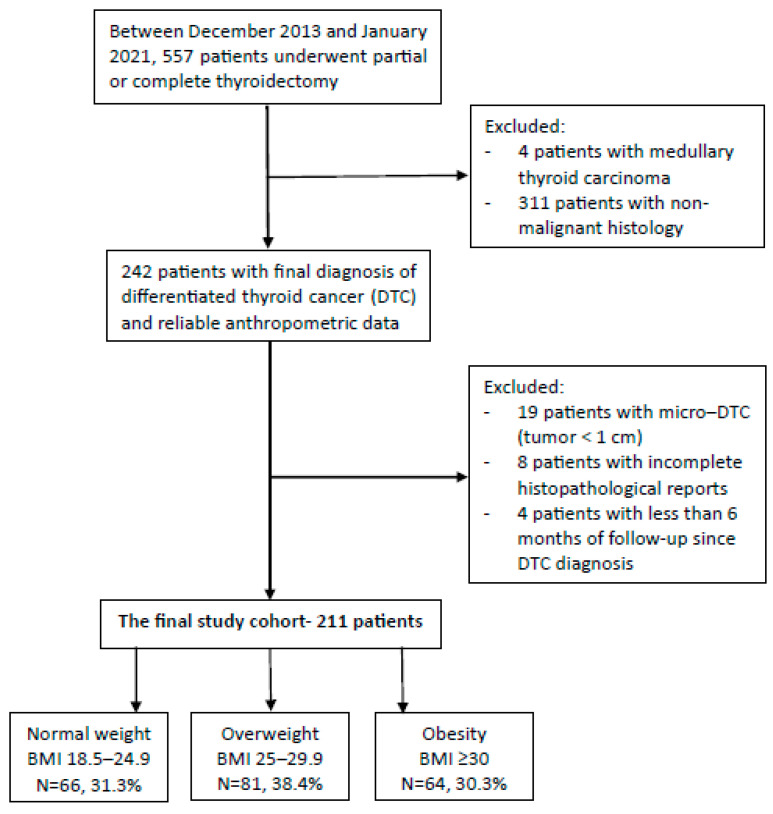
Obesity is a risk factor for differentiated thyroid cancer (DTC), but the association with DTC aggressiveness is controversial. To evaluate the association between preoperative body mass index (BMI)/other metabolic parameters and DTC aggressiveness in our surgical cohort, we retrospectively evaluated patients following thyroid surgery who were diagnosed with DTC between December 2013 and January 2021. Baseline characteristics, histopathological features, treatment modalities, and follow-up data were studied. We conducted logistic regression to analyze the association between BMI/other metabolic parameters and adverse DTC features. The final study cohort included 211 patients (79.6% women; mean age± standard deviation 48.7 ± 15.9 years): 66 (31.3%) with normal weight, 81 (38.4%) with overweight, and 64 (30.3%) with obesity. The median follow-up was 51 months (range 7-93). Complete versus partial thyroidectomy was more common among patients living with overweight or obesity than in normal weight patients (79.7% versus 61.7%, = 0.017, respectively). Logistic regression demonstrated that higher BMI was associated with mildly increased risk for lymph nodes metastases (odds ratio [OR] 1.077, 95% CI: 1.013-1.145), and higher triglycerides/high-density lipoprotein-cholesterol (TG/HDL-C) ratio was associated with aggressive histological variants of DTC (OR 1.269, 95% CI 1.001-1.61). To conclude, specific adverse clinical and histopathological DTC features were indeed associated with higher BMI and higher TG/HDL-C ratio.
肥胖是分化型甲状腺癌(DTC)的一个风险因素,但与DTC侵袭性之间的关联存在争议。为了评估我们手术队列中术前体重指数(BMI)/其他代谢参数与DTC侵袭性之间的关联,我们回顾性评估了2013年12月至2021年1月期间接受甲状腺手术且被诊断为DTC的患者。研究了基线特征、组织病理学特征、治疗方式和随访数据。我们进行逻辑回归分析BMI/其他代谢参数与不良DTC特征之间的关联。最终研究队列包括211名患者(79.6%为女性;平均年龄±标准差48.7±15.9岁):66名(31.3%)体重正常,81名(38.4%)超重,64名(30.3%)肥胖。中位随访时间为51个月(范围7 - 93个月)。超重或肥胖患者中全甲状腺切除与部分甲状腺切除比体重正常患者更常见(分别为79.7%对61.7%,P = 0.017)。逻辑回归表明,较高的BMI与淋巴结转移风险轻度增加相关(比值比[OR] 1.077,95%置信区间:1.013 - 1.145),较高的甘油三酯/高密度脂蛋白胆固醇(TG/HDL-C)比值与DTC侵袭性组织学亚型相关(OR 1.269,95%置信区间1.001 - 1.61)。总之,特定的不良临床和组织病理学DTC特征确实与较高的BMI和较高的TG/HDL-C比值相关。