Institute of Statistical Research and Training, University of Dhaka, Dhaka, Bangladesh.
School of Public Health, Louisiana State University Health Sciences Center-New Orleans, New Orleans, Louisiana, United States of America.
PLoS One. 2023 Sep 1;18(9):e0290994. doi: 10.1371/journal.pone.0290994. eCollection 2023.
This study evaluated the prevalence, associated factors and trends in the prevalence of obesity-related cancer (ORC) among U.S. adults with metabolic syndrome (MetS) and age ≥20 years.
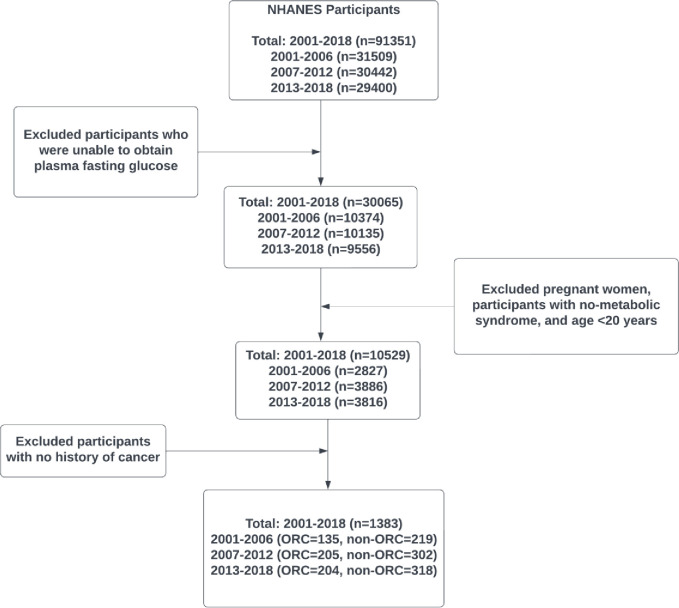
This study used cross-sectional data from the 2001-2018 National Health and Nutrition Examination Survey. The total period analyses included prevalence estimation, chi-square tests for comparing ORC vs non-ORC within subgroups, and a multivariable-logistic regression model to evaluate associated factors of ORC. For trend analysis, the total period was divided into three time periods: 2001-2006, 2007-2012 and 2013-2018. Age-standardized prevalence of ORC in each time period was calculated.
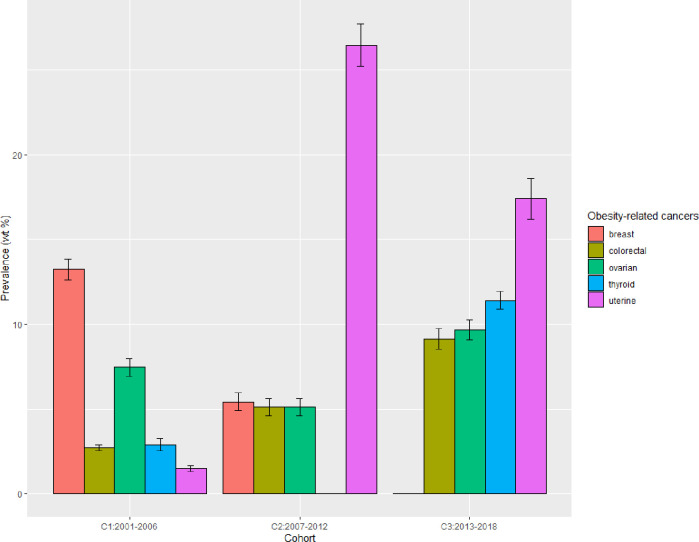
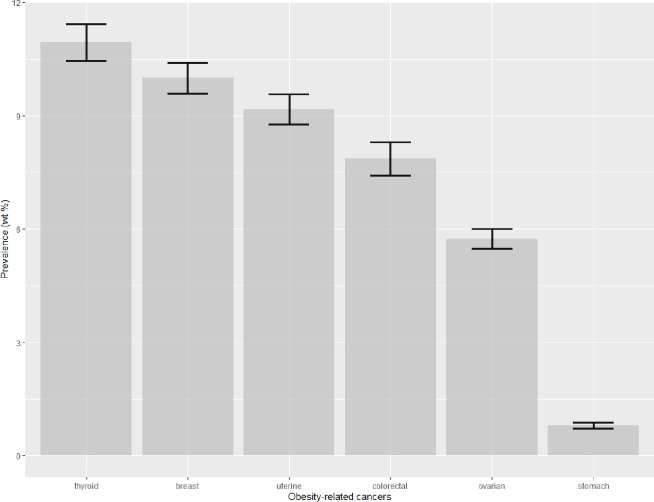
The ORC prevalence was 35.8% representing 4463614 adults with MetS. A higher odds of ORC was observed among females (OR = 7.1, 95% CI = 4.9-10.3) vs males, Hispanic (OR = 2.9, 95% CI = 1.7-4.8) and non-Hispanic Black (OR = 2.7, 95% CI = 1.8-4) vs non-Hispanic White, age ≥60 (OR = 5.4, 95% CI = 1.9-15.4) vs age 20-39 years. Individual ORCs were thyroid (10.95%), breast (10%), uterine (9.18%), colorectal (7.86%), ovarian (5.74%), and stomach (0.80%). The age-standardized prevalence of ORC was observed stable in three time periods (30.6%, 30.3% and 30.7%). However, an increasing trend was seen for thyroid, uterine, colorectal and ovarian cancers while decreasing trend for breast cancer. Hispanic people showed a significant increasing trend of ORC (p = 0.004).
ORC was found significantly higher among female, Hispanic, non-Hispanic black and older people with MetS. The stable temporal trend of overall ORC, with an increasing trend in certain ORCs, makes the disease spectrum a public health priority. The findings imply the importance of intensifying efforts to reduce the burden of MetS comorbidities among U.S. adults.
本研究评估了美国患有代谢综合征(MetS)且年龄≥20 岁的成年人中肥胖相关癌症(ORC)的流行率、相关因素和流行率趋势。
本研究使用了 2001 年至 2018 年全国健康和营养检查调查的横断面数据。总期间分析包括患病率估计、亚组内 ORC 与非 ORC 的卡方检验以及多变量逻辑回归模型评估 ORC 的相关因素。对于趋势分析,总期间分为三个时期:2001-2006 年、2007-2012 年和 2013-2018 年。计算每个时期 ORC 的年龄标准化患病率。
ORC 的患病率为 35.8%,代表 4463614 名患有 MetS 的成年人。与男性相比,女性(OR=7.1,95%CI=4.9-10.3)、西班牙裔(OR=2.9,95%CI=1.7-4.8)和非西班牙裔黑人(OR=2.7,95%CI=1.8-4)的 ORC 可能性更高非西班牙裔白人,年龄≥60 岁(OR=5.4,95%CI=1.9-15.4)vs 20-39 岁。个体 ORC 为甲状腺(10.95%)、乳房(10%)、子宫(9.18%)、结直肠(7.86%)、卵巢(5.74%)和胃(0.80%)。三个时期的 ORC 年龄标准化患病率观察到稳定(30.6%、30.3%和 30.7%)。然而,甲状腺、子宫、结直肠和卵巢癌的趋势呈上升趋势,而乳腺癌的趋势呈下降趋势。西班牙裔人群的 ORC 呈显著上升趋势(p=0.004)。
患有 MetS 的女性、西班牙裔、非西班牙裔黑人和老年人中 ORC 明显更高。总体 ORC 的时间趋势稳定,某些 ORC 的趋势呈上升趋势,这使得疾病谱成为公共卫生的重点。这些发现意味着必须加强努力,以减少美国成年人中 MetS 合并症的负担。