Department of Gastrointestinal Surgery, Union Hospital, Tongji Medical College, Huazhong University of Science and Technology, Wuhan 430022, China.
Int J Mol Sci. 2024 Feb 29;25(5):2817. doi: 10.3390/ijms25052817.
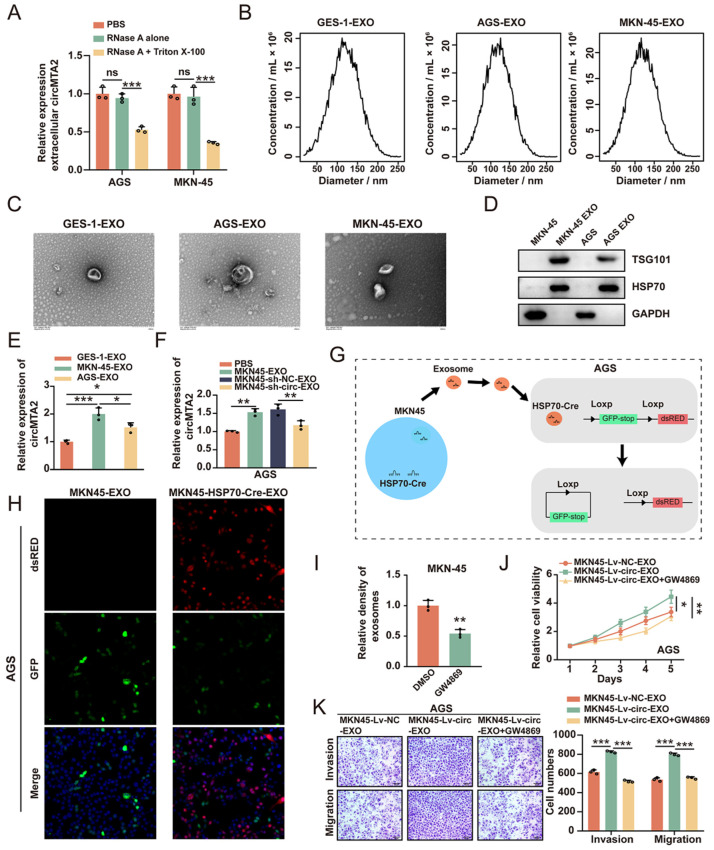
Our previous study has reported that metastasis-associated protein 2 () plays essential roles in tumorigenesis and aggressiveness of gastric cancer (GC). However, the underlying molecular mechanisms of -mediated GC and its upstream regulation mechanism remain elusive. In this study, we identified a novel circular RNA (circRNA) generated from the gene (circ) as a crucial regulator in GC progression. Circ was highly expressed in GC tissues and cell lines, and circ promoted the proliferation, invasion, and metastasis of GC cells both in vitro and in vivo. Mechanistically, circ interacted with ubiquitin carboxyl-terminal hydrolase L3 (UCHL3) to restrain ubiquitination and stabilize protein expression, thereby facilitating tumor progression. Moreover, circ was mainly encapsulated and transported by exosomes to promote GC cell progression. Taken together, these findings uncover that circ suppresses degradation by interacting with UCHL3, thereby promoting GC progression. In conclusion, we identified a cancer-promoting axis (circ/UCHL3/) in GC progression, which paves the way for us to design and synthesize targeted inhibitors as well as combination therapies.
我们之前的研究表明,转移相关蛋白 2() 在胃癌 (GC) 的发生和侵袭中起着重要作用。然而,-介导的 GC 的潜在分子机制及其上游调控机制仍不清楚。在这项研究中,我们鉴定出一个来自基因的新型环状 RNA(circRNA)(circ),作为 GC 进展中的关键调节因子。Circ 在 GC 组织和细胞系中高表达,circ 在体外和体内均促进 GC 细胞的增殖、侵袭和转移。机制上,circ 与泛素羧基末端水解酶 L3(UCHL3)相互作用,抑制的泛素化和稳定的蛋白表达,从而促进肿瘤进展。此外,circ 主要通过外泌体被包裹和运输,以促进 GC 细胞的进展。总之,这些发现揭示了 circ 通过与 UCHL3 相互作用抑制的降解,从而促进 GC 的进展。总之,我们鉴定了 GC 进展中的一个促进癌症的轴(circ/UCHL3/),为我们设计和合成靶向抑制剂以及联合治疗开辟了道路。