
菜豆中薇甘菊素和双羟菜豆素衍生物多样性的研究:LC-MS/MS 谱的见解。
Exploration of the Diversity of Vicine and Convicine Derivatives in Faba Bean ( L.) Cultivars: Insights from LC-MS/MS Spectra.
机构信息
Biotechnologies and Environmental Analytics Platform (BEAP), Environmental Research and Innovation Department (ERIN), Luxembourg Institute of Science and Technology (LIST), 5, Rue Bommel, L-4940 Hautcharage, Luxembourg.
NPZ Innovation GmbH, Hohenlieth-Hof 1, 24363 Holtsee, Germany.
出版信息
Molecules. 2024 Feb 29;29(5):1065. doi: 10.3390/molecules29051065.
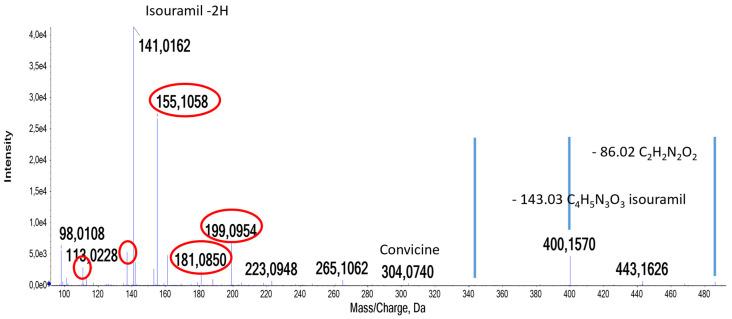
While numerous seeds are a good nutritional source of high-quality protein, the use of some species is hampered by toxic effects caused by exposure to metabolites that accumulate in the seeds. One such species is the faba or broad bean ( L.), which accumulates vicine and convicine. These two glycoalkaloids cause favism, the breakdown of red blood cells in persons with a glucose-6-phosphate dehydrogenase deficiency. Because this is the most common enzyme deficiency worldwide, faba bean breeding efforts have focused on developing cultivars with low levels of these alkaloids. Consequently, quantification methods have been developed; however, they quantify vicine and convicine only and not the derivatives of these compounds that potentially generate the same bio-active molecules. Based on the recognition of previously unknown (con)vicine-containing compounds, we screened the fragmentation spectra of LC-MS/MS data from five faba bean cultivars using the characteristic fragments generated by (con)vicine. This resulted in the recognition of more than a hundred derivatives, of which 89 were tentatively identified. (Con)vicine was mainly derivatized through the addition of sugars, hydroxycinnamic acids, and dicarboxylic acids, with a group of compounds composed of two (con)vicine residues linked by dicarboxyl fatty acids. In general, the abundance profiles of the different derivatives in the five cultivars mimicked that of vicine and convicine, but some showed a derivative-specific profile. The description of the (con)vicine diversity will impact the interpretation of future studies on the biosynthesis of (con)vicine, and the content in potentially bio-active alkaloids in faba beans may be higher than that represented by the quantification of vicine and convicine alone.
虽然许多种子是高质量蛋白质的良好营养来源,但由于暴露于在种子中积累的代谢物的毒性作用,某些物种的使用受到阻碍。其中一种物种是蚕豆(L.),它会积累野麻属糖苷和伴野麻属糖苷。这两种糖苷生物碱会引起蚕豆病,即葡萄糖-6-磷酸脱氢酶缺乏症患者的红细胞破裂。由于这是世界上最常见的酶缺乏症,蚕豆的培育工作一直集中在开发低水平这些生物碱的品种上。因此,已经开发出定量方法;然而,它们仅定量野麻属糖苷和伴野麻属糖苷,而不是可能产生相同生物活性分子的这些化合物的衍生物。基于对先前未知的(共)野麻属糖苷化合物的识别,我们使用(共)野麻属糖苷产生的特征片段筛选了来自五个蚕豆品种的 LC-MS/MS 数据的碎片光谱。这导致识别出一百多种衍生物,其中 89 种被暂定鉴定。(共)野麻属糖苷主要通过添加糖、羟基肉桂酸和二羧酸进行衍生化,其中一组化合物由通过二羧酸脂肪酸连接的两个(共)野麻属糖苷残基组成。一般来说,五种品种中不同衍生物的丰度分布与野麻属糖苷和伴野麻属糖苷相似,但有些表现出衍生物特异性分布。(共)野麻属糖苷多样性的描述将影响对(共)野麻属糖苷生物合成的未来研究的解释,并且蚕豆中潜在生物活性生物碱的含量可能高于仅通过野麻属糖苷和伴野麻属糖苷定量所代表的含量。



 Zotero 插件