Department of Human Health and Nutritional Sciences, University of Guelph, Guelph, ON N1G 2W1, Canada.
Department of Health Sciences, Carleton University, Ottawa, ON K1S 5B6, Canada.
Nutrients. 2024 Mar 1;16(5):719. doi: 10.3390/nu16050719.
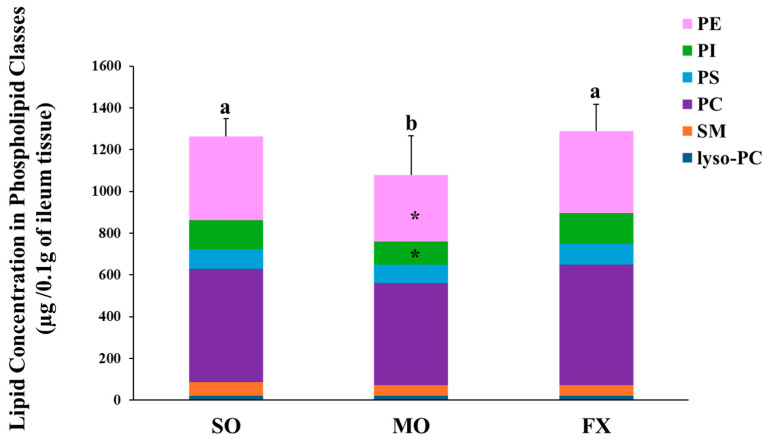
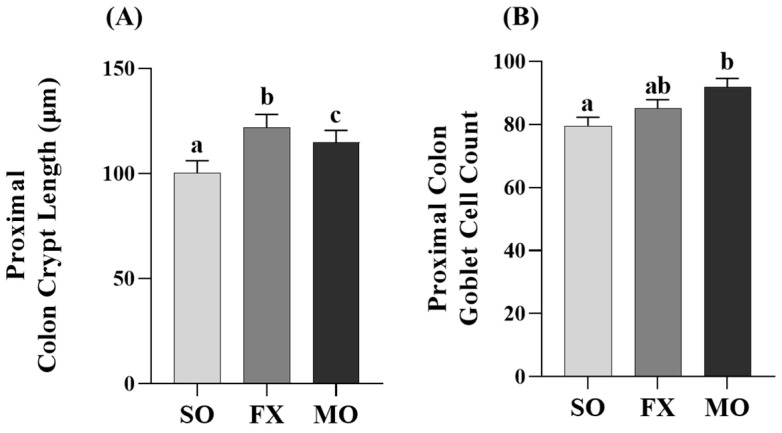
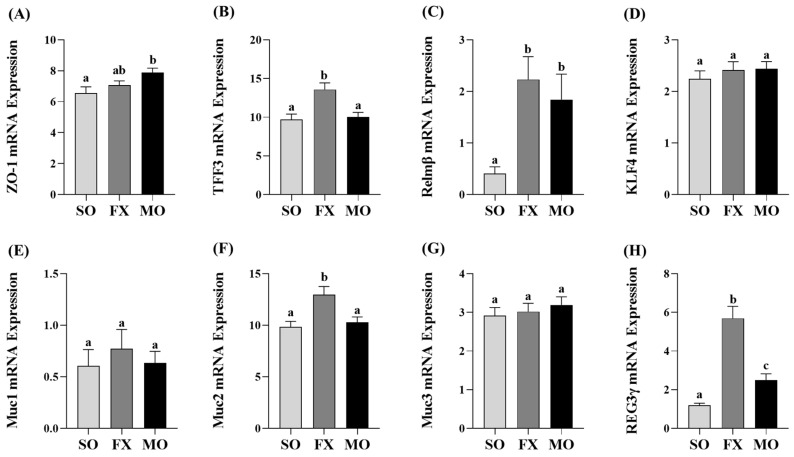
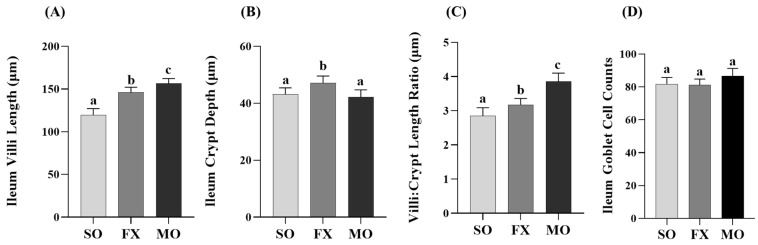
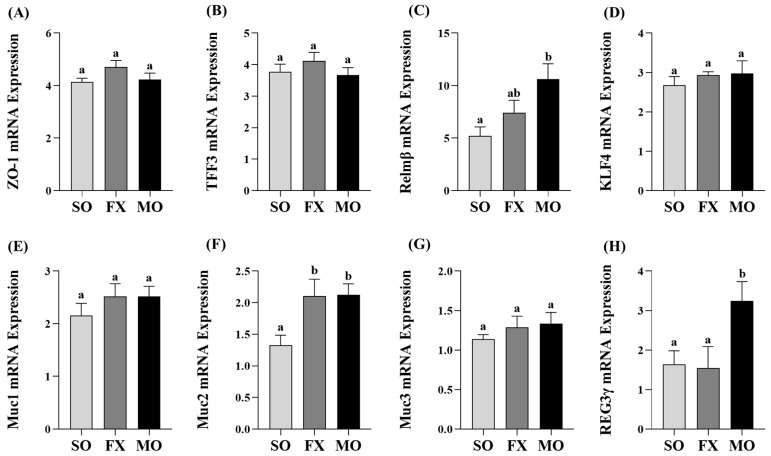
Altered intestinal health is also associated with the incidence and severity of many chronic inflammatory conditions, which could be attenuated via dietary -3 PUFA interventions. However, little is known about the effect of lifelong exposure to -3 PUFA from plant and marine sources (beginning in utero via the maternal diet) on early life biomarkers of intestinal health. Harems of C57Bl/6 mice were randomly assigned to one of three isocaloric AIN-93G modified diets differing in their fat sources consisting of the following: (i) 10% safflower oil (SO, enriched in -6 PUFA), (ii) 3% flaxseed oil + 7% safflower oil (FX, plant-based -3 PUFA-enriched diet), or (iii) 3% menhaden fish oil + 7% safflower oil (MO, marine-based -3 PUFA-enriched diet). Mothers remained on these diets throughout pregnancy and offspring (n = 14/diet) continued on the same parental diet until termination at 3 weeks of age. In ileum, villi:crypt length ratios were increased in both the FX and MO dietary groups compared to SO ( < 0.05). Ileum mRNA expression of critical intestinal health biomarkers was increased by both -3 PUFA-enriched diets including and compared to SO ( < 0.05), whereas only the FX diet increased mRNA expression of and ( < 0.05) and only the MO diet increased mRNA expression of ( < 0.05). In the proximal colon, both the FX and MO diets increased crypt lengths compared to SO ( < 0.05), whereas only the MO diet increased goblet cell numbers compared to SO ( < 0.05). Further, the MO diet increased proximal colon mRNA expression of and ( < 0.05) and both MO and FX increased mRNA expression of compared to SO ( < 0.05). Collectively, these results demonstrate that lifelong exposure to dietary -3 PUFA, beginning in utero, from both plant and marine sources, can support intestinal health development in early life. The differential effects between plant and marine sources warrants further investigation for optimizing health.
肠道健康的改变也与许多慢性炎症性疾病的发病率和严重程度有关,这些疾病可以通过饮食 -3 PUFA 干预来减轻。然而,人们对从植物和海洋来源(通过母体饮食在子宫内开始)终身暴露于 -3 PUFA 对肠道健康的早期生命生物标志物的影响知之甚少。C57Bl/6 小鼠的后宫被随机分配到三种等热量 AIN-93G 改良饮食中的一种,这些饮食的脂肪来源不同,包括:(i)10%红花油(富含 -6 PUFA),(ii)3%亚麻籽油+7%红花油(植物来源 -3 PUFA 富集饮食),或(iii)3%鲱鱼油+7%红花油(MO,海洋来源 -3 PUFA 富集饮食)。母亲在整个怀孕期间和后代(n = 14/饮食)继续在相同的父母饮食中,直到 3 周龄时终止。在回肠中,绒毛:隐窝长度比在 FX 和 MO 饮食组中均高于 SO(<0.05)。与 SO 相比,两种 -3 PUFA 富集饮食均增加了关键肠道健康生物标志物的回肠 mRNA 表达,包括 和 (<0.05),而只有 FX 饮食增加了 和 (<0.05)的 mRNA 表达,只有 MO 饮食增加了 (<0.05)的 mRNA 表达。在近端结肠中,与 SO 相比,FX 和 MO 饮食均增加了隐窝长度(<0.05),而只有 MO 饮食增加了 SO 相比的杯状细胞数量(<0.05)。此外,MO 饮食增加了近端结肠 mRNA 表达 和 (<0.05),MO 和 FX 饮食均增加了与 SO 相比的 mRNA 表达 (<0.05)。总的来说,这些结果表明,从植物和海洋来源开始,终身暴露于饮食 -3 PUFA 可以支持生命早期的肠道健康发育。植物和海洋来源之间的差异影响需要进一步研究,以优化健康。