Midwifery Research and Education Unit (OE 9210), Hannover Medical School, Carl-Neuberg-Straße 1, 30625, Hannover, Germany.
Biostatistics and Research Decision Sciences, MSD Europe Inc., Brussels, Belgium.
BMC Med. 2024 Mar 13;22(1):112. doi: 10.1186/s12916-024-03322-1.
The transitivity assumption is the cornerstone of network meta-analysis (NMA). Violating transitivity compromises the credibility of the indirect estimates and, by extent, the estimated treatment effects of the comparisons in the network. The present study offers comprehensive empirical evidence on the completeness of reporting and evaluating transitivity in systematic reviews with multiple interventions.
We screened the datasets of two previous empirical studies, resulting in 361 systematic reviews with NMA published between January 2011 and April 2015. We updated our evidence base with an additional 360 systematic reviews with NMA published between 2016 and 2021, employing a pragmatic approach. We devised assessment criteria for reporting and evaluating transitivity using relevant methodological literature and compared their reporting frequency before and after the PRISMA-NMA statement.
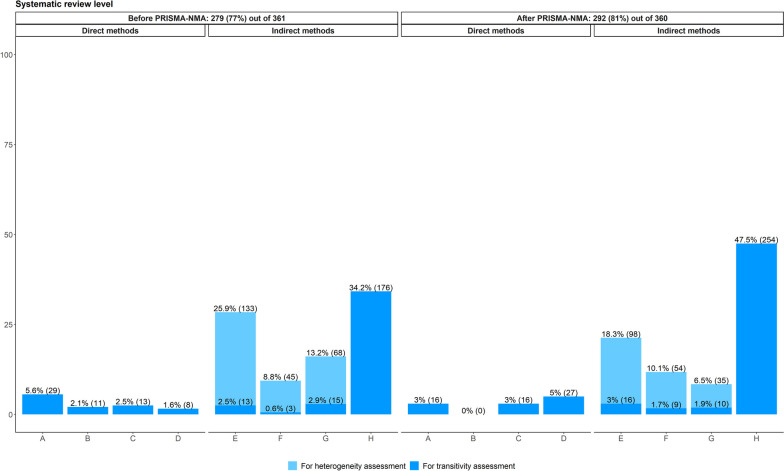
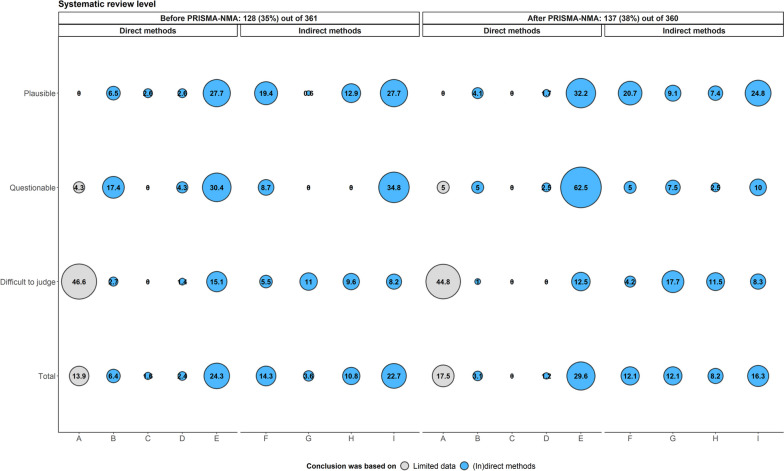
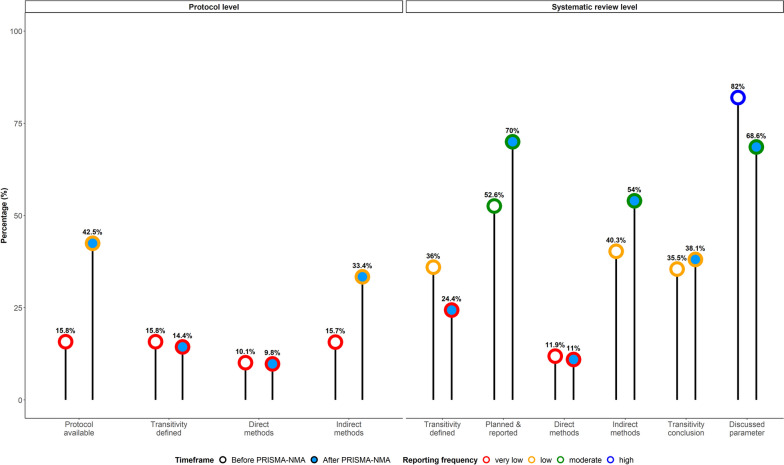
Systematic reviews published after PRISMA-NMA were more likely to provide a protocol (odds ratio (OR): 3.94, 95% CI: 2.79-5.64), pre-plan the transitivity evaluation (OR: 3.01, 95% CI: 1.54-6.23), and report the evaluation and results (OR: 2.10, 95% CI: 1.55-2.86) than those before PRISMA-NMA. However, systematic reviews after PRISMA-NMA were less likely to define transitivity (OR: 0.57, 95% CI: 0.42-0.79) and discuss the implications of transitivity (OR: 0.48, 95% CI: 0.27-0.85) than those published before PRISMA-NMA. Most systematic reviews evaluated transitivity statistically than conceptually (40% versus 12% before PRISMA-NMA, and 54% versus 11% after PRISMA-NMA), with consistency evaluation being the most preferred (34% before versus 47% after PRISMA-NMA). One in five reviews inferred the plausibility of the transitivity (22% before versus 18% after PRISMA-NMA), followed by 11% of reviews that found it difficult to judge transitivity due to insufficient data. In justifying their conclusions, reviews considered mostly the comparability of the trials (24% before versus 30% after PRISMA-NMA), followed by the consistency evaluation (23% before versus 16% after PRISMA-NMA).
Overall, there has been a slight improvement in reporting and evaluating transitivity since releasing PRISMA-NMA, particularly in items related to the systematic review report. Nevertheless, there has been limited attention to pre-planning the transitivity evaluation and low awareness of the conceptual evaluation methods that align with the nature of the assumption.
传递性假设是网络荟萃分析(NMA)的基石。违反传递性会损害间接估计的可信度,并在一定程度上影响网络中比较的估计治疗效果。本研究提供了关于系统评价中多干预措施的传递性完整报告和评估的综合经验证据。
我们筛选了之前两项实证研究的数据,结果是 2011 年 1 月至 2015 年 4 月期间发表的 361 项 NMA 系统评价。我们采用实用方法,用另外 2016 年至 2021 年期间发表的 360 项 NMA 系统评价更新了我们的证据基础。我们使用相关方法学文献设计了报告和评估传递性的评估标准,并比较了 PRISMA-NMA 声明前后的报告频率。
与 PRISMA-NMA 之前发表的系统评价相比,发表在 PRISMA-NMA 之后的系统评价更有可能提供方案(优势比(OR):3.94,95%置信区间(CI):2.79-5.64),预先计划传递性评估(OR:3.01,95%CI:1.54-6.23),并报告评估和结果(OR:2.10,95%CI:1.55-2.86)。然而,PRISMA-NMA 后发表的系统评价比 PRISMA-NMA 前发表的系统评价更不可能定义传递性(OR:0.57,95%CI:0.42-0.79)和讨论传递性的影响(OR:0.48,95%CI:0.27-0.85)。与 PRISMA-NMA 之前发表的系统评价相比,大多数系统评价是从统计学上而不是从概念上评估传递性(PRISMA-NMA 之前为 40%,之后为 54%),一致性评估是最受欢迎的(PRISMA-NMA 之前为 34%,之后为 47%)。五分之一的综述推断了传递性的合理性(PRISMA-NMA 之前为 22%,之后为 18%),其次是 11%的综述由于数据不足难以判断传递性。在为他们的结论辩护时,综述主要考虑了试验的可比性(PRISMA-NMA 之前为 24%,之后为 30%),其次是一致性评估(PRISMA-NMA 之前为 23%,之后为 16%)。
总体而言,自发布 PRISMA-NMA 以来,在报告和评估传递性方面略有改善,特别是在与系统评价报告相关的项目方面。然而,对传递性评估的预先规划关注有限,对与假设性质一致的概念评估方法的认识较低。