Dong Fureng Institute of Economic and Social Development, Wuhan University, Luojia Hill, Wuhan, 430072, China.
Economics and Management School, Wuhan University, Luojia Hill, Wuhan, 430072, China.
Hum Resour Health. 2024 Mar 12;22(1):20. doi: 10.1186/s12960-024-00903-2.
Pay-for-performance (P4P) schemes are commonly used to incentivize primary healthcare (PHC) providers to improve the quality of care they deliver. However, the effectiveness of P4P schemes can vary depending on their design. In this study, we aimed to investigate the preferences of PHC providers for participating in P4P programs in a city in Shandong province, China.
We conducted a discrete choice experiment (DCE) with 882 PHC providers, using six attributes: type of incentive, whom to incentivize, frequency of incentive, size of incentive, the domain of performance measurement, and release of performance results. Mixed logit models and latent class models were used for the statistical analyses.
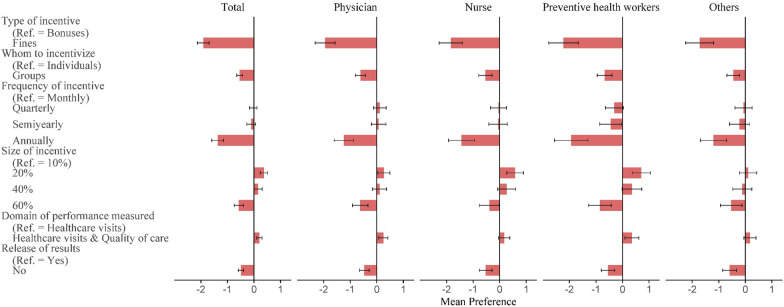
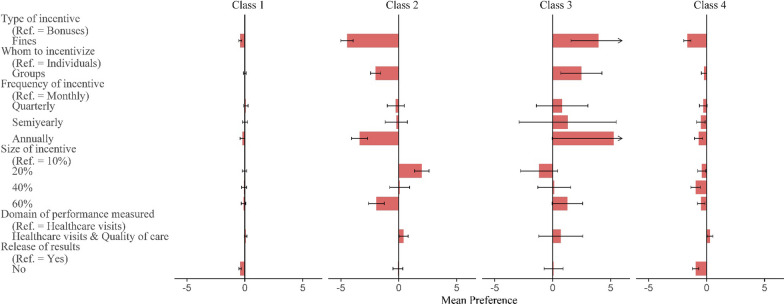
Our results showed that PHC providers had a strong negative preference for fines compared to bonuses (- 1.91; 95%CI - 2.13 to - 1.69) and for annual incentive payments compared to monthly (- 1.37; 95%CI - 1.59 to - 1.14). Providers also showed negative preferences for incentive size of 60% of monthly income, group incentives, and non-release of performance results. On the other hand, an incentive size of 20% of monthly income and including quality of care in performance measures were preferred. We identified four distinct classes of providers with different preferences for P4P schemes. Class 2 and Class 3 valued most of the attributes differently, while Class 1 and Class 4 had a relatively small influence from most attributes.
P4P schemes that offer bonuses rather than fines, monthly rather than annual payments, incentive size of 20% of monthly income, paid to individuals, including quality of care in performance measures, and release of performance results are likely to be more effective in improving PHC performance. Our findings also highlight the importance of considering preference heterogeneity when designing P4P schemes.
绩效薪酬制(P4P)方案常用于激励基层医疗保健(PHC)提供者提高其提供的医疗质量。然而,P4P 方案的有效性可能因方案设计而异。在这项研究中,我们旨在调查山东省某市 PHC 提供者参与 P4P 项目的偏好。
我们使用六种属性(激励类型、激励对象、激励频率、激励规模、绩效衡量领域和绩效结果发布)进行了一项离散选择实验(DCE),共涉及 882 名 PHC 提供者。我们使用混合对数模型和潜在类别模型进行了统计分析。
我们的研究结果表明,与奖金相比,提供者对罚款有强烈的负偏好(-1.91;95%置信区间-2.13 至-1.69),与每月相比,提供者对每年的激励支付也有负偏好(-1.37;95%置信区间-1.59 至-1.14)。提供者还对激励规模为月收入的 60%、团体激励和不发布绩效结果表现出负偏好。另一方面,他们对激励规模为月收入的 20%和包括医疗质量的绩效衡量表示偏好。我们确定了四类具有不同 P4P 方案偏好的提供者。第二类和第三类对大多数属性的评价差异最大,而第一类和第四类对大多数属性的影响较小。
提供奖金而非罚款、每月而非每年支付、激励规模为月收入的 20%、支付给个人、包括医疗质量的绩效衡量以及发布绩效结果的 P4P 方案,可能更有效地提高 PHC 绩效。我们的研究结果还强调了在设计 P4P 方案时考虑偏好异质性的重要性。